Antifungal phloroglucinol derivatives from Dryopteris fragrans (L.) Schott
BACKGROUND
Potatoes, a major economic crop, are significantly impacted by Fusarium dry rot, a prevalent postharvest disease. In Dryopteris fragrans, the research of phloroglucinol derivatives are mainly focused on antibacterial activity, while the inhibitory effects on phytopathogenic fungi have not been reported.
RESULTS
In our study, six new phloroglucinol derivatives, Ortho-desaspidin AA (1), Ortho-desaspidin PA (2), Ortho-desaspidin BA (3), Dryaspidin B (4), Alde-iso-methylaspidinol B (5), and Iso-methylaspidinol P (6), and nine known phloroglucinol derivatives, were isolated from D. fragrans. And Compound 10, aspidinol B, showed significant inhibitory activity against Fusarium oxysporum, Fusarium graminearum, Fusarium proliferatum with EC50 = 3.619, 6.051, and 8.221 μg/mL, respectively, outperforming the commercial fungicide hymexazol (EC50 = 34.88, 8.21, 17.91). Aspidinol B displayed potent in vivo antifungal activity against F. oxysporum, F. graminearum, and F. proliferatum at 10 μg/mL with an inhibitory rate of 83.26, 54.15 and 79.62%, respectively. Transcriptome analysis speculates that aspidinol B, by affecting the uptake of iron ions into the bacterium, and cause heme depletion that ultimately leads to changes in oxidation-related pathways.
期刊介绍:
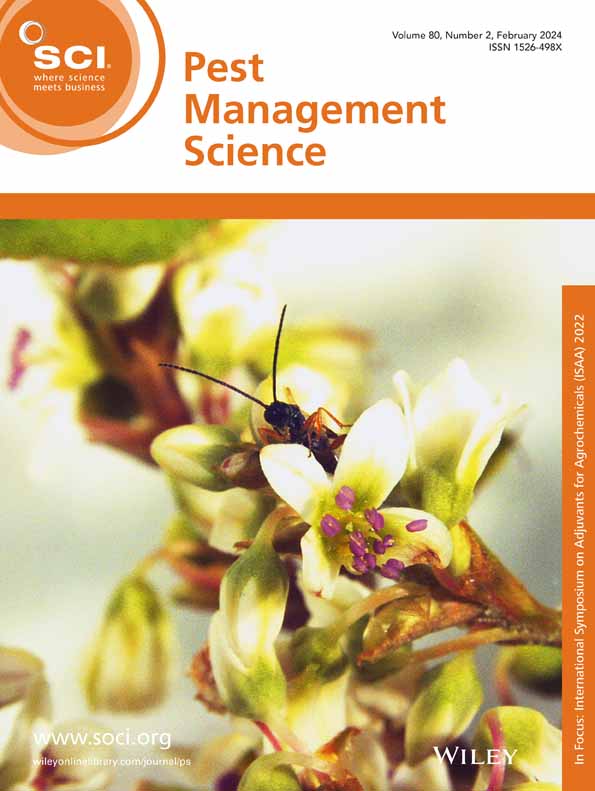
Pest Management Science is the international journal of research and development in crop protection and pest control. Since its launch in 1970, the journal has become the premier forum for papers on the discovery, application, and impact on the environment of products and strategies designed for pest management.
Published for SCI by John Wiley & Sons Ltd.






 京公网安备 11010802042870号
京ICP备2023020795号-1
京公网安备 11010802042870号
京ICP备2023020795号-1

 分享
分享
 求助内容:
求助内容: 应助结果提醒方式:
 扫码关注我们
