{"title":"利用定点切割和液相色谱串联质谱技术对100 Nt sgRNA和大RNA进行鉴定和全测序","authors":"Hong Yan, Mingpan Qi, Hong Li","doi":"10.1021/acs.analchem.4c06606","DOIUrl":null,"url":null,"abstract":"CRISPR/Cas9 is widely recognized as the most effective, efficient, and precise genome editing tool, inspiring numerous applications in basic science, medicine, and biotechnology. In the CRISPR/Cas9 system, single guide RNA (sgRNA) and Cas9 enzyme form a ribonucleoprotein complex that specifically and effectively cleaves target DNA. Accurate sequencing of sgRNA, particularly identifying the target sequence within the first 20 nucleotides (nt) at the 5′-end, is crucial for quality assurance and regulatory compliance. In this study, we used site-directed cleavage using ribonuclease H (RNase H) and DNAzyme for the first time to digest 100 nt sgRNA, achieving full sequencing with 100% coverage by analyzing the two cleaved fragments separately via LC MS/MS. We evaluated four different DNA-RNA chimeras as capture probes for the RNase H site-directed cleavage approach, finding that the chimera with four deoxynucleotides provided the most specific cleavage. Compared to RNase H, the DNAzyme demonstrated higher specificity and stability for 100 nt sgRNA digestion, successfully identifying up to 200 nucleotides of large RNA with 100% sequence coverage by fully sequencing the four short cleaved fragments. Due to the high specificity of DNAzyme cleavage, we used this method to study the designed 5′-end N-X truncated impurities of 100 nt sgRNA, demonstrating accurate identification and relative quantification. For 100 nt sgRNA, the limited available cleavage site was set on the scaffold sequence for both site-directed cleavage approaches, and the captured probes designed for RNase H and DNAzyme can be universally applied to sequence all 100 nt sgRNAs because of the conserved scaffold sequence.","PeriodicalId":27,"journal":{"name":"Analytical Chemistry","volume":"13 1","pages":""},"PeriodicalIF":6.7000,"publicationDate":"2025-04-22","publicationTypes":"Journal Article","fieldsOfStudy":null,"isOpenAccess":false,"openAccessPdf":"","citationCount":"0","resultStr":"{\"title\":\"Characterization and Full Sequencing of 100 Nt sgRNA and Large RNA Using Site-Directed Cleavage and Liquid Chromatography Tandem Mass Spectrometry\",\"authors\":\"Hong Yan, Mingpan Qi, Hong Li\",\"doi\":\"10.1021/acs.analchem.4c06606\",\"DOIUrl\":null,\"url\":null,\"abstract\":\"CRISPR/Cas9 is widely recognized as the most effective, efficient, and precise genome editing tool, inspiring numerous applications in basic science, medicine, and biotechnology. In the CRISPR/Cas9 system, single guide RNA (sgRNA) and Cas9 enzyme form a ribonucleoprotein complex that specifically and effectively cleaves target DNA. Accurate sequencing of sgRNA, particularly identifying the target sequence within the first 20 nucleotides (nt) at the 5′-end, is crucial for quality assurance and regulatory compliance. In this study, we used site-directed cleavage using ribonuclease H (RNase H) and DNAzyme for the first time to digest 100 nt sgRNA, achieving full sequencing with 100% coverage by analyzing the two cleaved fragments separately via LC MS/MS. We evaluated four different DNA-RNA chimeras as capture probes for the RNase H site-directed cleavage approach, finding that the chimera with four deoxynucleotides provided the most specific cleavage. Compared to RNase H, the DNAzyme demonstrated higher specificity and stability for 100 nt sgRNA digestion, successfully identifying up to 200 nucleotides of large RNA with 100% sequence coverage by fully sequencing the four short cleaved fragments. Due to the high specificity of DNAzyme cleavage, we used this method to study the designed 5′-end N-X truncated impurities of 100 nt sgRNA, demonstrating accurate identification and relative quantification. For 100 nt sgRNA, the limited available cleavage site was set on the scaffold sequence for both site-directed cleavage approaches, and the captured probes designed for RNase H and DNAzyme can be universally applied to sequence all 100 nt sgRNAs because of the conserved scaffold sequence.\",\"PeriodicalId\":27,\"journal\":{\"name\":\"Analytical Chemistry\",\"volume\":\"13 1\",\"pages\":\"\"},\"PeriodicalIF\":6.7000,\"publicationDate\":\"2025-04-22\",\"publicationTypes\":\"Journal Article\",\"fieldsOfStudy\":null,\"isOpenAccess\":false,\"openAccessPdf\":\"\",\"citationCount\":\"0\",\"resultStr\":null,\"platform\":\"Semanticscholar\",\"paperid\":null,\"PeriodicalName\":\"Analytical Chemistry\",\"FirstCategoryId\":\"92\",\"ListUrlMain\":\"https://doi.org/10.1021/acs.analchem.4c06606\",\"RegionNum\":1,\"RegionCategory\":\"化学\",\"ArticlePicture\":[],\"TitleCN\":null,\"AbstractTextCN\":null,\"PMCID\":null,\"EPubDate\":\"\",\"PubModel\":\"\",\"JCR\":\"Q1\",\"JCRName\":\"CHEMISTRY, ANALYTICAL\",\"Score\":null,\"Total\":0}","platform":"Semanticscholar","paperid":null,"PeriodicalName":"Analytical Chemistry","FirstCategoryId":"92","ListUrlMain":"https://doi.org/10.1021/acs.analchem.4c06606","RegionNum":1,"RegionCategory":"化学","ArticlePicture":[],"TitleCN":null,"AbstractTextCN":null,"PMCID":null,"EPubDate":"","PubModel":"","JCR":"Q1","JCRName":"CHEMISTRY, ANALYTICAL","Score":null,"Total":0}
引用次数: 0
摘要
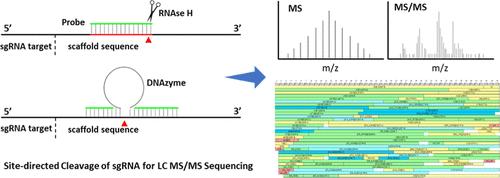
CRISPR/Cas9 被公认为最有效、高效和精确的基因组编辑工具,在基础科学、医学和生物技术领域得到了广泛应用。在 CRISPR/Cas9 系统中,单导 RNA(sgRNA)和 Cas9 酶形成核糖核蛋白复合物,能特异、有效地切割目标 DNA。对 sgRNA 进行精确测序,特别是识别 5′端前 20 个核苷酸(nt)内的靶序列,对于保证质量和符合法规要求至关重要。在这项研究中,我们首次使用核糖核酸酶 H(RNase H)和 DNA 酶进行定点定向裂解来消化 100 nt sgRNA,通过 LC MS/MS 分别分析两个裂解片段,实现了 100%覆盖率的全测序。我们评估了四种不同的 DNA-RNA 嵌合体作为 RNase H 定点裂解方法的捕获探针,发现含有四个脱氧核苷酸的嵌合体能提供最特异的裂解。与RNase H相比,DNA酶在消化100 nt sgRNA时表现出更高的特异性和稳定性,通过对四个短裂解片段进行完全测序,成功鉴定了多达200个核苷酸的大RNA,序列覆盖率达100%。由于 DNA 酶裂解的特异性很高,我们用这种方法研究了设计的 100 nt sgRNA 的 5′ 端 N-X 截短杂质,结果表明能准确识别和相对定量。对于 100 nt sgRNA,有限的裂解位点被设置在两种定点裂解方法的支架序列上,由于支架序列的保守性,为 RNase H 和 DNAzyme 设计的捕获探针可普遍应用于所有 100 nt sgRNA 的测序。
Characterization and Full Sequencing of 100 Nt sgRNA and Large RNA Using Site-Directed Cleavage and Liquid Chromatography Tandem Mass Spectrometry
CRISPR/Cas9 is widely recognized as the most effective, efficient, and precise genome editing tool, inspiring numerous applications in basic science, medicine, and biotechnology. In the CRISPR/Cas9 system, single guide RNA (sgRNA) and Cas9 enzyme form a ribonucleoprotein complex that specifically and effectively cleaves target DNA. Accurate sequencing of sgRNA, particularly identifying the target sequence within the first 20 nucleotides (nt) at the 5′-end, is crucial for quality assurance and regulatory compliance. In this study, we used site-directed cleavage using ribonuclease H (RNase H) and DNAzyme for the first time to digest 100 nt sgRNA, achieving full sequencing with 100% coverage by analyzing the two cleaved fragments separately via LC MS/MS. We evaluated four different DNA-RNA chimeras as capture probes for the RNase H site-directed cleavage approach, finding that the chimera with four deoxynucleotides provided the most specific cleavage. Compared to RNase H, the DNAzyme demonstrated higher specificity and stability for 100 nt sgRNA digestion, successfully identifying up to 200 nucleotides of large RNA with 100% sequence coverage by fully sequencing the four short cleaved fragments. Due to the high specificity of DNAzyme cleavage, we used this method to study the designed 5′-end N-X truncated impurities of 100 nt sgRNA, demonstrating accurate identification and relative quantification. For 100 nt sgRNA, the limited available cleavage site was set on the scaffold sequence for both site-directed cleavage approaches, and the captured probes designed for RNase H and DNAzyme can be universally applied to sequence all 100 nt sgRNAs because of the conserved scaffold sequence.
期刊介绍:
Analytical Chemistry, a peer-reviewed research journal, focuses on disseminating new and original knowledge across all branches of analytical chemistry. Fundamental articles may explore general principles of chemical measurement science and need not directly address existing or potential analytical methodology. They can be entirely theoretical or report experimental results. Contributions may cover various phases of analytical operations, including sampling, bioanalysis, electrochemistry, mass spectrometry, microscale and nanoscale systems, environmental analysis, separations, spectroscopy, chemical reactions and selectivity, instrumentation, imaging, surface analysis, and data processing. Papers discussing known analytical methods should present a significant, original application of the method, a notable improvement, or results on an important analyte.




 京公网安备 11010802042870号
京ICP备2023020795号-1
京公网安备 11010802042870号
京ICP备2023020795号-1

 分享
分享
 求助内容:
求助内容: 应助结果提醒方式:
 扫码关注我们
