Etienne A. LaPierre, Roope A. Suvinen, Brian O. Patrick, Heikki M. Tuononen and Ian Manners
{"title":"六氯磷腈多位点还原为低价PN杂环及向多氯磷腈还原的延伸","authors":"Etienne A. LaPierre, Roope A. Suvinen, Brian O. Patrick, Heikki M. Tuononen and Ian Manners","doi":"10.1039/D4SC07559E","DOIUrl":null,"url":null,"abstract":"<p >Facile one and two site reduction of hexachlorophosphazene using cyclic (alkyl)(amino)carbene substituents are shown to yield <em>P</em>-CAAC<small><sup>Me</sup></small>-<em>cyclo</em>-(PNP(Cl)<small><sub>2</sub></small>NP(Cl)<small><sub>2</sub></small>N) <strong>1</strong> and <em>P</em>,<em>P</em>′-bis-CAAC<small><sup>Me</sup></small>-<em>cyclo</em>-(PNPNP(Cl)<small><sub>2</sub></small>N) <strong>2</strong> (CAAC<small><sup>Me</sup></small> = 1-[2,6-bis(isopropyl)phenyl]-3,3,5,5-tetramethyl-2-pyrrolidinylidene), respectively. Compound <strong>1</strong> is characterized by its predominantly phosphorus-centered HOMO, which results in typical phosphine-type nucleophilic and reductive reactivity; however, the resultant compounds of such reactions feature properties distinct from their classical phosphine analogues due to the CAAC-centered LUMO, which acts as an acceptor for both intramolecular interactions and photophysical excitations. In contrast, compound <strong>2</strong> exhibits π-conjugation spanning the endocyclic PNP moiety and the two CAAC<small><sup>Me</sup></small> substituents, despite its non-planar structure. Treatment of <strong>2</strong> with [Cp*RuCl]<small><sub>4</sub></small> results in the electrophilic displacement of one of the CAAC<small><sup>Me</sup></small> moieties by two Cp*RuCl fragments to yield the spirocyclic compound <strong>3</strong>. Preliminary results show that the methodology used to reduce hexachlorophosphazene to <strong>1</strong> can be directly transposed to the regiospecific reduction of poly-chlorophosphazene, to yield poly-<strong>1</strong>, a fundamentally new class of inorganic polymer that possesses a phosphorus center with chemically active lone pairs in the main chain.</p>","PeriodicalId":9909,"journal":{"name":"Chemical Science","volume":" 22","pages":" 9820-9832"},"PeriodicalIF":8.1000,"publicationDate":"2025-04-24","publicationTypes":"Journal Article","fieldsOfStudy":null,"isOpenAccess":false,"openAccessPdf":"https://pubs.rsc.org/en/content/articlepdf/2025/sc/d4sc07559e?page=search","citationCount":"0","resultStr":"{\"title\":\"Multi-site reduction of hexachlorophosphazene to low-valent PN heterocycles and extension to the reduction of poly-chlorophosphazene†\",\"authors\":\"Etienne A. LaPierre, Roope A. Suvinen, Brian O. Patrick, Heikki M. Tuononen and Ian Manners\",\"doi\":\"10.1039/D4SC07559E\",\"DOIUrl\":null,\"url\":null,\"abstract\":\"<p >Facile one and two site reduction of hexachlorophosphazene using cyclic (alkyl)(amino)carbene substituents are shown to yield <em>P</em>-CAAC<small><sup>Me</sup></small>-<em>cyclo</em>-(PNP(Cl)<small><sub>2</sub></small>NP(Cl)<small><sub>2</sub></small>N) <strong>1</strong> and <em>P</em>,<em>P</em>′-bis-CAAC<small><sup>Me</sup></small>-<em>cyclo</em>-(PNPNP(Cl)<small><sub>2</sub></small>N) <strong>2</strong> (CAAC<small><sup>Me</sup></small> = 1-[2,6-bis(isopropyl)phenyl]-3,3,5,5-tetramethyl-2-pyrrolidinylidene), respectively. Compound <strong>1</strong> is characterized by its predominantly phosphorus-centered HOMO, which results in typical phosphine-type nucleophilic and reductive reactivity; however, the resultant compounds of such reactions feature properties distinct from their classical phosphine analogues due to the CAAC-centered LUMO, which acts as an acceptor for both intramolecular interactions and photophysical excitations. In contrast, compound <strong>2</strong> exhibits π-conjugation spanning the endocyclic PNP moiety and the two CAAC<small><sup>Me</sup></small> substituents, despite its non-planar structure. Treatment of <strong>2</strong> with [Cp*RuCl]<small><sub>4</sub></small> results in the electrophilic displacement of one of the CAAC<small><sup>Me</sup></small> moieties by two Cp*RuCl fragments to yield the spirocyclic compound <strong>3</strong>. Preliminary results show that the methodology used to reduce hexachlorophosphazene to <strong>1</strong> can be directly transposed to the regiospecific reduction of poly-chlorophosphazene, to yield poly-<strong>1</strong>, a fundamentally new class of inorganic polymer that possesses a phosphorus center with chemically active lone pairs in the main chain.</p>\",\"PeriodicalId\":9909,\"journal\":{\"name\":\"Chemical Science\",\"volume\":\" 22\",\"pages\":\" 9820-9832\"},\"PeriodicalIF\":8.1000,\"publicationDate\":\"2025-04-24\",\"publicationTypes\":\"Journal Article\",\"fieldsOfStudy\":null,\"isOpenAccess\":false,\"openAccessPdf\":\"https://pubs.rsc.org/en/content/articlepdf/2025/sc/d4sc07559e?page=search\",\"citationCount\":\"0\",\"resultStr\":null,\"platform\":\"Semanticscholar\",\"paperid\":null,\"PeriodicalName\":\"Chemical Science\",\"FirstCategoryId\":\"92\",\"ListUrlMain\":\"https://pubs.rsc.org/en/content/articlelanding/2025/sc/d4sc07559e\",\"RegionNum\":1,\"RegionCategory\":\"化学\",\"ArticlePicture\":[],\"TitleCN\":null,\"AbstractTextCN\":null,\"PMCID\":null,\"EPubDate\":\"\",\"PubModel\":\"\",\"JCR\":\"Q1\",\"JCRName\":\"CHEMISTRY, MULTIDISCIPLINARY\",\"Score\":null,\"Total\":0}","platform":"Semanticscholar","paperid":null,"PeriodicalName":"Chemical Science","FirstCategoryId":"92","ListUrlMain":"https://pubs.rsc.org/en/content/articlelanding/2025/sc/d4sc07559e","RegionNum":1,"RegionCategory":"化学","ArticlePicture":[],"TitleCN":null,"AbstractTextCN":null,"PMCID":null,"EPubDate":"","PubModel":"","JCR":"Q1","JCRName":"CHEMISTRY, MULTIDISCIPLINARY","Score":null,"Total":0}
Multi-site reduction of hexachlorophosphazene to low-valent PN heterocycles and extension to the reduction of poly-chlorophosphazene†
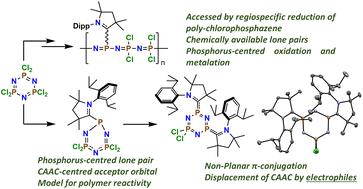
Facile one and two site reduction of hexachlorophosphazene using cyclic (alkyl)(amino)carbene substituents are shown to yield P-CAACMe-cyclo-(PNP(Cl)2NP(Cl)2N) 1 and P,P′-bis-CAACMe-cyclo-(PNPNP(Cl)2N) 2 (CAACMe = 1-[2,6-bis(isopropyl)phenyl]-3,3,5,5-tetramethyl-2-pyrrolidinylidene), respectively. Compound 1 is characterized by its predominantly phosphorus-centered HOMO, which results in typical phosphine-type nucleophilic and reductive reactivity; however, the resultant compounds of such reactions feature properties distinct from their classical phosphine analogues due to the CAAC-centered LUMO, which acts as an acceptor for both intramolecular interactions and photophysical excitations. In contrast, compound 2 exhibits π-conjugation spanning the endocyclic PNP moiety and the two CAACMe substituents, despite its non-planar structure. Treatment of 2 with [Cp*RuCl]4 results in the electrophilic displacement of one of the CAACMe moieties by two Cp*RuCl fragments to yield the spirocyclic compound 3. Preliminary results show that the methodology used to reduce hexachlorophosphazene to 1 can be directly transposed to the regiospecific reduction of poly-chlorophosphazene, to yield poly-1, a fundamentally new class of inorganic polymer that possesses a phosphorus center with chemically active lone pairs in the main chain.
期刊介绍:
Chemical Science is a journal that encompasses various disciplines within the chemical sciences. Its scope includes publishing ground-breaking research with significant implications for its respective field, as well as appealing to a wider audience in related areas. To be considered for publication, articles must showcase innovative and original advances in their field of study and be presented in a manner that is understandable to scientists from diverse backgrounds. However, the journal generally does not publish highly specialized research.





 京公网安备 11010802042870号
京ICP备2023020795号-1
京公网安备 11010802042870号
京ICP备2023020795号-1

 分享
分享
 求助内容:
求助内容: 应助结果提醒方式:
 扫码关注我们
