Fabian Dankert, Simon P. Muhm, Chandan Nandi, Sergi Danés, Sneha Mullassery, Petra Herbeck-Engel, Bernd Morgenstern, Robert Weiss, Pedro Salvador, Dominik Munz
{"title":"六苯基-1,2-二磷指示[Ph3P-PPh3]2+:超强酸、超氧化剂还是超级试剂?","authors":"Fabian Dankert, Simon P. Muhm, Chandan Nandi, Sergi Danés, Sneha Mullassery, Petra Herbeck-Engel, Bernd Morgenstern, Robert Weiss, Pedro Salvador, Dominik Munz","doi":"10.1021/jacs.5c01271","DOIUrl":null,"url":null,"abstract":"The oxidation of triphenylphosphine by perfluorinated phenazinium<sup>F</sup> aluminate in difluorobenzene affords hexaaryl-1,2-diphosphonium dialuminate <b>1</b>. Dication <b>1</b><sup><b>2+</b></sup> is valence isoelectronic with elusive hexaphenylethane, where instead the formation of a mixture of the trityl radical and Gomberg’s dimer is favored. Quantum-chemical calculations in combination with Raman/IR spectroscopies rationalize the stability of the P–P bonded dimer in <b>1</b><sup><b>2+</b></sup> and suggest, akin to the halogens, facile homolytic as well as heterolytic scission. Thus, <b>1</b><sup><b>2+</b></sup> serves as a surrogate of both the triphenylphosphorandiylium dication (Ph<sub>3</sub>P<sup>2+</sup>) and the triphenylphosphine radical monocation (Ph<sub>3</sub>P<sup>·+</sup>). Treating <b>1</b> with dimethylaminopyridine (DMAP) or <i><sup>t</sup></i>Bu<sub>3</sub>P replaces triphenylphosphine under heterolytic P–P bond scission. Qualifying as a superoxidant (<i>E</i> vs Fc/Fc<sup>+</sup> = +1.44 V), <b>1</b> oxidizes trimethylphosphine. Based on halide abstraction experiments (<b><sup>–</sup></b>BF<sub>4</sub>, <b><sup>–</sup></b>PF<sub>6</sub>, <b><sup>–</sup></b>SbCl<sub>6</sub>, <b><sup>–</sup></b>SbF<sub>6</sub>) as well as the deoxygenation of triethylphosphine oxide, triflate anions as well as toluic acid, <b>1</b> also features Lewis superacidity. The controlled hydrolysis affords Hendrickson’s reagent, which itself finds broad use as a dehydration agent. Formally, homolytic P–P bond scission occurs with diphenyldisulfide (PhSSPh) and the triple bonds in benzo- and acetonitrile. The irradiation by light cleaves the P–P bond homolytically and generates transient triphenylphosphine radical cations, which engage in H-atom abstraction as well as CH phosphoranylation.","PeriodicalId":49,"journal":{"name":"Journal of the American Chemical Society","volume":"24 1","pages":""},"PeriodicalIF":15.6000,"publicationDate":"2025-04-24","publicationTypes":"Journal Article","fieldsOfStudy":null,"isOpenAccess":false,"openAccessPdf":"","citationCount":"0","resultStr":"{\"title\":\"Hexaphenyl-1,2-Diphosphonium Dication [Ph3P–PPh3]2+: Superacid, Superoxidant, or Super Reagent?\",\"authors\":\"Fabian Dankert, Simon P. Muhm, Chandan Nandi, Sergi Danés, Sneha Mullassery, Petra Herbeck-Engel, Bernd Morgenstern, Robert Weiss, Pedro Salvador, Dominik Munz\",\"doi\":\"10.1021/jacs.5c01271\",\"DOIUrl\":null,\"url\":null,\"abstract\":\"The oxidation of triphenylphosphine by perfluorinated phenazinium<sup>F</sup> aluminate in difluorobenzene affords hexaaryl-1,2-diphosphonium dialuminate <b>1</b>. Dication <b>1</b><sup><b>2+</b></sup> is valence isoelectronic with elusive hexaphenylethane, where instead the formation of a mixture of the trityl radical and Gomberg’s dimer is favored. Quantum-chemical calculations in combination with Raman/IR spectroscopies rationalize the stability of the P–P bonded dimer in <b>1</b><sup><b>2+</b></sup> and suggest, akin to the halogens, facile homolytic as well as heterolytic scission. Thus, <b>1</b><sup><b>2+</b></sup> serves as a surrogate of both the triphenylphosphorandiylium dication (Ph<sub>3</sub>P<sup>2+</sup>) and the triphenylphosphine radical monocation (Ph<sub>3</sub>P<sup>·+</sup>). Treating <b>1</b> with dimethylaminopyridine (DMAP) or <i><sup>t</sup></i>Bu<sub>3</sub>P replaces triphenylphosphine under heterolytic P–P bond scission. Qualifying as a superoxidant (<i>E</i> vs Fc/Fc<sup>+</sup> = +1.44 V), <b>1</b> oxidizes trimethylphosphine. Based on halide abstraction experiments (<b><sup>–</sup></b>BF<sub>4</sub>, <b><sup>–</sup></b>PF<sub>6</sub>, <b><sup>–</sup></b>SbCl<sub>6</sub>, <b><sup>–</sup></b>SbF<sub>6</sub>) as well as the deoxygenation of triethylphosphine oxide, triflate anions as well as toluic acid, <b>1</b> also features Lewis superacidity. The controlled hydrolysis affords Hendrickson’s reagent, which itself finds broad use as a dehydration agent. Formally, homolytic P–P bond scission occurs with diphenyldisulfide (PhSSPh) and the triple bonds in benzo- and acetonitrile. The irradiation by light cleaves the P–P bond homolytically and generates transient triphenylphosphine radical cations, which engage in H-atom abstraction as well as CH phosphoranylation.\",\"PeriodicalId\":49,\"journal\":{\"name\":\"Journal of the American Chemical Society\",\"volume\":\"24 1\",\"pages\":\"\"},\"PeriodicalIF\":15.6000,\"publicationDate\":\"2025-04-24\",\"publicationTypes\":\"Journal Article\",\"fieldsOfStudy\":null,\"isOpenAccess\":false,\"openAccessPdf\":\"\",\"citationCount\":\"0\",\"resultStr\":null,\"platform\":\"Semanticscholar\",\"paperid\":null,\"PeriodicalName\":\"Journal of the American Chemical Society\",\"FirstCategoryId\":\"92\",\"ListUrlMain\":\"https://doi.org/10.1021/jacs.5c01271\",\"RegionNum\":1,\"RegionCategory\":\"化学\",\"ArticlePicture\":[],\"TitleCN\":null,\"AbstractTextCN\":null,\"PMCID\":null,\"EPubDate\":\"\",\"PubModel\":\"\",\"JCR\":\"Q1\",\"JCRName\":\"CHEMISTRY, MULTIDISCIPLINARY\",\"Score\":null,\"Total\":0}","platform":"Semanticscholar","paperid":null,"PeriodicalName":"Journal of the American Chemical Society","FirstCategoryId":"92","ListUrlMain":"https://doi.org/10.1021/jacs.5c01271","RegionNum":1,"RegionCategory":"化学","ArticlePicture":[],"TitleCN":null,"AbstractTextCN":null,"PMCID":null,"EPubDate":"","PubModel":"","JCR":"Q1","JCRName":"CHEMISTRY, MULTIDISCIPLINARY","Score":null,"Total":0}
引用次数: 0
摘要
三苯基膦在二氟苯中被全氟化非那津铝酸盐氧化得到六芳基-1,2-二铝酸盐1。12+是与难以捉摸的六苯基乙烷的价等电子,取而代之的是形成三烷基自由基和Gomberg二聚体的混合物。量子化学计算与拉曼/红外光谱相结合,合理化了P-P键二聚体在12+中的稳定性,并表明,与卤素类似,易于均裂和异裂。因此,12+可以作为三苯基磷二炔的指示(Ph3P2+)和三苯基膦自由基的单位(Ph3P·+)的替代物。用二甲氨基吡啶(DMAP)或tBu3P处理1在异裂P-P键断裂下取代三苯基膦。作为超氧化剂(E vs Fc/Fc+ = +1.44 V), 1氧化三甲基膦。通过卤化物提取实验(-BF4, -PF6, -SbCl6, -SbF6)以及氧化三乙基膦、三氟酸阴离子和甲苯的脱氧,1也具有Lewis超酸性。控制水解提供了亨德里克森试剂,它本身作为脱水剂被广泛使用。形式上,P-P键均裂发生在二苯基二硫(PhSSPh)和苯腈和乙腈中的三键之间。光照射使P-P键均聚分裂,产生瞬时三苯基膦自由基阳离子,参与h原子抽离和CH磷酸化。
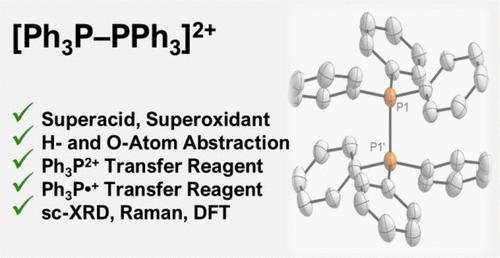
Hexaphenyl-1,2-Diphosphonium Dication [Ph3P–PPh3]2+: Superacid, Superoxidant, or Super Reagent?
The oxidation of triphenylphosphine by perfluorinated phenaziniumF aluminate in difluorobenzene affords hexaaryl-1,2-diphosphonium dialuminate 1. Dication 12+ is valence isoelectronic with elusive hexaphenylethane, where instead the formation of a mixture of the trityl radical and Gomberg’s dimer is favored. Quantum-chemical calculations in combination with Raman/IR spectroscopies rationalize the stability of the P–P bonded dimer in 12+ and suggest, akin to the halogens, facile homolytic as well as heterolytic scission. Thus, 12+ serves as a surrogate of both the triphenylphosphorandiylium dication (Ph3P2+) and the triphenylphosphine radical monocation (Ph3P·+). Treating 1 with dimethylaminopyridine (DMAP) or tBu3P replaces triphenylphosphine under heterolytic P–P bond scission. Qualifying as a superoxidant (E vs Fc/Fc+ = +1.44 V), 1 oxidizes trimethylphosphine. Based on halide abstraction experiments (–BF4, –PF6, –SbCl6, –SbF6) as well as the deoxygenation of triethylphosphine oxide, triflate anions as well as toluic acid, 1 also features Lewis superacidity. The controlled hydrolysis affords Hendrickson’s reagent, which itself finds broad use as a dehydration agent. Formally, homolytic P–P bond scission occurs with diphenyldisulfide (PhSSPh) and the triple bonds in benzo- and acetonitrile. The irradiation by light cleaves the P–P bond homolytically and generates transient triphenylphosphine radical cations, which engage in H-atom abstraction as well as CH phosphoranylation.
期刊介绍:
The flagship journal of the American Chemical Society, known as the Journal of the American Chemical Society (JACS), has been a prestigious publication since its establishment in 1879. It holds a preeminent position in the field of chemistry and related interdisciplinary sciences. JACS is committed to disseminating cutting-edge research papers, covering a wide range of topics, and encompasses approximately 19,000 pages of Articles, Communications, and Perspectives annually. With a weekly publication frequency, JACS plays a vital role in advancing the field of chemistry by providing essential research.




 京公网安备 11010802042870号
京ICP备2023020795号-1
京公网安备 11010802042870号
京ICP备2023020795号-1

 分享
分享
 求助内容:
求助内容: 应助结果提醒方式:
 扫码关注我们
