Ning Ding, Yaoyukun Jiang, Robbie Ge, Qianzhen Shao, Wook Shin, Xinchun Ran, Zhongyue J. Yang
{"title":"利用高通量计算工程增强双域淀粉酶的冷适应性","authors":"Ning Ding, Yaoyukun Jiang, Robbie Ge, Qianzhen Shao, Wook Shin, Xinchun Ran, Zhongyue J. Yang","doi":"10.1002/anie.202505991","DOIUrl":null,"url":null,"abstract":"<p>Cold-adapted bidomain enzymes have the potential to foster industrial sustainability by reducing energy consumption and greenhouse gas emissions. Despite their allure, these benefits are unattainable, as the molecular basis of cold adaptation remains elusive, and there are no strategies to guide the acquisition of this behavior. To uncover principles of cold adaptation, we selected the cold-adapted <i>Saccharophagus degradans</i> amylase (sdA) and mesophilic <i>Pseudomonas saccharophila</i> amylase (psA) as model systems. Through molecular dynamics (MD) simulations and biochemical assays, we found that sdA exhibits significantly greater interdomain separation between its catalytic domain (CD) and carbohydrate-binding module (CBM) at low temperatures. Therefore, we introduce the domain separation index metric to guide the in silico screening of 120 psA variants using high-throughput enzyme modeling. The highest-ranked variant, psA121, shows a 3-fold increase in relative activity over the wild type at 0 °C. MD simulations suggest that psA121 achieves cold adaptation via helical linkers, which induce interdomain separation and enhance flexibility of the active site and binding loops via dynamic allostery, promoting substrate recruitment, binding, and catalysis at lower temperatures. This study highlights how domain separation contributes to cold adaptation in bidomain amylases and offers strategies for introducing such cold adaptation to other systems.</p>","PeriodicalId":125,"journal":{"name":"Angewandte Chemie International Edition","volume":"64 29","pages":""},"PeriodicalIF":16.9000,"publicationDate":"2025-04-24","publicationTypes":"Journal Article","fieldsOfStudy":null,"isOpenAccess":false,"openAccessPdf":"https://onlinelibrary.wiley.com/doi/epdf/10.1002/anie.202505991","citationCount":"0","resultStr":"{\"title\":\"Enhancing Cold Adaptation of Bidomain Amylases by High-Throughput Computational Engineering\",\"authors\":\"Ning Ding, Yaoyukun Jiang, Robbie Ge, Qianzhen Shao, Wook Shin, Xinchun Ran, Zhongyue J. Yang\",\"doi\":\"10.1002/anie.202505991\",\"DOIUrl\":null,\"url\":null,\"abstract\":\"<p>Cold-adapted bidomain enzymes have the potential to foster industrial sustainability by reducing energy consumption and greenhouse gas emissions. Despite their allure, these benefits are unattainable, as the molecular basis of cold adaptation remains elusive, and there are no strategies to guide the acquisition of this behavior. To uncover principles of cold adaptation, we selected the cold-adapted <i>Saccharophagus degradans</i> amylase (sdA) and mesophilic <i>Pseudomonas saccharophila</i> amylase (psA) as model systems. Through molecular dynamics (MD) simulations and biochemical assays, we found that sdA exhibits significantly greater interdomain separation between its catalytic domain (CD) and carbohydrate-binding module (CBM) at low temperatures. Therefore, we introduce the domain separation index metric to guide the in silico screening of 120 psA variants using high-throughput enzyme modeling. The highest-ranked variant, psA121, shows a 3-fold increase in relative activity over the wild type at 0 °C. MD simulations suggest that psA121 achieves cold adaptation via helical linkers, which induce interdomain separation and enhance flexibility of the active site and binding loops via dynamic allostery, promoting substrate recruitment, binding, and catalysis at lower temperatures. This study highlights how domain separation contributes to cold adaptation in bidomain amylases and offers strategies for introducing such cold adaptation to other systems.</p>\",\"PeriodicalId\":125,\"journal\":{\"name\":\"Angewandte Chemie International Edition\",\"volume\":\"64 29\",\"pages\":\"\"},\"PeriodicalIF\":16.9000,\"publicationDate\":\"2025-04-24\",\"publicationTypes\":\"Journal Article\",\"fieldsOfStudy\":null,\"isOpenAccess\":false,\"openAccessPdf\":\"https://onlinelibrary.wiley.com/doi/epdf/10.1002/anie.202505991\",\"citationCount\":\"0\",\"resultStr\":null,\"platform\":\"Semanticscholar\",\"paperid\":null,\"PeriodicalName\":\"Angewandte Chemie International Edition\",\"FirstCategoryId\":\"92\",\"ListUrlMain\":\"https://onlinelibrary.wiley.com/doi/10.1002/anie.202505991\",\"RegionNum\":1,\"RegionCategory\":\"化学\",\"ArticlePicture\":[],\"TitleCN\":null,\"AbstractTextCN\":null,\"PMCID\":null,\"EPubDate\":\"\",\"PubModel\":\"\",\"JCR\":\"Q1\",\"JCRName\":\"CHEMISTRY, MULTIDISCIPLINARY\",\"Score\":null,\"Total\":0}","platform":"Semanticscholar","paperid":null,"PeriodicalName":"Angewandte Chemie International Edition","FirstCategoryId":"92","ListUrlMain":"https://onlinelibrary.wiley.com/doi/10.1002/anie.202505991","RegionNum":1,"RegionCategory":"化学","ArticlePicture":[],"TitleCN":null,"AbstractTextCN":null,"PMCID":null,"EPubDate":"","PubModel":"","JCR":"Q1","JCRName":"CHEMISTRY, MULTIDISCIPLINARY","Score":null,"Total":0}
Enhancing Cold Adaptation of Bidomain Amylases by High-Throughput Computational Engineering
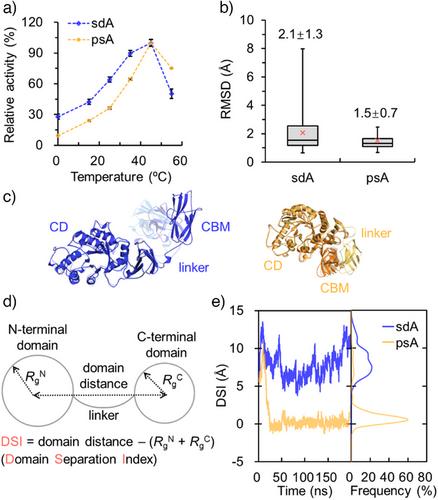
Cold-adapted bidomain enzymes have the potential to foster industrial sustainability by reducing energy consumption and greenhouse gas emissions. Despite their allure, these benefits are unattainable, as the molecular basis of cold adaptation remains elusive, and there are no strategies to guide the acquisition of this behavior. To uncover principles of cold adaptation, we selected the cold-adapted Saccharophagus degradans amylase (sdA) and mesophilic Pseudomonas saccharophila amylase (psA) as model systems. Through molecular dynamics (MD) simulations and biochemical assays, we found that sdA exhibits significantly greater interdomain separation between its catalytic domain (CD) and carbohydrate-binding module (CBM) at low temperatures. Therefore, we introduce the domain separation index metric to guide the in silico screening of 120 psA variants using high-throughput enzyme modeling. The highest-ranked variant, psA121, shows a 3-fold increase in relative activity over the wild type at 0 °C. MD simulations suggest that psA121 achieves cold adaptation via helical linkers, which induce interdomain separation and enhance flexibility of the active site and binding loops via dynamic allostery, promoting substrate recruitment, binding, and catalysis at lower temperatures. This study highlights how domain separation contributes to cold adaptation in bidomain amylases and offers strategies for introducing such cold adaptation to other systems.
期刊介绍:
Angewandte Chemie, a journal of the German Chemical Society (GDCh), maintains a leading position among scholarly journals in general chemistry with an impressive Impact Factor of 16.6 (2022 Journal Citation Reports, Clarivate, 2023). Published weekly in a reader-friendly format, it features new articles almost every day. Established in 1887, Angewandte Chemie is a prominent chemistry journal, offering a dynamic blend of Review-type articles, Highlights, Communications, and Research Articles on a weekly basis, making it unique in the field.




 京公网安备 11010802042870号
京ICP备2023020795号-1
京公网安备 11010802042870号
京ICP备2023020795号-1

 分享
分享
 求助内容:
求助内容: 应助结果提醒方式:
 扫码关注我们
