Yong-Hoon Yoon, Gyung-Min Park, Jae-Hyung Roh, Sung-Ho Her, Seong-Hoon Lim, Tae Soo Kang, Seung Jin Lee, Jang-Whan Bae, WoongGil Choi, Yong-Mo Yang, Junghee Kim, Yu Jeong Choi, Si Wan Choi, Jae-Hwan Lee
{"title":"生物可降解聚合物依维莫司洗脱支架经皮冠状动脉介入术后 6 个月双联抗血小板疗法与长期双联抗血小板疗法的比较","authors":"Yong-Hoon Yoon, Gyung-Min Park, Jae-Hyung Roh, Sung-Ho Her, Seong-Hoon Lim, Tae Soo Kang, Seung Jin Lee, Jang-Whan Bae, WoongGil Choi, Yong-Mo Yang, Junghee Kim, Yu Jeong Choi, Si Wan Choi, Jae-Hwan Lee","doi":"10.1155/2022/2914385","DOIUrl":null,"url":null,"abstract":"<p><strong>Background: </strong>The optimal duration of dual antiplatelet therapy (DAPT) after biodegradable-polymer (BP) everolimus-eluting stent (EES) implantation remains uncertain.</p><p><strong>Methods: </strong>This study analyzed 793 patients who underwent percutaneous coronary intervention (PCI) with BP-EES in 10 cardiovascular centers in Korea between July 2016 and January 2018. Using the prescription data at 6 months post-PCI, we divided these patients into two groups, namely, short-DAPT and prolonged-DAPT groups, which underwent DAPT for 6 and > 6 months of PCI, respectively. The primary endpoint, which included mortality, myocardial infarction, or target-vessel revascularization at 2 years, was compared by propensity score (PS) matching between the two groups.</p><p><strong>Results: </strong>Out of the 793 patients, 283 matched pairs were identified by PS matching. Out of this matched population, 405 (71.6%) patients had an acute coronary syndrome. The primary endpoint did not differ in 2 years between the short-DAPT and prolonged-DAPT groups (7.5% vs. 8.3%; hazard ratio, 0.87; 95% confidential interval, 0.47-1.60; <i>P</i> = 0.648). Likewise, no difference was found regarding mortality, cardiac mortality, myocardial infarction, target-lesion failure, target-vessel failure, and bleeding events defined by the Bleeding Academic Research Consortium and Thrombolysis In the Myocardial Infarction classification. Meanwhile, one patient in the short-DAPT group had definite stent thrombosis at 364 days post-PCI. Subgroup analysis showed that several anatomical and procedural factors were not significantly related to DAPT duration. Most patients (77.4%) in both groups were prescribed clopidogrel at discharge.</p><p><strong>Conclusions: </strong>In real-world patients undergoing PCI with BP-EES, the ischemic and bleeding endpoints demonstrated no difference between 6-month and prolonged (>6 months) DAPT.</p>","PeriodicalId":1,"journal":{"name":"Accounts of Chemical Research","volume":" ","pages":"2914385"},"PeriodicalIF":17.7000,"publicationDate":"2022-09-28","publicationTypes":"Journal Article","fieldsOfStudy":null,"isOpenAccess":false,"openAccessPdf":"https://www.ncbi.nlm.nih.gov/pmc/articles/PMC9534716/pdf/","citationCount":"0","resultStr":"{\"title\":\"Comparison of 6-Month and Prolonged Dual Antiplatelet Therapy after Percutaneous Coronary Intervention with Biodegradable Polymer Everolimus-Eluting Stent.\",\"authors\":\"Yong-Hoon Yoon, Gyung-Min Park, Jae-Hyung Roh, Sung-Ho Her, Seong-Hoon Lim, Tae Soo Kang, Seung Jin Lee, Jang-Whan Bae, WoongGil Choi, Yong-Mo Yang, Junghee Kim, Yu Jeong Choi, Si Wan Choi, Jae-Hwan Lee\",\"doi\":\"10.1155/2022/2914385\",\"DOIUrl\":null,\"url\":null,\"abstract\":\"<p><strong>Background: </strong>The optimal duration of dual antiplatelet therapy (DAPT) after biodegradable-polymer (BP) everolimus-eluting stent (EES) implantation remains uncertain.</p><p><strong>Methods: </strong>This study analyzed 793 patients who underwent percutaneous coronary intervention (PCI) with BP-EES in 10 cardiovascular centers in Korea between July 2016 and January 2018. Using the prescription data at 6 months post-PCI, we divided these patients into two groups, namely, short-DAPT and prolonged-DAPT groups, which underwent DAPT for 6 and > 6 months of PCI, respectively. The primary endpoint, which included mortality, myocardial infarction, or target-vessel revascularization at 2 years, was compared by propensity score (PS) matching between the two groups.</p><p><strong>Results: </strong>Out of the 793 patients, 283 matched pairs were identified by PS matching. Out of this matched population, 405 (71.6%) patients had an acute coronary syndrome. The primary endpoint did not differ in 2 years between the short-DAPT and prolonged-DAPT groups (7.5% vs. 8.3%; hazard ratio, 0.87; 95% confidential interval, 0.47-1.60; <i>P</i> = 0.648). Likewise, no difference was found regarding mortality, cardiac mortality, myocardial infarction, target-lesion failure, target-vessel failure, and bleeding events defined by the Bleeding Academic Research Consortium and Thrombolysis In the Myocardial Infarction classification. Meanwhile, one patient in the short-DAPT group had definite stent thrombosis at 364 days post-PCI. Subgroup analysis showed that several anatomical and procedural factors were not significantly related to DAPT duration. Most patients (77.4%) in both groups were prescribed clopidogrel at discharge.</p><p><strong>Conclusions: </strong>In real-world patients undergoing PCI with BP-EES, the ischemic and bleeding endpoints demonstrated no difference between 6-month and prolonged (>6 months) DAPT.</p>\",\"PeriodicalId\":1,\"journal\":{\"name\":\"Accounts of Chemical Research\",\"volume\":\" \",\"pages\":\"2914385\"},\"PeriodicalIF\":17.7000,\"publicationDate\":\"2022-09-28\",\"publicationTypes\":\"Journal Article\",\"fieldsOfStudy\":null,\"isOpenAccess\":false,\"openAccessPdf\":\"https://www.ncbi.nlm.nih.gov/pmc/articles/PMC9534716/pdf/\",\"citationCount\":\"0\",\"resultStr\":null,\"platform\":\"Semanticscholar\",\"paperid\":null,\"PeriodicalName\":\"Accounts of Chemical Research\",\"FirstCategoryId\":\"3\",\"ListUrlMain\":\"https://doi.org/10.1155/2022/2914385\",\"RegionNum\":1,\"RegionCategory\":\"化学\",\"ArticlePicture\":[],\"TitleCN\":null,\"AbstractTextCN\":null,\"PMCID\":null,\"EPubDate\":\"2022/1/1 0:00:00\",\"PubModel\":\"eCollection\",\"JCR\":\"Q1\",\"JCRName\":\"CHEMISTRY, MULTIDISCIPLINARY\",\"Score\":null,\"Total\":0}","platform":"Semanticscholar","paperid":null,"PeriodicalName":"Accounts of Chemical Research","FirstCategoryId":"3","ListUrlMain":"https://doi.org/10.1155/2022/2914385","RegionNum":1,"RegionCategory":"化学","ArticlePicture":[],"TitleCN":null,"AbstractTextCN":null,"PMCID":null,"EPubDate":"2022/1/1 0:00:00","PubModel":"eCollection","JCR":"Q1","JCRName":"CHEMISTRY, MULTIDISCIPLINARY","Score":null,"Total":0}
Comparison of 6-Month and Prolonged Dual Antiplatelet Therapy after Percutaneous Coronary Intervention with Biodegradable Polymer Everolimus-Eluting Stent.
Background: The optimal duration of dual antiplatelet therapy (DAPT) after biodegradable-polymer (BP) everolimus-eluting stent (EES) implantation remains uncertain.
Methods: This study analyzed 793 patients who underwent percutaneous coronary intervention (PCI) with BP-EES in 10 cardiovascular centers in Korea between July 2016 and January 2018. Using the prescription data at 6 months post-PCI, we divided these patients into two groups, namely, short-DAPT and prolonged-DAPT groups, which underwent DAPT for 6 and > 6 months of PCI, respectively. The primary endpoint, which included mortality, myocardial infarction, or target-vessel revascularization at 2 years, was compared by propensity score (PS) matching between the two groups.
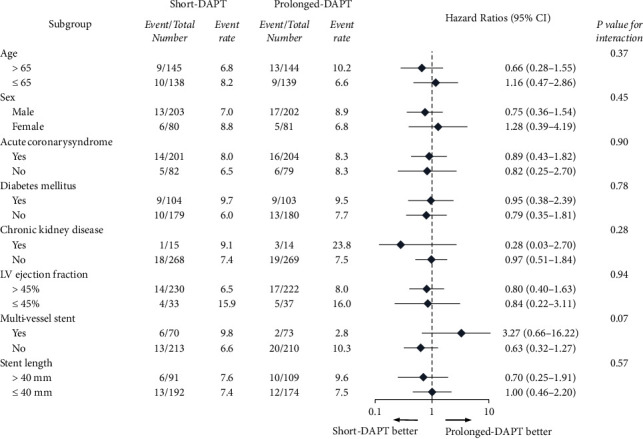
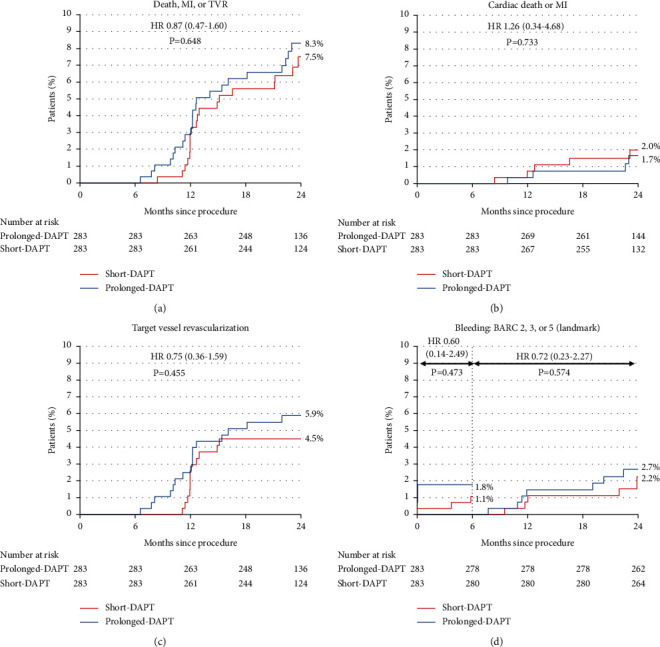
Results: Out of the 793 patients, 283 matched pairs were identified by PS matching. Out of this matched population, 405 (71.6%) patients had an acute coronary syndrome. The primary endpoint did not differ in 2 years between the short-DAPT and prolonged-DAPT groups (7.5% vs. 8.3%; hazard ratio, 0.87; 95% confidential interval, 0.47-1.60; P = 0.648). Likewise, no difference was found regarding mortality, cardiac mortality, myocardial infarction, target-lesion failure, target-vessel failure, and bleeding events defined by the Bleeding Academic Research Consortium and Thrombolysis In the Myocardial Infarction classification. Meanwhile, one patient in the short-DAPT group had definite stent thrombosis at 364 days post-PCI. Subgroup analysis showed that several anatomical and procedural factors were not significantly related to DAPT duration. Most patients (77.4%) in both groups were prescribed clopidogrel at discharge.
Conclusions: In real-world patients undergoing PCI with BP-EES, the ischemic and bleeding endpoints demonstrated no difference between 6-month and prolonged (>6 months) DAPT.
期刊介绍:
Accounts of Chemical Research presents short, concise and critical articles offering easy-to-read overviews of basic research and applications in all areas of chemistry and biochemistry. These short reviews focus on research from the author’s own laboratory and are designed to teach the reader about a research project. In addition, Accounts of Chemical Research publishes commentaries that give an informed opinion on a current research problem. Special Issues online are devoted to a single topic of unusual activity and significance.
Accounts of Chemical Research replaces the traditional article abstract with an article "Conspectus." These entries synopsize the research affording the reader a closer look at the content and significance of an article. Through this provision of a more detailed description of the article contents, the Conspectus enhances the article's discoverability by search engines and the exposure for the research.




 京公网安备 11010802042870号
京ICP备2023020795号-1
京公网安备 11010802042870号
京ICP备2023020795号-1

 分享
分享
 求助内容:
求助内容: 应助结果提醒方式:
 扫码关注我们
