Teresa A Milner, Ryan X Chen, Diedreanna Welington, Batsheva R Rubin, Natalina H Contoreggi, Megan A Johnson, Sanoara Mazid, Jose Marques-Lopes, Roberta Marongiu, Michael J Glass
{"title":"血管紧张素II对年轻成年雄性和雌性小鼠海马神经胶质炎性标志物的影响不同。","authors":"Teresa A Milner, Ryan X Chen, Diedreanna Welington, Batsheva R Rubin, Natalina H Contoreggi, Megan A Johnson, Sanoara Mazid, Jose Marques-Lopes, Roberta Marongiu, Michael J Glass","doi":"10.1101/lm.053507.121","DOIUrl":null,"url":null,"abstract":"<p><p>Hypertension is a risk factor for neurodegenerative disorders involving inflammation and inflammatory cytokine-producing brain cells (microglia and astrocytes) in the hippocampus and medial prefrontal cortex (mPFC). Here we investigated the effect of slow-pressor angiotensin II (AngII) on gliosis in the hippocampus and mPFC of young adult (2-mo-old) male and female mice. In males, AngII induced hypertension, and this resulted in an increase in the density of the astrocyte marker glial fibrillary acidic protein (GFAP) in the subgranular hilus and a decrease in the density of the microglial marker ionized calcium binding adapter molecule (Iba-1) in the CA1 region. Females infused with AngII did not show hypertension but, significantly, showed alterations in hippocampal glial activation. Compared with vehicle, AngII-infused female mice had an increased density of Iba-1 in the dentate gyrus and CA2/3a region. Like males, females infused with AngII exhibited decreased Iba-1 in the CA1 region. Neither male nor female mice showed differences in GFAP or Iba-1 in the mPFC following AngII infusion. These results demonstrate that the hippocampus is particularly vulnerable to AngII in young adulthood. Differences in gonadal hormones or the sensitivity to AngII hypertension may account for divergences in GFAP and Iba-1 in males and females.</p>","PeriodicalId":1,"journal":{"name":"Accounts of Chemical Research","volume":" ","pages":"265-273"},"PeriodicalIF":18.0000,"publicationDate":"2022-09-06","publicationTypes":"Journal Article","fieldsOfStudy":null,"isOpenAccess":false,"openAccessPdf":"https://www.ncbi.nlm.nih.gov/pmc/articles/PMC9488028/pdf/","citationCount":"0","resultStr":"{\"title\":\"Angiotensin II differentially affects hippocampal glial inflammatory markers in young adult male and female mice.\",\"authors\":\"Teresa A Milner, Ryan X Chen, Diedreanna Welington, Batsheva R Rubin, Natalina H Contoreggi, Megan A Johnson, Sanoara Mazid, Jose Marques-Lopes, Roberta Marongiu, Michael J Glass\",\"doi\":\"10.1101/lm.053507.121\",\"DOIUrl\":null,\"url\":null,\"abstract\":\"<p><p>Hypertension is a risk factor for neurodegenerative disorders involving inflammation and inflammatory cytokine-producing brain cells (microglia and astrocytes) in the hippocampus and medial prefrontal cortex (mPFC). Here we investigated the effect of slow-pressor angiotensin II (AngII) on gliosis in the hippocampus and mPFC of young adult (2-mo-old) male and female mice. In males, AngII induced hypertension, and this resulted in an increase in the density of the astrocyte marker glial fibrillary acidic protein (GFAP) in the subgranular hilus and a decrease in the density of the microglial marker ionized calcium binding adapter molecule (Iba-1) in the CA1 region. Females infused with AngII did not show hypertension but, significantly, showed alterations in hippocampal glial activation. Compared with vehicle, AngII-infused female mice had an increased density of Iba-1 in the dentate gyrus and CA2/3a region. Like males, females infused with AngII exhibited decreased Iba-1 in the CA1 region. Neither male nor female mice showed differences in GFAP or Iba-1 in the mPFC following AngII infusion. These results demonstrate that the hippocampus is particularly vulnerable to AngII in young adulthood. Differences in gonadal hormones or the sensitivity to AngII hypertension may account for divergences in GFAP and Iba-1 in males and females.</p>\",\"PeriodicalId\":1,\"journal\":{\"name\":\"Accounts of Chemical Research\",\"volume\":\" \",\"pages\":\"265-273\"},\"PeriodicalIF\":18.0000,\"publicationDate\":\"2022-09-06\",\"publicationTypes\":\"Journal Article\",\"fieldsOfStudy\":null,\"isOpenAccess\":false,\"openAccessPdf\":\"https://www.ncbi.nlm.nih.gov/pmc/articles/PMC9488028/pdf/\",\"citationCount\":\"0\",\"resultStr\":null,\"platform\":\"Semanticscholar\",\"paperid\":null,\"PeriodicalName\":\"Accounts of Chemical Research\",\"FirstCategoryId\":\"3\",\"ListUrlMain\":\"https://doi.org/10.1101/lm.053507.121\",\"RegionNum\":1,\"RegionCategory\":\"化学\",\"ArticlePicture\":[],\"TitleCN\":null,\"AbstractTextCN\":null,\"PMCID\":null,\"EPubDate\":\"2022/9/1 0:00:00\",\"PubModel\":\"Print\",\"JCR\":\"Q1\",\"JCRName\":\"CHEMISTRY, MULTIDISCIPLINARY\",\"Score\":null,\"Total\":0}","platform":"Semanticscholar","paperid":null,"PeriodicalName":"Accounts of Chemical Research","FirstCategoryId":"3","ListUrlMain":"https://doi.org/10.1101/lm.053507.121","RegionNum":1,"RegionCategory":"化学","ArticlePicture":[],"TitleCN":null,"AbstractTextCN":null,"PMCID":null,"EPubDate":"2022/9/1 0:00:00","PubModel":"Print","JCR":"Q1","JCRName":"CHEMISTRY, MULTIDISCIPLINARY","Score":null,"Total":0}
Angiotensin II differentially affects hippocampal glial inflammatory markers in young adult male and female mice.
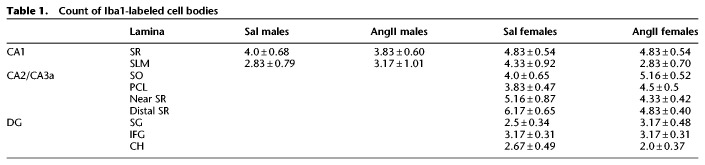
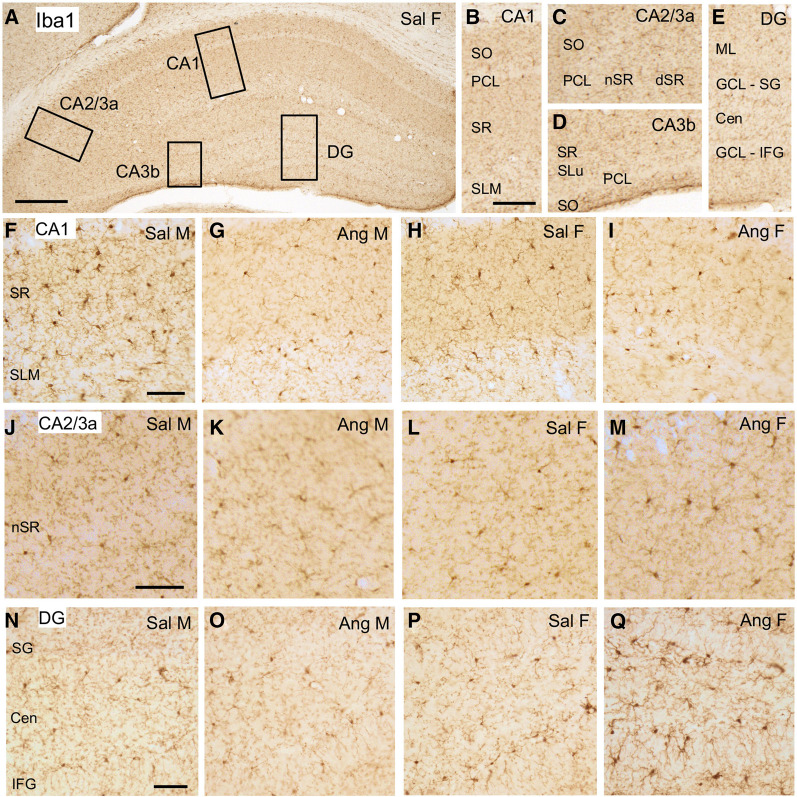
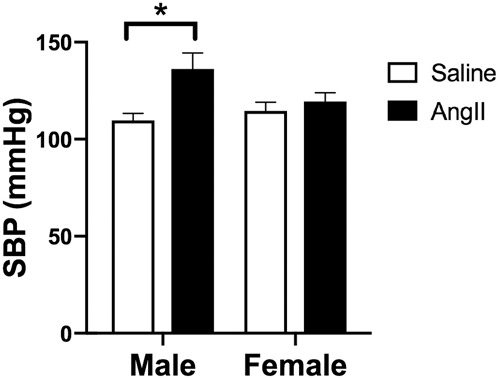
Hypertension is a risk factor for neurodegenerative disorders involving inflammation and inflammatory cytokine-producing brain cells (microglia and astrocytes) in the hippocampus and medial prefrontal cortex (mPFC). Here we investigated the effect of slow-pressor angiotensin II (AngII) on gliosis in the hippocampus and mPFC of young adult (2-mo-old) male and female mice. In males, AngII induced hypertension, and this resulted in an increase in the density of the astrocyte marker glial fibrillary acidic protein (GFAP) in the subgranular hilus and a decrease in the density of the microglial marker ionized calcium binding adapter molecule (Iba-1) in the CA1 region. Females infused with AngII did not show hypertension but, significantly, showed alterations in hippocampal glial activation. Compared with vehicle, AngII-infused female mice had an increased density of Iba-1 in the dentate gyrus and CA2/3a region. Like males, females infused with AngII exhibited decreased Iba-1 in the CA1 region. Neither male nor female mice showed differences in GFAP or Iba-1 in the mPFC following AngII infusion. These results demonstrate that the hippocampus is particularly vulnerable to AngII in young adulthood. Differences in gonadal hormones or the sensitivity to AngII hypertension may account for divergences in GFAP and Iba-1 in males and females.
期刊介绍:
Accounts of Chemical Research presents short, concise and critical articles offering easy-to-read overviews of basic research and applications in all areas of chemistry and biochemistry. These short reviews focus on research from the author’s own laboratory and are designed to teach the reader about a research project. In addition, Accounts of Chemical Research publishes commentaries that give an informed opinion on a current research problem. Special Issues online are devoted to a single topic of unusual activity and significance.
Accounts of Chemical Research replaces the traditional article abstract with an article "Conspectus." These entries synopsize the research affording the reader a closer look at the content and significance of an article. Through this provision of a more detailed description of the article contents, the Conspectus enhances the article's discoverability by search engines and the exposure for the research.





 京公网安备 11010802042870号
京ICP备2023020795号-1
京公网安备 11010802042870号
京ICP备2023020795号-1

 分享
分享
 求助内容:
求助内容: 应助结果提醒方式:
 扫码关注我们
