{"title":"circ_0002346通过调控miR-582-3p/STXBP6轴抑制非小细胞肺癌进展","authors":"Weijie Wang, Yi Lin, Guanghui Zhang, Guofu Shi, Yongsheng Jiang, Wentao Hu, Wei Zuo","doi":"10.1155/2021/1565660","DOIUrl":null,"url":null,"abstract":"<div>\n <p><i>Background</i>. Accumulating articles have reported the pivotal regulatory roles of circular RNAs (circRNAs) in non-small-cell lung cancer (NSCLC) tumorigenesis. Here, our purpose was to explore the role of circ_0002346 in NSCLC progression and its associated mechanism. <i>Methods</i>. Cell proliferation ability was assessed by a 5-ethynyl-2 <sup>′</sup>-deoxyuridine (EDU) assay and a colony formation assay. Transwell assays were conducted to analyze cell migration and invasion abilities. Cell apoptosis was analyzed by flow cytometry and by using a caspase3 activity assay kit. The glycolysis of NSCLC cells was analyzed using a fluorescence-based glucose/lactate assay kit. A dual-luciferase reporter assay and an RNA pull-down assay were performed to verify the binding relationship between microRNA-582-3p (miR-582-3p) and circ_0002346 or syntaxin-binding protein 6 (STXBP6). <i>Results</i>. circ_0002346 level was prominently downregulated in NSCLC tissues and cell lines. circ_0002346 overexpression significantly suppressed the proliferation, migration, invasion, and glycolysis and triggered the apoptosis of NSCLC cells. circ_0002346 directly interacted with miR-582-3p, and circ_0002346 overexpression-mediated antitumor effects in NSCLC cells were partly reversed by miR-582-3p overexpression. miR-582-3p directly interacted with the 3 <sup>′</sup> untranslated region (3 <sup>′</sup>UTR) of STXBP6, and STXBP6 silencing partly counteracted circ_0002346 overexpression-mediated antitumor influences in NSCLC cells. circ_0002346 can upregulate the expression of STXBP6 by acting as a miR-582-3p sponge in NSCLC cells. circ_0002346 overexpression suppressed xenograft tumor growth <i>in vivo</i>. <i>Conclusion</i>. circ_0002346 overexpression suppressed the malignant properties of NSCLC cells by binding to miR-582-3p to induce the expression of STXBP6.</p>\n </div>","PeriodicalId":55239,"journal":{"name":"Comparative and Functional Genomics","volume":"2021 1","pages":""},"PeriodicalIF":0.0000,"publicationDate":"2021-10-20","publicationTypes":"Journal Article","fieldsOfStudy":null,"isOpenAccess":false,"openAccessPdf":"https://www.ncbi.nlm.nih.gov/pmc/articles/PMC8550861/pdf/","citationCount":"0","resultStr":"{\"title\":\"circ_0002346 Suppresses Non-Small-Cell Lung Cancer Progression Depending on the Regulation of the miR-582-3p/STXBP6 Axis\",\"authors\":\"Weijie Wang, Yi Lin, Guanghui Zhang, Guofu Shi, Yongsheng Jiang, Wentao Hu, Wei Zuo\",\"doi\":\"10.1155/2021/1565660\",\"DOIUrl\":null,\"url\":null,\"abstract\":\"<div>\\n <p><i>Background</i>. Accumulating articles have reported the pivotal regulatory roles of circular RNAs (circRNAs) in non-small-cell lung cancer (NSCLC) tumorigenesis. Here, our purpose was to explore the role of circ_0002346 in NSCLC progression and its associated mechanism. <i>Methods</i>. Cell proliferation ability was assessed by a 5-ethynyl-2 <sup>′</sup>-deoxyuridine (EDU) assay and a colony formation assay. Transwell assays were conducted to analyze cell migration and invasion abilities. Cell apoptosis was analyzed by flow cytometry and by using a caspase3 activity assay kit. The glycolysis of NSCLC cells was analyzed using a fluorescence-based glucose/lactate assay kit. A dual-luciferase reporter assay and an RNA pull-down assay were performed to verify the binding relationship between microRNA-582-3p (miR-582-3p) and circ_0002346 or syntaxin-binding protein 6 (STXBP6). <i>Results</i>. circ_0002346 level was prominently downregulated in NSCLC tissues and cell lines. circ_0002346 overexpression significantly suppressed the proliferation, migration, invasion, and glycolysis and triggered the apoptosis of NSCLC cells. circ_0002346 directly interacted with miR-582-3p, and circ_0002346 overexpression-mediated antitumor effects in NSCLC cells were partly reversed by miR-582-3p overexpression. miR-582-3p directly interacted with the 3 <sup>′</sup> untranslated region (3 <sup>′</sup>UTR) of STXBP6, and STXBP6 silencing partly counteracted circ_0002346 overexpression-mediated antitumor influences in NSCLC cells. circ_0002346 can upregulate the expression of STXBP6 by acting as a miR-582-3p sponge in NSCLC cells. circ_0002346 overexpression suppressed xenograft tumor growth <i>in vivo</i>. <i>Conclusion</i>. circ_0002346 overexpression suppressed the malignant properties of NSCLC cells by binding to miR-582-3p to induce the expression of STXBP6.</p>\\n </div>\",\"PeriodicalId\":55239,\"journal\":{\"name\":\"Comparative and Functional Genomics\",\"volume\":\"2021 1\",\"pages\":\"\"},\"PeriodicalIF\":0.0000,\"publicationDate\":\"2021-10-20\",\"publicationTypes\":\"Journal Article\",\"fieldsOfStudy\":null,\"isOpenAccess\":false,\"openAccessPdf\":\"https://www.ncbi.nlm.nih.gov/pmc/articles/PMC8550861/pdf/\",\"citationCount\":\"0\",\"resultStr\":null,\"platform\":\"Semanticscholar\",\"paperid\":null,\"PeriodicalName\":\"Comparative and Functional Genomics\",\"FirstCategoryId\":\"1085\",\"ListUrlMain\":\"https://onlinelibrary.wiley.com/doi/10.1155/2021/1565660\",\"RegionNum\":0,\"RegionCategory\":null,\"ArticlePicture\":[],\"TitleCN\":null,\"AbstractTextCN\":null,\"PMCID\":null,\"EPubDate\":\"\",\"PubModel\":\"\",\"JCR\":\"\",\"JCRName\":\"\",\"Score\":null,\"Total\":0}","platform":"Semanticscholar","paperid":null,"PeriodicalName":"Comparative and Functional Genomics","FirstCategoryId":"1085","ListUrlMain":"https://onlinelibrary.wiley.com/doi/10.1155/2021/1565660","RegionNum":0,"RegionCategory":null,"ArticlePicture":[],"TitleCN":null,"AbstractTextCN":null,"PMCID":null,"EPubDate":"","PubModel":"","JCR":"","JCRName":"","Score":null,"Total":0}
circ_0002346 Suppresses Non-Small-Cell Lung Cancer Progression Depending on the Regulation of the miR-582-3p/STXBP6 Axis
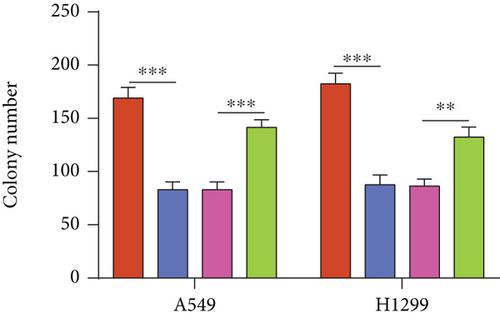
Background. Accumulating articles have reported the pivotal regulatory roles of circular RNAs (circRNAs) in non-small-cell lung cancer (NSCLC) tumorigenesis. Here, our purpose was to explore the role of circ_0002346 in NSCLC progression and its associated mechanism. Methods. Cell proliferation ability was assessed by a 5-ethynyl-2 ′-deoxyuridine (EDU) assay and a colony formation assay. Transwell assays were conducted to analyze cell migration and invasion abilities. Cell apoptosis was analyzed by flow cytometry and by using a caspase3 activity assay kit. The glycolysis of NSCLC cells was analyzed using a fluorescence-based glucose/lactate assay kit. A dual-luciferase reporter assay and an RNA pull-down assay were performed to verify the binding relationship between microRNA-582-3p (miR-582-3p) and circ_0002346 or syntaxin-binding protein 6 (STXBP6). Results. circ_0002346 level was prominently downregulated in NSCLC tissues and cell lines. circ_0002346 overexpression significantly suppressed the proliferation, migration, invasion, and glycolysis and triggered the apoptosis of NSCLC cells. circ_0002346 directly interacted with miR-582-3p, and circ_0002346 overexpression-mediated antitumor effects in NSCLC cells were partly reversed by miR-582-3p overexpression. miR-582-3p directly interacted with the 3 ′ untranslated region (3 ′UTR) of STXBP6, and STXBP6 silencing partly counteracted circ_0002346 overexpression-mediated antitumor influences in NSCLC cells. circ_0002346 can upregulate the expression of STXBP6 by acting as a miR-582-3p sponge in NSCLC cells. circ_0002346 overexpression suppressed xenograft tumor growth in vivo. Conclusion. circ_0002346 overexpression suppressed the malignant properties of NSCLC cells by binding to miR-582-3p to induce the expression of STXBP6.




 京公网安备 11010802042870号
京ICP备2023020795号-1
京公网安备 11010802042870号
京ICP备2023020795号-1

 分享
分享
 求助内容:
求助内容: 应助结果提醒方式:
 扫码关注我们
