Qi Ding, Bai-Bing Mi, Xia Wei, Jie Li, Jiu-Yun Mi, Jing-Ting Ren, Rui-Li Li
{"title":"慢性支气管炎伴肺功能保留的小气道功能障碍。","authors":"Qi Ding, Bai-Bing Mi, Xia Wei, Jie Li, Jiu-Yun Mi, Jing-Ting Ren, Rui-Li Li","doi":"10.1155/2022/4201786","DOIUrl":null,"url":null,"abstract":"<p><p>Impairment of pulmonary function was evaluated in chronic bronchitis patients with preserved ratio impaired spirometry (PRISm). We retrospectively collected clinical data from 157 chronic bronchitis (CB) and 186 chronic obstructive pulmonary disease (COPD) patients between October 2014 and September 2017. These patients were assigned to three groups: control (normal pulmonary function), PRISm (forced expiratory volume in 1 second [FEV1]/forced vital capacity [FVC] ≥ 0.7, FEV1 < 80% of predicted value), and COPD (FEV1/FVC <0.7) groups. Because small airway function was the main focus, in the COPD group, only patients in accordance with the Global Initiative for Chronic Obstructive Lung Disease (GOLD) grades 1 and 2 were included. Evaluation of pulmonary function (including impulse oscillometry) was performed and compared among these groups. Compared with the control group, the PRISm and COPD groups showed statistically significant differences in the predicted FEV1% (<i>p</i> < 0.001), maximal expiratory flow (MEF) 25% (<i>p</i> < 0.001), MEF50% (<i>p</i> < 0.001), maximal midexpiratory flow (MMEF) 25-75% (<i>p</i> < 0.001), residual volume (RV)/total lung capacity (TLC; <i>p</i> < 0.001), FVC% (<i>p</i> < 0.001), total respiratory resistance and proximal respiratory resistance (R5-R20; <i>p</i> < 0.001), respiratory system reactance at 5 Hz (X5; <i>p</i> < 0.001), resonant frequency (Fres; <i>p</i> < 0.001), and area of reactance (Ax; <i>p</i> < 0.001). However, the predicted FEV1% and RV/TLC were similar between the PRISm and COPD groups (<i>p</i>=0.992 and 0.122, respectively). PRISm is a nonspecific pattern of pulmonary function that indicates small airway dysfunction and may increase the risk of transformation to obstructive ventilation dysfunction. This trial is registered with ChiCTR-OCH-14004904.</p>","PeriodicalId":9416,"journal":{"name":"Canadian respiratory journal","volume":" ","pages":"4201786"},"PeriodicalIF":2.1000,"publicationDate":"2022-08-24","publicationTypes":"Journal Article","fieldsOfStudy":null,"isOpenAccess":false,"openAccessPdf":"https://www.ncbi.nlm.nih.gov/pmc/articles/PMC9433251/pdf/","citationCount":"0","resultStr":"{\"title\":\"Small Airway Dysfunction in Chronic Bronchitis with Preserved Pulmonary Function.\",\"authors\":\"Qi Ding, Bai-Bing Mi, Xia Wei, Jie Li, Jiu-Yun Mi, Jing-Ting Ren, Rui-Li Li\",\"doi\":\"10.1155/2022/4201786\",\"DOIUrl\":null,\"url\":null,\"abstract\":\"<p><p>Impairment of pulmonary function was evaluated in chronic bronchitis patients with preserved ratio impaired spirometry (PRISm). We retrospectively collected clinical data from 157 chronic bronchitis (CB) and 186 chronic obstructive pulmonary disease (COPD) patients between October 2014 and September 2017. These patients were assigned to three groups: control (normal pulmonary function), PRISm (forced expiratory volume in 1 second [FEV1]/forced vital capacity [FVC] ≥ 0.7, FEV1 < 80% of predicted value), and COPD (FEV1/FVC <0.7) groups. Because small airway function was the main focus, in the COPD group, only patients in accordance with the Global Initiative for Chronic Obstructive Lung Disease (GOLD) grades 1 and 2 were included. Evaluation of pulmonary function (including impulse oscillometry) was performed and compared among these groups. Compared with the control group, the PRISm and COPD groups showed statistically significant differences in the predicted FEV1% (<i>p</i> < 0.001), maximal expiratory flow (MEF) 25% (<i>p</i> < 0.001), MEF50% (<i>p</i> < 0.001), maximal midexpiratory flow (MMEF) 25-75% (<i>p</i> < 0.001), residual volume (RV)/total lung capacity (TLC; <i>p</i> < 0.001), FVC% (<i>p</i> < 0.001), total respiratory resistance and proximal respiratory resistance (R5-R20; <i>p</i> < 0.001), respiratory system reactance at 5 Hz (X5; <i>p</i> < 0.001), resonant frequency (Fres; <i>p</i> < 0.001), and area of reactance (Ax; <i>p</i> < 0.001). However, the predicted FEV1% and RV/TLC were similar between the PRISm and COPD groups (<i>p</i>=0.992 and 0.122, respectively). PRISm is a nonspecific pattern of pulmonary function that indicates small airway dysfunction and may increase the risk of transformation to obstructive ventilation dysfunction. This trial is registered with ChiCTR-OCH-14004904.</p>\",\"PeriodicalId\":9416,\"journal\":{\"name\":\"Canadian respiratory journal\",\"volume\":\" \",\"pages\":\"4201786\"},\"PeriodicalIF\":2.1000,\"publicationDate\":\"2022-08-24\",\"publicationTypes\":\"Journal Article\",\"fieldsOfStudy\":null,\"isOpenAccess\":false,\"openAccessPdf\":\"https://www.ncbi.nlm.nih.gov/pmc/articles/PMC9433251/pdf/\",\"citationCount\":\"0\",\"resultStr\":null,\"platform\":\"Semanticscholar\",\"paperid\":null,\"PeriodicalName\":\"Canadian respiratory journal\",\"FirstCategoryId\":\"3\",\"ListUrlMain\":\"https://doi.org/10.1155/2022/4201786\",\"RegionNum\":4,\"RegionCategory\":\"医学\",\"ArticlePicture\":[],\"TitleCN\":null,\"AbstractTextCN\":null,\"PMCID\":null,\"EPubDate\":\"2022/1/1 0:00:00\",\"PubModel\":\"eCollection\",\"JCR\":\"Q3\",\"JCRName\":\"RESPIRATORY SYSTEM\",\"Score\":null,\"Total\":0}","platform":"Semanticscholar","paperid":null,"PeriodicalName":"Canadian respiratory journal","FirstCategoryId":"3","ListUrlMain":"https://doi.org/10.1155/2022/4201786","RegionNum":4,"RegionCategory":"医学","ArticlePicture":[],"TitleCN":null,"AbstractTextCN":null,"PMCID":null,"EPubDate":"2022/1/1 0:00:00","PubModel":"eCollection","JCR":"Q3","JCRName":"RESPIRATORY SYSTEM","Score":null,"Total":0}
引用次数: 0
摘要
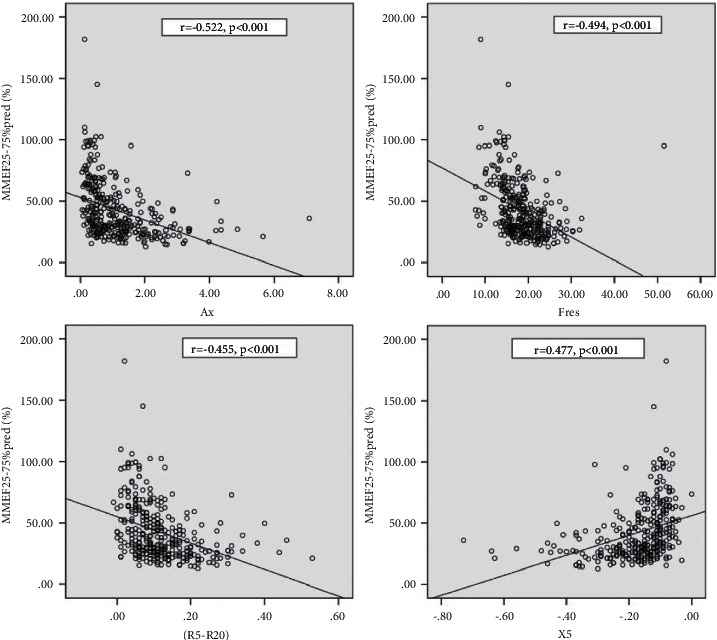
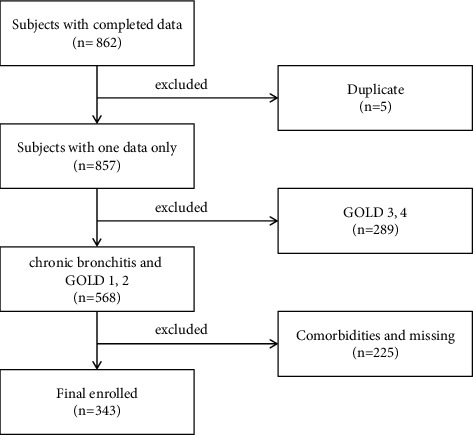
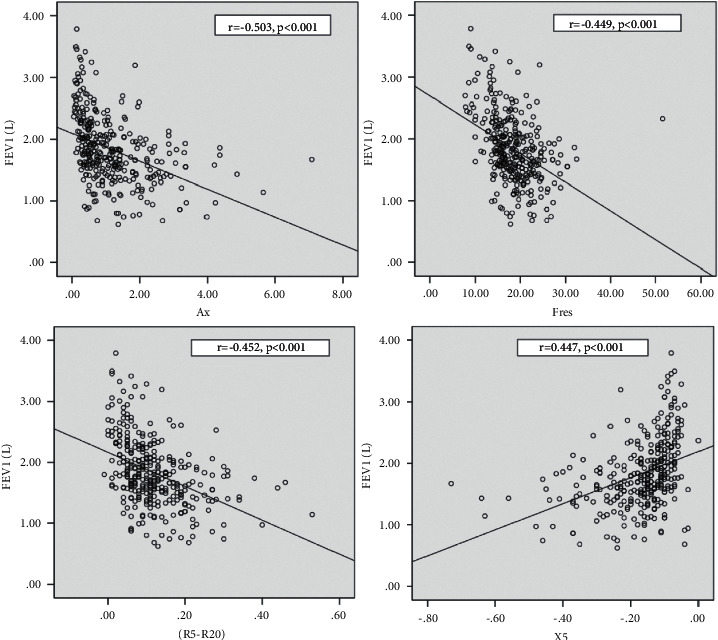
采用保留比值肺功能受损法(PRISm)评价慢性支气管炎患者肺功能受损情况。我们回顾性收集了2014年10月至2017年9月期间157例慢性支气管炎(CB)和186例慢性阻塞性肺疾病(COPD)患者的临床资料。这些患者被分为三组:对照组(肺功能正常)、PRISm组(1秒用力呼气量[FEV1]/用力肺活量[FVC]≥0.7,FEV1 p < 0.001)、最大呼气流量(MEF) 25% (p < 0.001)、MEF50% (p < 0.001)、最大呼气中流量(MMEF) 25-75% (p < 0.001)、残气量(RV)/总肺活量(TLC, p < 0.001)、FVC% (p < 0.001)、总呼吸阻力和近端呼吸阻力(R5-R20;p < 0.001)、5hz时呼吸系统电抗(X5, p < 0.001)、共振频率(Fres, p < 0.001)、电抗面积(Ax, p < 0.001)。然而,PRISm组和COPD组预测FEV1%和RV/TLC相似(p分别=0.992和0.122)。PRISm是一种非特异性肺功能模式,提示小气道功能障碍,可能增加转变为阻塞性通气功能障碍的风险。该试验注册号为ChiCTR-OCH-14004904。
Small Airway Dysfunction in Chronic Bronchitis with Preserved Pulmonary Function.
Impairment of pulmonary function was evaluated in chronic bronchitis patients with preserved ratio impaired spirometry (PRISm). We retrospectively collected clinical data from 157 chronic bronchitis (CB) and 186 chronic obstructive pulmonary disease (COPD) patients between October 2014 and September 2017. These patients were assigned to three groups: control (normal pulmonary function), PRISm (forced expiratory volume in 1 second [FEV1]/forced vital capacity [FVC] ≥ 0.7, FEV1 < 80% of predicted value), and COPD (FEV1/FVC <0.7) groups. Because small airway function was the main focus, in the COPD group, only patients in accordance with the Global Initiative for Chronic Obstructive Lung Disease (GOLD) grades 1 and 2 were included. Evaluation of pulmonary function (including impulse oscillometry) was performed and compared among these groups. Compared with the control group, the PRISm and COPD groups showed statistically significant differences in the predicted FEV1% (p < 0.001), maximal expiratory flow (MEF) 25% (p < 0.001), MEF50% (p < 0.001), maximal midexpiratory flow (MMEF) 25-75% (p < 0.001), residual volume (RV)/total lung capacity (TLC; p < 0.001), FVC% (p < 0.001), total respiratory resistance and proximal respiratory resistance (R5-R20; p < 0.001), respiratory system reactance at 5 Hz (X5; p < 0.001), resonant frequency (Fres; p < 0.001), and area of reactance (Ax; p < 0.001). However, the predicted FEV1% and RV/TLC were similar between the PRISm and COPD groups (p=0.992 and 0.122, respectively). PRISm is a nonspecific pattern of pulmonary function that indicates small airway dysfunction and may increase the risk of transformation to obstructive ventilation dysfunction. This trial is registered with ChiCTR-OCH-14004904.
期刊介绍:
Canadian Respiratory Journal is a peer-reviewed, Open Access journal that aims to provide a multidisciplinary forum for research in all areas of respiratory medicine. The journal publishes original research articles, review articles, and clinical studies related to asthma, allergy, COPD, non-invasive ventilation, therapeutic intervention, lung cancer, airway and lung infections, as well as any other respiratory diseases.




 京公网安备 11010802042870号
京ICP备2023020795号-1
京公网安备 11010802042870号
京ICP备2023020795号-1

 分享
分享
 求助内容:
求助内容: 应助结果提醒方式:
 扫码关注我们
