Alla G. Oleinik, Evgeniia I. Bondar, Andrey D. Kukhlevsky, Lubov A. Skurikhina, Natalia E. Kovpak
{"title":"亚洲东北部鲑科鲑属两种系统发育谱系的渐进杂交","authors":"Alla G. Oleinik, Evgeniia I. Bondar, Andrey D. Kukhlevsky, Lubov A. Skurikhina, Natalia E. Kovpak","doi":"10.1111/jzs.12563","DOIUrl":null,"url":null,"abstract":"<p>Many lacustrine charrs of the genus <i>Salvelinus</i> were described as separate species, and their origin and phylogenetic relationships are still under debate. In this study, we described the genetic variation of charrs from Lake Grand (Elikchan Lake Group, the mainland coast of the Sea of Okhotsk, Russia) and several locations outside of this system based on eight microsatellite (ms) loci and mitochondrial (mt) DNA control region. We tested the hypothesis of the resident charr membership to (a) the Arctic lineage of <i>Salvelinus taranetzi</i> sensu (Oleinik et al., <i>Russian Journal of Genetics</i>, 51, 2015, 55); (b) the Bering lineage of the Northern Dolly Varden <i>Salvelinus malma malma</i>; and (c) the Atlantic lineage of the Arctic charr <i>Salvelinus alpinus</i>. Analysis of phylogenetic relationships based on the mtDNA control region showed that all individuals from Lake Grand grouped with the Bering lineage. Bayesian analysis using msDNA supports the clustering together of charrs from Lake Grand and Arctic lineage, regardless of their mtDNA haplotypes. Incongruence between mtDNA and msDNA markers provided strong evidence of historical mtDNA introgression from <i>S</i>. <i>malma malma</i> to <i>S</i>. <i>taranetzi</i>. Patterns of divergence confirm a postglacial secondary contact of the representatives of Arctic and Bering lineages in the area of the Sea of Okhotsk coast and past hybridization in Lake Grand with the following features: (a) complete fixation of introgressed mtDNA of one species within populations of another and (b) absence of modern population of <i>S</i>. <i>malma malma</i> in the lake.</p>","PeriodicalId":91350,"journal":{"name":"","volume":"59 8","pages":"2119-2133"},"PeriodicalIF":0.0,"publicationDate":"2021-11-24","publicationTypes":"Journal Article","fieldsOfStudy":null,"isOpenAccess":false,"openAccessPdf":"","citationCount":"1","resultStr":"{\"title\":\"Introgressive hybridization between two phylogenetic lineages of charrs (Salvelinus: Salmonidae) in northeastern Asia\",\"authors\":\"Alla G. Oleinik, Evgeniia I. Bondar, Andrey D. Kukhlevsky, Lubov A. Skurikhina, Natalia E. Kovpak\",\"doi\":\"10.1111/jzs.12563\",\"DOIUrl\":null,\"url\":null,\"abstract\":\"<p>Many lacustrine charrs of the genus <i>Salvelinus</i> were described as separate species, and their origin and phylogenetic relationships are still under debate. In this study, we described the genetic variation of charrs from Lake Grand (Elikchan Lake Group, the mainland coast of the Sea of Okhotsk, Russia) and several locations outside of this system based on eight microsatellite (ms) loci and mitochondrial (mt) DNA control region. We tested the hypothesis of the resident charr membership to (a) the Arctic lineage of <i>Salvelinus taranetzi</i> sensu (Oleinik et al., <i>Russian Journal of Genetics</i>, 51, 2015, 55); (b) the Bering lineage of the Northern Dolly Varden <i>Salvelinus malma malma</i>; and (c) the Atlantic lineage of the Arctic charr <i>Salvelinus alpinus</i>. Analysis of phylogenetic relationships based on the mtDNA control region showed that all individuals from Lake Grand grouped with the Bering lineage. Bayesian analysis using msDNA supports the clustering together of charrs from Lake Grand and Arctic lineage, regardless of their mtDNA haplotypes. Incongruence between mtDNA and msDNA markers provided strong evidence of historical mtDNA introgression from <i>S</i>. <i>malma malma</i> to <i>S</i>. <i>taranetzi</i>. Patterns of divergence confirm a postglacial secondary contact of the representatives of Arctic and Bering lineages in the area of the Sea of Okhotsk coast and past hybridization in Lake Grand with the following features: (a) complete fixation of introgressed mtDNA of one species within populations of another and (b) absence of modern population of <i>S</i>. <i>malma malma</i> in the lake.</p>\",\"PeriodicalId\":91350,\"journal\":{\"name\":\"\",\"volume\":\"59 8\",\"pages\":\"2119-2133\"},\"PeriodicalIF\":0.0,\"publicationDate\":\"2021-11-24\",\"publicationTypes\":\"Journal Article\",\"fieldsOfStudy\":null,\"isOpenAccess\":false,\"openAccessPdf\":\"\",\"citationCount\":\"1\",\"resultStr\":null,\"platform\":\"Semanticscholar\",\"paperid\":null,\"PeriodicalName\":\"\",\"FirstCategoryId\":\"99\",\"ListUrlMain\":\"https://onlinelibrary.wiley.com/doi/10.1111/jzs.12563\",\"RegionNum\":0,\"RegionCategory\":null,\"ArticlePicture\":[],\"TitleCN\":null,\"AbstractTextCN\":null,\"PMCID\":null,\"EPubDate\":\"\",\"PubModel\":\"\",\"JCR\":\"\",\"JCRName\":\"\",\"Score\":null,\"Total\":0}","platform":"Semanticscholar","paperid":null,"PeriodicalName":"","FirstCategoryId":"99","ListUrlMain":"https://onlinelibrary.wiley.com/doi/10.1111/jzs.12563","RegionNum":0,"RegionCategory":null,"ArticlePicture":[],"TitleCN":null,"AbstractTextCN":null,"PMCID":null,"EPubDate":"","PubModel":"","JCR":"","JCRName":"","Score":null,"Total":0}
引用次数: 1
摘要
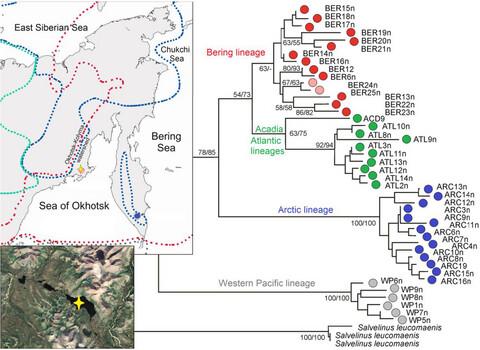
Salvelinus属的许多湖相charrs被描述为单独的物种,它们的起源和系统发育关系仍在争论中。本研究基于8个微卫星(ms)位点和线粒体(mt) DNA控制区,描述了来自大湖(俄罗斯鄂霍次克海大陆海岸的Elikchan Lake Group)和该系统外几个地点的charrs的遗传变异。我们对Salvelinus taranetzi sensu的北极谱系(Oleinik et al., Russian Journal of Genetics, 51, 2015,55)的常驻charr成员资格假设进行了检验;(b) Northern Dolly Varden Salvelinus malma malma的白令海系;(c)北极鲑(Salvelinus alpinus)的大西洋谱系。基于mtDNA控制区的系统发育关系分析表明,所有来自格兰湖的个体都属于白令世系。使用msDNA的贝叶斯分析支持来自格兰德湖和北极谱系的charr聚类,无论其mtDNA单倍型如何。mtDNA和msDNA标记之间的不一致提供了强有力的证据,证明了malma malma向S. taranetzi的mtDNA历史渗入。分化模式证实了在鄂霍次克海沿岸地区北极和白令海两种谱系的代表在冰期后的二次接触,以及在大湖中过去的杂交,具有以下特征:(a)一个物种的逐渐渗透的mtDNA完全固定在另一个物种的种群中;(b)湖中没有S. malma malma的现代种群。
Introgressive hybridization between two phylogenetic lineages of charrs (Salvelinus: Salmonidae) in northeastern Asia
Many lacustrine charrs of the genus Salvelinus were described as separate species, and their origin and phylogenetic relationships are still under debate. In this study, we described the genetic variation of charrs from Lake Grand (Elikchan Lake Group, the mainland coast of the Sea of Okhotsk, Russia) and several locations outside of this system based on eight microsatellite (ms) loci and mitochondrial (mt) DNA control region. We tested the hypothesis of the resident charr membership to (a) the Arctic lineage of Salvelinus taranetzi sensu (Oleinik et al., Russian Journal of Genetics, 51, 2015, 55); (b) the Bering lineage of the Northern Dolly Varden Salvelinus malma malma; and (c) the Atlantic lineage of the Arctic charr Salvelinus alpinus. Analysis of phylogenetic relationships based on the mtDNA control region showed that all individuals from Lake Grand grouped with the Bering lineage. Bayesian analysis using msDNA supports the clustering together of charrs from Lake Grand and Arctic lineage, regardless of their mtDNA haplotypes. Incongruence between mtDNA and msDNA markers provided strong evidence of historical mtDNA introgression from S. malma malma to S. taranetzi. Patterns of divergence confirm a postglacial secondary contact of the representatives of Arctic and Bering lineages in the area of the Sea of Okhotsk coast and past hybridization in Lake Grand with the following features: (a) complete fixation of introgressed mtDNA of one species within populations of another and (b) absence of modern population of S. malma malma in the lake.



 京公网安备 11010802042870号
京ICP备2023020795号-1
京公网安备 11010802042870号
京ICP备2023020795号-1

 分享
分享
 求助内容:
求助内容: 应助结果提醒方式:
 扫码关注我们
