{"title":"运行45年的激光量热计实现光功率标度","authors":"Matthew T Spidell, Anna K Vaskuri","doi":"10.6028/jres.126.011","DOIUrl":null,"url":null,"abstract":"<p><p>To calibrate laser power and energy meters, the National Institute of Standards and Technology (NIST) uses several detector-based realizations of the scale for optical radiant flux; these realizations are appropriate for specific laser power/energy ranges and optical coupling configurations. Calibrations from 1 µW to 2 W are currently based upon calorimeters. Validation by comparisons against other primary representations of the optical watt over the last two decades suggests the instruments operate well within their typical reported uncertainty level of 0.86 % with 95 % confidence. The dominant uncertainty contribution in the instrument is attributable to light scattered by the legacy window, which was not previously recognized. The inherent electro-optical inequivalence in the calorimeter's response was reassessed by thermal modeling to be 0.03 %. The principal contributions to the overall inequivalence were corrected, yielding a shift in scale representation under 0.2 % for typical calibrations. With updates in several uncertainty contributions resulting from this reassessment, the resulting combined expanded uncertainty (k = 2) is 0.84 %, which is essentially unchanged from the previous result provided to calibration customers.</p>","PeriodicalId":1,"journal":{"name":"Accounts of Chemical Research","volume":" ","pages":"126011"},"PeriodicalIF":17.7000,"publicationDate":"2021-06-28","publicationTypes":"Journal Article","fieldsOfStudy":null,"isOpenAccess":false,"openAccessPdf":"https://www.ncbi.nlm.nih.gov/pmc/articles/PMC10046752/pdf/","citationCount":"0","resultStr":"{\"title\":\"Optical Power Scale Realization by Laser Calorimeter after 45 Years of Operation.\",\"authors\":\"Matthew T Spidell, Anna K Vaskuri\",\"doi\":\"10.6028/jres.126.011\",\"DOIUrl\":null,\"url\":null,\"abstract\":\"<p><p>To calibrate laser power and energy meters, the National Institute of Standards and Technology (NIST) uses several detector-based realizations of the scale for optical radiant flux; these realizations are appropriate for specific laser power/energy ranges and optical coupling configurations. Calibrations from 1 µW to 2 W are currently based upon calorimeters. Validation by comparisons against other primary representations of the optical watt over the last two decades suggests the instruments operate well within their typical reported uncertainty level of 0.86 % with 95 % confidence. The dominant uncertainty contribution in the instrument is attributable to light scattered by the legacy window, which was not previously recognized. The inherent electro-optical inequivalence in the calorimeter's response was reassessed by thermal modeling to be 0.03 %. The principal contributions to the overall inequivalence were corrected, yielding a shift in scale representation under 0.2 % for typical calibrations. With updates in several uncertainty contributions resulting from this reassessment, the resulting combined expanded uncertainty (k = 2) is 0.84 %, which is essentially unchanged from the previous result provided to calibration customers.</p>\",\"PeriodicalId\":1,\"journal\":{\"name\":\"Accounts of Chemical Research\",\"volume\":\" \",\"pages\":\"126011\"},\"PeriodicalIF\":17.7000,\"publicationDate\":\"2021-06-28\",\"publicationTypes\":\"Journal Article\",\"fieldsOfStudy\":null,\"isOpenAccess\":false,\"openAccessPdf\":\"https://www.ncbi.nlm.nih.gov/pmc/articles/PMC10046752/pdf/\",\"citationCount\":\"0\",\"resultStr\":null,\"platform\":\"Semanticscholar\",\"paperid\":null,\"PeriodicalName\":\"Accounts of Chemical Research\",\"FirstCategoryId\":\"5\",\"ListUrlMain\":\"https://doi.org/10.6028/jres.126.011\",\"RegionNum\":1,\"RegionCategory\":\"化学\",\"ArticlePicture\":[],\"TitleCN\":null,\"AbstractTextCN\":null,\"PMCID\":null,\"EPubDate\":\"2021/1/1 0:00:00\",\"PubModel\":\"eCollection\",\"JCR\":\"Q1\",\"JCRName\":\"CHEMISTRY, MULTIDISCIPLINARY\",\"Score\":null,\"Total\":0}","platform":"Semanticscholar","paperid":null,"PeriodicalName":"Accounts of Chemical Research","FirstCategoryId":"5","ListUrlMain":"https://doi.org/10.6028/jres.126.011","RegionNum":1,"RegionCategory":"化学","ArticlePicture":[],"TitleCN":null,"AbstractTextCN":null,"PMCID":null,"EPubDate":"2021/1/1 0:00:00","PubModel":"eCollection","JCR":"Q1","JCRName":"CHEMISTRY, MULTIDISCIPLINARY","Score":null,"Total":0}
Optical Power Scale Realization by Laser Calorimeter after 45 Years of Operation.
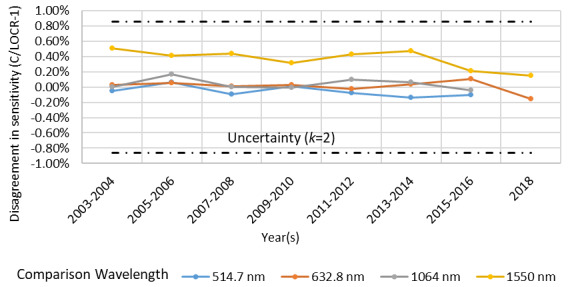
To calibrate laser power and energy meters, the National Institute of Standards and Technology (NIST) uses several detector-based realizations of the scale for optical radiant flux; these realizations are appropriate for specific laser power/energy ranges and optical coupling configurations. Calibrations from 1 µW to 2 W are currently based upon calorimeters. Validation by comparisons against other primary representations of the optical watt over the last two decades suggests the instruments operate well within their typical reported uncertainty level of 0.86 % with 95 % confidence. The dominant uncertainty contribution in the instrument is attributable to light scattered by the legacy window, which was not previously recognized. The inherent electro-optical inequivalence in the calorimeter's response was reassessed by thermal modeling to be 0.03 %. The principal contributions to the overall inequivalence were corrected, yielding a shift in scale representation under 0.2 % for typical calibrations. With updates in several uncertainty contributions resulting from this reassessment, the resulting combined expanded uncertainty (k = 2) is 0.84 %, which is essentially unchanged from the previous result provided to calibration customers.
期刊介绍:
Accounts of Chemical Research presents short, concise and critical articles offering easy-to-read overviews of basic research and applications in all areas of chemistry and biochemistry. These short reviews focus on research from the author’s own laboratory and are designed to teach the reader about a research project. In addition, Accounts of Chemical Research publishes commentaries that give an informed opinion on a current research problem. Special Issues online are devoted to a single topic of unusual activity and significance.
Accounts of Chemical Research replaces the traditional article abstract with an article "Conspectus." These entries synopsize the research affording the reader a closer look at the content and significance of an article. Through this provision of a more detailed description of the article contents, the Conspectus enhances the article's discoverability by search engines and the exposure for the research.






 京公网安备 11010802042870号
京ICP备2023020795号-1
京公网安备 11010802042870号
京ICP备2023020795号-1

 分享
分享
 求助内容:
求助内容: 应助结果提醒方式:
 扫码关注我们
