Jingxi Li , Gemeng Liang , Wei Zheng , Shilin Zhang , Kenneth Davey , Wei Kong Pang , Zaiping Guo
{"title":"解决锂离子电池层状结构阴极中的阳离子混合问题:综述","authors":"Jingxi Li , Gemeng Liang , Wei Zheng , Shilin Zhang , Kenneth Davey , Wei Kong Pang , Zaiping Guo","doi":"10.1016/j.nanoms.2022.09.001","DOIUrl":null,"url":null,"abstract":"<div><div>High-performance lithium-ion batteries (LIB) are important in powering emerging technologies. Cathodes are regarded as the bottleneck of increasing battery energy density, among which layered oxides are the most promising candidates for LIB. However, a limitation with layered oxides cathodes is the transition metal and Li site mixing, which significantly impacts battery capacity and cycling stability. Despite recent research on Li/Ni mixing, there is a lack of comprehensive understanding of the origin of cation mixing between the transition metal and Li; therefore, practical means to address it. Here, a critical review of cation mixing in layered cathodes has been provided, emphasising the understanding of cation mixing mechanisms and their impact on cathode material design. We list and compare advanced characterisation techniques to detect cation mixing in the material structure; examine methods to regulate the degree of cation mixing in layered oxides to boost battery capacity and cycling performance, and critically assess how these can be applied practically. An appraisal of future research directions, including superexchange interaction to stabilise structures and boost capacity retention has also been concluded. Findings will be of immediate benefit in the design of layered cathodes for high-performance rechargeable LIB and, therefore, of interest to researchers and manufacturers.</div></div>","PeriodicalId":33573,"journal":{"name":"Nano Materials Science","volume":"5 4","pages":"Pages 404-420"},"PeriodicalIF":17.9000,"publicationDate":"2023-12-01","publicationTypes":"Journal Article","fieldsOfStudy":null,"isOpenAccess":false,"openAccessPdf":"","citationCount":"0","resultStr":"{\"title\":\"Addressing cation mixing in layered structured cathodes for lithium-ion batteries: A critical review\",\"authors\":\"Jingxi Li , Gemeng Liang , Wei Zheng , Shilin Zhang , Kenneth Davey , Wei Kong Pang , Zaiping Guo\",\"doi\":\"10.1016/j.nanoms.2022.09.001\",\"DOIUrl\":null,\"url\":null,\"abstract\":\"<div><div>High-performance lithium-ion batteries (LIB) are important in powering emerging technologies. Cathodes are regarded as the bottleneck of increasing battery energy density, among which layered oxides are the most promising candidates for LIB. However, a limitation with layered oxides cathodes is the transition metal and Li site mixing, which significantly impacts battery capacity and cycling stability. Despite recent research on Li/Ni mixing, there is a lack of comprehensive understanding of the origin of cation mixing between the transition metal and Li; therefore, practical means to address it. Here, a critical review of cation mixing in layered cathodes has been provided, emphasising the understanding of cation mixing mechanisms and their impact on cathode material design. We list and compare advanced characterisation techniques to detect cation mixing in the material structure; examine methods to regulate the degree of cation mixing in layered oxides to boost battery capacity and cycling performance, and critically assess how these can be applied practically. An appraisal of future research directions, including superexchange interaction to stabilise structures and boost capacity retention has also been concluded. Findings will be of immediate benefit in the design of layered cathodes for high-performance rechargeable LIB and, therefore, of interest to researchers and manufacturers.</div></div>\",\"PeriodicalId\":33573,\"journal\":{\"name\":\"Nano Materials Science\",\"volume\":\"5 4\",\"pages\":\"Pages 404-420\"},\"PeriodicalIF\":17.9000,\"publicationDate\":\"2023-12-01\",\"publicationTypes\":\"Journal Article\",\"fieldsOfStudy\":null,\"isOpenAccess\":false,\"openAccessPdf\":\"\",\"citationCount\":\"0\",\"resultStr\":null,\"platform\":\"Semanticscholar\",\"paperid\":null,\"PeriodicalName\":\"Nano Materials Science\",\"FirstCategoryId\":\"1089\",\"ListUrlMain\":\"https://www.sciencedirect.com/science/article/pii/S2589965122000496\",\"RegionNum\":2,\"RegionCategory\":\"材料科学\",\"ArticlePicture\":[],\"TitleCN\":null,\"AbstractTextCN\":null,\"PMCID\":null,\"EPubDate\":\"2022/10/9 0:00:00\",\"PubModel\":\"Epub\",\"JCR\":\"Q1\",\"JCRName\":\"Engineering\",\"Score\":null,\"Total\":0}","platform":"Semanticscholar","paperid":null,"PeriodicalName":"Nano Materials Science","FirstCategoryId":"1089","ListUrlMain":"https://www.sciencedirect.com/science/article/pii/S2589965122000496","RegionNum":2,"RegionCategory":"材料科学","ArticlePicture":[],"TitleCN":null,"AbstractTextCN":null,"PMCID":null,"EPubDate":"2022/10/9 0:00:00","PubModel":"Epub","JCR":"Q1","JCRName":"Engineering","Score":null,"Total":0}
Addressing cation mixing in layered structured cathodes for lithium-ion batteries: A critical review
High-performance lithium-ion batteries (LIB) are important in powering emerging technologies. Cathodes are regarded as the bottleneck of increasing battery energy density, among which layered oxides are the most promising candidates for LIB. However, a limitation with layered oxides cathodes is the transition metal and Li site mixing, which significantly impacts battery capacity and cycling stability. Despite recent research on Li/Ni mixing, there is a lack of comprehensive understanding of the origin of cation mixing between the transition metal and Li; therefore, practical means to address it. Here, a critical review of cation mixing in layered cathodes has been provided, emphasising the understanding of cation mixing mechanisms and their impact on cathode material design. We list and compare advanced characterisation techniques to detect cation mixing in the material structure; examine methods to regulate the degree of cation mixing in layered oxides to boost battery capacity and cycling performance, and critically assess how these can be applied practically. An appraisal of future research directions, including superexchange interaction to stabilise structures and boost capacity retention has also been concluded. Findings will be of immediate benefit in the design of layered cathodes for high-performance rechargeable LIB and, therefore, of interest to researchers and manufacturers.
期刊介绍:
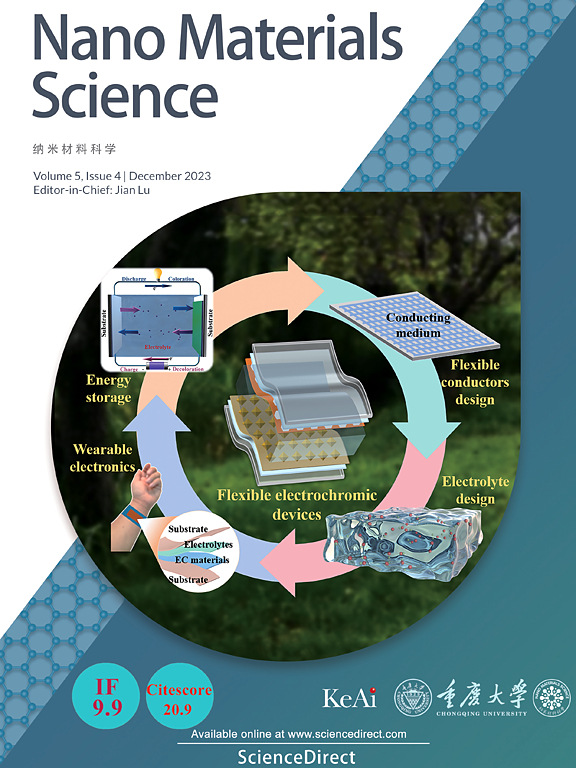
Nano Materials Science (NMS) is an international and interdisciplinary, open access, scholarly journal. NMS publishes peer-reviewed original articles and reviews on nanoscale material science and nanometer devices, with topics encompassing preparation and processing; high-throughput characterization; material performance evaluation and application of material characteristics such as the microstructure and properties of one-dimensional, two-dimensional, and three-dimensional nanostructured and nanofunctional materials; design, preparation, and processing techniques; and performance evaluation technology and nanometer device applications.




 京公网安备 11010802042870号
京ICP备2023020795号-1
京公网安备 11010802042870号
京ICP备2023020795号-1

 分享
分享
 求助内容:
求助内容: 应助结果提醒方式:
 扫码关注我们
