Pawel Rajwa, Fahad Quhal, David D'Andrea, Stephan Korn, Patrik Petrov, Takafumi Yanagisawa, Tatsushi Kawada, Reza Sari Motlagh, Hadi Mostafaei, Ekaterina Laukhtina, Abdulmajeed Aydh, Frederik König, Maximilian Pallauf, Benjamin Pradere, Peter Nyirády, Mohammad Abufaraj, Giancarlo Marra, Giorgio Gandaglia, Alberto Briganti, Pierre Karakiewicz, Ding-Wei Ye, Martin Haydter, Piotr Chlosta, Eva Comperat, Dmitry Enikeev, Shahrokh F Shariat
{"title":"阳性家族史作为非转移性前列腺癌根治性前列腺切除术后疾病结果的预测因素","authors":"Pawel Rajwa, Fahad Quhal, David D'Andrea, Stephan Korn, Patrik Petrov, Takafumi Yanagisawa, Tatsushi Kawada, Reza Sari Motlagh, Hadi Mostafaei, Ekaterina Laukhtina, Abdulmajeed Aydh, Frederik König, Maximilian Pallauf, Benjamin Pradere, Peter Nyirády, Mohammad Abufaraj, Giancarlo Marra, Giorgio Gandaglia, Alberto Briganti, Pierre Karakiewicz, Ding-Wei Ye, Martin Haydter, Piotr Chlosta, Eva Comperat, Dmitry Enikeev, Shahrokh F Shariat","doi":"10.1080/2090598X.2023.2196911","DOIUrl":null,"url":null,"abstract":"<p><strong>Background: </strong>While family history (FHx) of prostate cancer (PCa) increases the risk of PCa, comparably less is known regarding the impact of FHx on pathologic and oncologic outcomes after radical prostatectomy (RP).</p><p><strong>Methods: </strong>We retrospectively reviewed our multicenter database comprising 6,041 nonmetastatic PCa patients treated with RP. Patients with a FHx of PCa in one or more first-degree relatives were considered as FHx positive. We examined the association of FHx with pathologic outcomes and biochemical recurrence (BCR) using logistic and Cox regression models, respectively.</p><p><strong>Results: </strong>In total, 1,677 (28%) patients reported a FHx of PCa. Compared to patients without FHx, those with, were younger at RP (median age of 59 vs. 62 years, <i>p</i> < 0.01), and had significantlymore favorable biopsy and RP histopathologic findings. On multivariable logistic regression analysis, positive FHx was associated with extracapsular extension (odds ratio [OR] 0.77, 95% confidence interval [CI] 0.66-0.90, <i>p</i> < 0.01; model AUC 0.73) and upgrading (OR 0.70, 95% CI 0.62-0.80, <i>p</i> < 0.01; model AUC 0.68). Incorporating FHx significantly improved the AUC of the base model for upgrading (<i>p</i> < 0.01). Positive FHx was not associated with BCR in pre- and postoperative multivariable models (<i>p</i> = 0.1 and <i>p</i> = 0.7); c-indexes of Cox multivariable models were: 0.73 and 0.82, respectively.</p><p><strong>Conclusions: </strong>We found that patients with clinically nonmetastatic PCa who have positive FHx of PCa undergo RP at a younger age and have more favorable pathologic outcomes. Nevertheless, FHx of PCa did not confer better BCR rates, suggesting that FHx leads to potentially early detection and treatment without impact on BCR.</p>","PeriodicalId":1,"journal":{"name":"Accounts of Chemical Research","volume":" ","pages":"241-247"},"PeriodicalIF":17.7000,"publicationDate":"2023-04-03","publicationTypes":"Journal Article","fieldsOfStudy":null,"isOpenAccess":false,"openAccessPdf":"https://www.ncbi.nlm.nih.gov/pmc/articles/PMC10763581/pdf/","citationCount":"0","resultStr":"{\"title\":\"Positive family history as a predictor for disease outcomes after radical prostatectomy for nonmetastatic prostate cancer.\",\"authors\":\"Pawel Rajwa, Fahad Quhal, David D'Andrea, Stephan Korn, Patrik Petrov, Takafumi Yanagisawa, Tatsushi Kawada, Reza Sari Motlagh, Hadi Mostafaei, Ekaterina Laukhtina, Abdulmajeed Aydh, Frederik König, Maximilian Pallauf, Benjamin Pradere, Peter Nyirády, Mohammad Abufaraj, Giancarlo Marra, Giorgio Gandaglia, Alberto Briganti, Pierre Karakiewicz, Ding-Wei Ye, Martin Haydter, Piotr Chlosta, Eva Comperat, Dmitry Enikeev, Shahrokh F Shariat\",\"doi\":\"10.1080/2090598X.2023.2196911\",\"DOIUrl\":null,\"url\":null,\"abstract\":\"<p><strong>Background: </strong>While family history (FHx) of prostate cancer (PCa) increases the risk of PCa, comparably less is known regarding the impact of FHx on pathologic and oncologic outcomes after radical prostatectomy (RP).</p><p><strong>Methods: </strong>We retrospectively reviewed our multicenter database comprising 6,041 nonmetastatic PCa patients treated with RP. Patients with a FHx of PCa in one or more first-degree relatives were considered as FHx positive. We examined the association of FHx with pathologic outcomes and biochemical recurrence (BCR) using logistic and Cox regression models, respectively.</p><p><strong>Results: </strong>In total, 1,677 (28%) patients reported a FHx of PCa. Compared to patients without FHx, those with, were younger at RP (median age of 59 vs. 62 years, <i>p</i> < 0.01), and had significantlymore favorable biopsy and RP histopathologic findings. On multivariable logistic regression analysis, positive FHx was associated with extracapsular extension (odds ratio [OR] 0.77, 95% confidence interval [CI] 0.66-0.90, <i>p</i> < 0.01; model AUC 0.73) and upgrading (OR 0.70, 95% CI 0.62-0.80, <i>p</i> < 0.01; model AUC 0.68). Incorporating FHx significantly improved the AUC of the base model for upgrading (<i>p</i> < 0.01). Positive FHx was not associated with BCR in pre- and postoperative multivariable models (<i>p</i> = 0.1 and <i>p</i> = 0.7); c-indexes of Cox multivariable models were: 0.73 and 0.82, respectively.</p><p><strong>Conclusions: </strong>We found that patients with clinically nonmetastatic PCa who have positive FHx of PCa undergo RP at a younger age and have more favorable pathologic outcomes. Nevertheless, FHx of PCa did not confer better BCR rates, suggesting that FHx leads to potentially early detection and treatment without impact on BCR.</p>\",\"PeriodicalId\":1,\"journal\":{\"name\":\"Accounts of Chemical Research\",\"volume\":\" \",\"pages\":\"241-247\"},\"PeriodicalIF\":17.7000,\"publicationDate\":\"2023-04-03\",\"publicationTypes\":\"Journal Article\",\"fieldsOfStudy\":null,\"isOpenAccess\":false,\"openAccessPdf\":\"https://www.ncbi.nlm.nih.gov/pmc/articles/PMC10763581/pdf/\",\"citationCount\":\"0\",\"resultStr\":null,\"platform\":\"Semanticscholar\",\"paperid\":null,\"PeriodicalName\":\"Accounts of Chemical Research\",\"FirstCategoryId\":\"1085\",\"ListUrlMain\":\"https://doi.org/10.1080/2090598X.2023.2196911\",\"RegionNum\":1,\"RegionCategory\":\"化学\",\"ArticlePicture\":[],\"TitleCN\":null,\"AbstractTextCN\":null,\"PMCID\":null,\"EPubDate\":\"2023/1/1 0:00:00\",\"PubModel\":\"eCollection\",\"JCR\":\"Q1\",\"JCRName\":\"CHEMISTRY, MULTIDISCIPLINARY\",\"Score\":null,\"Total\":0}","platform":"Semanticscholar","paperid":null,"PeriodicalName":"Accounts of Chemical Research","FirstCategoryId":"1085","ListUrlMain":"https://doi.org/10.1080/2090598X.2023.2196911","RegionNum":1,"RegionCategory":"化学","ArticlePicture":[],"TitleCN":null,"AbstractTextCN":null,"PMCID":null,"EPubDate":"2023/1/1 0:00:00","PubModel":"eCollection","JCR":"Q1","JCRName":"CHEMISTRY, MULTIDISCIPLINARY","Score":null,"Total":0}
引用次数: 0
摘要
背景:虽然前列腺癌(PCa)家族史(FHx)会增加患 PCa 的风险,但 FHx 对根治性前列腺切除术(RP)后病理和肿瘤结果的影响却知之甚少:我们回顾性地查看了我们的多中心数据库,其中包括 6041 名接受前列腺癌根治术治疗的非转移性 PCa 患者。一名或多名直系亲属中存在 PCa FHx 的患者被视为 FHx 阳性。我们分别使用逻辑回归模型和考克斯回归模型研究了FHx与病理结果和生化复发(BCR)的关系:共有 1,677 例(28%)患者报告了 PCa 的 FHx。与无 FHx 的患者相比,有 FHx 的患者在 RP 时更年轻(中位年龄为 59 岁对 62 岁,p p p p = 0.1 和 p = 0.7);Cox 多变量模型的 c 指数分别为 0.73 和 0.82,p p p = 0.1 和 p = 0.7:结论:我们发现,FHx阳性的临床非转移性PCa患者接受RP手术的年龄更小,病理结果更佳。然而,PCa的FHx并不会带来更好的BCR率,这表明FHx可能会导致早期检测和治疗,但不会对BCR产生影响。
Positive family history as a predictor for disease outcomes after radical prostatectomy for nonmetastatic prostate cancer.
Background: While family history (FHx) of prostate cancer (PCa) increases the risk of PCa, comparably less is known regarding the impact of FHx on pathologic and oncologic outcomes after radical prostatectomy (RP).
Methods: We retrospectively reviewed our multicenter database comprising 6,041 nonmetastatic PCa patients treated with RP. Patients with a FHx of PCa in one or more first-degree relatives were considered as FHx positive. We examined the association of FHx with pathologic outcomes and biochemical recurrence (BCR) using logistic and Cox regression models, respectively.
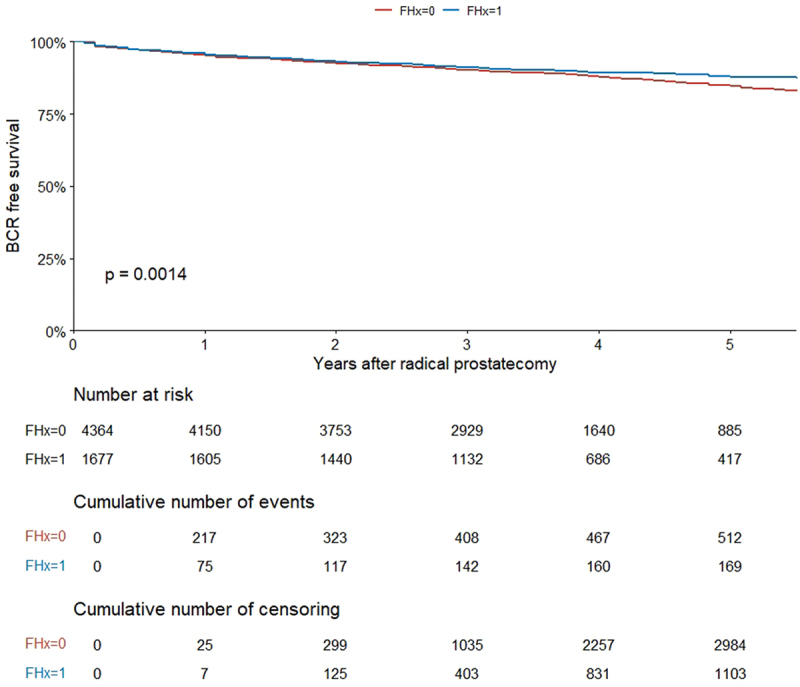
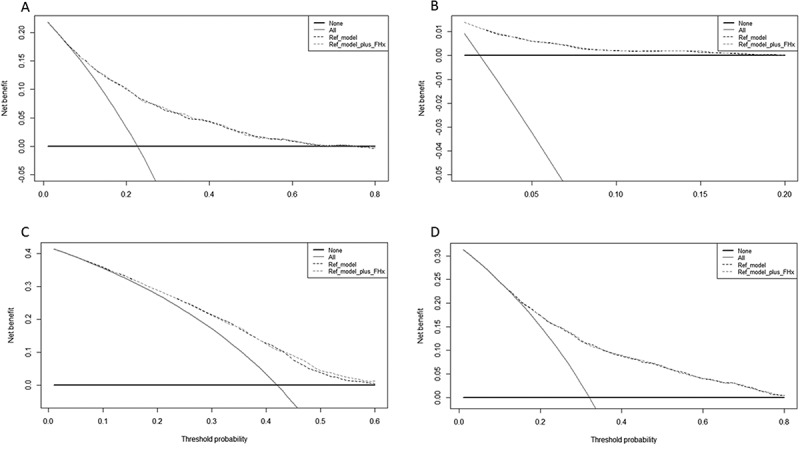
Results: In total, 1,677 (28%) patients reported a FHx of PCa. Compared to patients without FHx, those with, were younger at RP (median age of 59 vs. 62 years, p < 0.01), and had significantlymore favorable biopsy and RP histopathologic findings. On multivariable logistic regression analysis, positive FHx was associated with extracapsular extension (odds ratio [OR] 0.77, 95% confidence interval [CI] 0.66-0.90, p < 0.01; model AUC 0.73) and upgrading (OR 0.70, 95% CI 0.62-0.80, p < 0.01; model AUC 0.68). Incorporating FHx significantly improved the AUC of the base model for upgrading (p < 0.01). Positive FHx was not associated with BCR in pre- and postoperative multivariable models (p = 0.1 and p = 0.7); c-indexes of Cox multivariable models were: 0.73 and 0.82, respectively.
Conclusions: We found that patients with clinically nonmetastatic PCa who have positive FHx of PCa undergo RP at a younger age and have more favorable pathologic outcomes. Nevertheless, FHx of PCa did not confer better BCR rates, suggesting that FHx leads to potentially early detection and treatment without impact on BCR.
期刊介绍:
Accounts of Chemical Research presents short, concise and critical articles offering easy-to-read overviews of basic research and applications in all areas of chemistry and biochemistry. These short reviews focus on research from the author’s own laboratory and are designed to teach the reader about a research project. In addition, Accounts of Chemical Research publishes commentaries that give an informed opinion on a current research problem. Special Issues online are devoted to a single topic of unusual activity and significance.
Accounts of Chemical Research replaces the traditional article abstract with an article "Conspectus." These entries synopsize the research affording the reader a closer look at the content and significance of an article. Through this provision of a more detailed description of the article contents, the Conspectus enhances the article's discoverability by search engines and the exposure for the research.






 京公网安备 11010802042870号
京ICP备2023020795号-1
京公网安备 11010802042870号
京ICP备2023020795号-1

 分享
分享
 求助内容:
求助内容: 应助结果提醒方式:
 扫码关注我们
