{"title":"非洲南部莱索托不同管理下土壤有机质组分和碳分布","authors":"Maysoon M. Mikha, Makoala V. Marake","doi":"10.1002/saj2.20471","DOIUrl":null,"url":null,"abstract":"<p>Soil organic matter (SOM) is a complex mixture of multiple fractions of soil organic C (SOC) that can be influenced by management decisions. This study evaluate the effects of tillage (moldboard plow [MP] and no-tillage [NT]) and commercial fertilizer as limestone ammonium nitrate (28–0–0) at three rates (0 [0-N], 100 [100-N], and 200 [200-N] kg N ha<sup>–1</sup>) on SOC, soil total N (STN), and SOM fractions (total particulate organic matter-C [POM-C] and mineral-associated organic matter-C [MAOM-C]). The study was established in 2008 on the National University of Lesotho Campus Farm, Roma Valley of the Maseru District in Lesotho, southern Africa. The soil classified as Berea series. Soil samples were collected from 0-to-5-, 5-to-10-, 10-to-15-, and 15-to-30-cm depths. Under NT, the SOC, STN, and POM at 0-to-15-cm were 54, 47, and 40% higher than 15-to-30-cm depth, respectively. Differently, 0-to-15-cm the MP had 17, 17, 35% higher SOC, STN, and POM than 15-to-30-cm depth. The SOC in the 0-to-15-cm increased by 27% with MP and by 36% with NT at the 200-N compared with the 100-N rate. The highest N-rate (200-N) increased total POM by 28.8% for MP and 22.6% for NT than the100-N rate. The greater increase in POM under MP with high N rate was probably related to the low initial total POM, where small changes in POM will be pronounced, whereas the high total POM in NT could mask the effect the high N rate addition. The coarse and fine POM accounted for 39 and 61%, respectively, of the changes in total POM at both NT and MP. The high percentage of SOC was observed within fine POM fraction (48.4%) in MP, which makes it susceptible to wind erosion, and within MAOM fraction (48.9%) in NT practice. The C/N ratio was highest with coarse POM (C/N ≈ 25) and lowest with MAOM (C/N ≈ 7.2) at both tillage practices. The low C/N ratio made MAOMC vulnerable to microbial decomposition. These findings suggest the need for conservation efforts where conservation tillage and N rates could be used to reduce SOC and POM losses and contribute to improve land sustainability and SOM conservation.</p>","PeriodicalId":101043,"journal":{"name":"Proceedings - Soil Science Society of America","volume":"87 1","pages":"140-155"},"PeriodicalIF":0.0000,"publicationDate":"2022-08-20","publicationTypes":"Journal Article","fieldsOfStudy":null,"isOpenAccess":false,"openAccessPdf":"https://onlinelibrary.wiley.com/doi/epdf/10.1002/saj2.20471","citationCount":"0","resultStr":"{\"title\":\"Soil organic matter fractions and carbon distribution under different management in Lesotho, southern Africa\",\"authors\":\"Maysoon M. Mikha, Makoala V. Marake\",\"doi\":\"10.1002/saj2.20471\",\"DOIUrl\":null,\"url\":null,\"abstract\":\"<p>Soil organic matter (SOM) is a complex mixture of multiple fractions of soil organic C (SOC) that can be influenced by management decisions. This study evaluate the effects of tillage (moldboard plow [MP] and no-tillage [NT]) and commercial fertilizer as limestone ammonium nitrate (28–0–0) at three rates (0 [0-N], 100 [100-N], and 200 [200-N] kg N ha<sup>–1</sup>) on SOC, soil total N (STN), and SOM fractions (total particulate organic matter-C [POM-C] and mineral-associated organic matter-C [MAOM-C]). The study was established in 2008 on the National University of Lesotho Campus Farm, Roma Valley of the Maseru District in Lesotho, southern Africa. The soil classified as Berea series. Soil samples were collected from 0-to-5-, 5-to-10-, 10-to-15-, and 15-to-30-cm depths. Under NT, the SOC, STN, and POM at 0-to-15-cm were 54, 47, and 40% higher than 15-to-30-cm depth, respectively. Differently, 0-to-15-cm the MP had 17, 17, 35% higher SOC, STN, and POM than 15-to-30-cm depth. The SOC in the 0-to-15-cm increased by 27% with MP and by 36% with NT at the 200-N compared with the 100-N rate. The highest N-rate (200-N) increased total POM by 28.8% for MP and 22.6% for NT than the100-N rate. The greater increase in POM under MP with high N rate was probably related to the low initial total POM, where small changes in POM will be pronounced, whereas the high total POM in NT could mask the effect the high N rate addition. The coarse and fine POM accounted for 39 and 61%, respectively, of the changes in total POM at both NT and MP. The high percentage of SOC was observed within fine POM fraction (48.4%) in MP, which makes it susceptible to wind erosion, and within MAOM fraction (48.9%) in NT practice. The C/N ratio was highest with coarse POM (C/N ≈ 25) and lowest with MAOM (C/N ≈ 7.2) at both tillage practices. The low C/N ratio made MAOMC vulnerable to microbial decomposition. These findings suggest the need for conservation efforts where conservation tillage and N rates could be used to reduce SOC and POM losses and contribute to improve land sustainability and SOM conservation.</p>\",\"PeriodicalId\":101043,\"journal\":{\"name\":\"Proceedings - Soil Science Society of America\",\"volume\":\"87 1\",\"pages\":\"140-155\"},\"PeriodicalIF\":0.0000,\"publicationDate\":\"2022-08-20\",\"publicationTypes\":\"Journal Article\",\"fieldsOfStudy\":null,\"isOpenAccess\":false,\"openAccessPdf\":\"https://onlinelibrary.wiley.com/doi/epdf/10.1002/saj2.20471\",\"citationCount\":\"0\",\"resultStr\":null,\"platform\":\"Semanticscholar\",\"paperid\":null,\"PeriodicalName\":\"Proceedings - Soil Science Society of America\",\"FirstCategoryId\":\"1085\",\"ListUrlMain\":\"https://onlinelibrary.wiley.com/doi/10.1002/saj2.20471\",\"RegionNum\":0,\"RegionCategory\":null,\"ArticlePicture\":[],\"TitleCN\":null,\"AbstractTextCN\":null,\"PMCID\":null,\"EPubDate\":\"\",\"PubModel\":\"\",\"JCR\":\"\",\"JCRName\":\"\",\"Score\":null,\"Total\":0}","platform":"Semanticscholar","paperid":null,"PeriodicalName":"Proceedings - Soil Science Society of America","FirstCategoryId":"1085","ListUrlMain":"https://onlinelibrary.wiley.com/doi/10.1002/saj2.20471","RegionNum":0,"RegionCategory":null,"ArticlePicture":[],"TitleCN":null,"AbstractTextCN":null,"PMCID":null,"EPubDate":"","PubModel":"","JCR":"","JCRName":"","Score":null,"Total":0}
引用次数: 0
摘要
土壤有机质(SOM)是土壤有机碳(SOC)多个组分的复杂混合物,可受管理决策的影响。本研究评价了耕作(犁耕[MP]和免耕[NT])和石灰石硝酸铵(28-0-0)3种施肥水平(0 [0-N]、100 [100-N]和200 [200-N] kg N hm - 1)对土壤有机碳、土壤全氮(STN)和有机质组分(总颗粒有机质- c [POM-C]和矿物伴生有机质- c [MAOM-C])的影响。该研究于2008年在非洲南部莱索托马塞卢地区罗马山谷的莱索托国立大学校园农场开展。土壤分类为伯里亚系列。土壤样品采集深度为0 ~ 5 cm、5 ~ 10 cm、10 ~ 15 cm和15 ~ 30 cm。NT处理下,0 ~ 15 cm土壤有机碳、STN和POM分别比15 ~ 30 cm高54%、47%和40%。不同的是,0- 15厘米深度的深水区比15- 30厘米深度的深水区SOC、STN和POM分别高17%、17%和35%。与100-N处理相比,200-N处理下,MP和NT分别使0- 15 cm土壤有机碳增加27%和36%。最高施氮量(200-N)比施氮量(100- n)增加了MP的28.8%和NT的22.6%。在高施氮量的土壤中,POM的增加可能与初始总POM较低有关,初始总POM的变化较小,而NT的高总POM可以掩盖高施氮量的影响。粗POM和细POM分别占NT和MP总POM变化的39%和61%。土壤有机碳比例较高的是MP的细POM组分(48.4%),这使其容易受到风蚀,而在NT实践中,MAOM组分(48.9%)的土壤有机碳比例较高。两种耕作方式的碳氮比均以粗POM最高(C/N≈25),MAOM最低(C/N≈7.2)。低碳氮比使MAOMC易被微生物分解。这些发现表明,需要采取保护措施,通过保护性耕作和氮肥施用来减少有机碳和有机有机质的损失,并有助于提高土地的可持续性和土壤有机质的保护。
Soil organic matter fractions and carbon distribution under different management in Lesotho, southern Africa
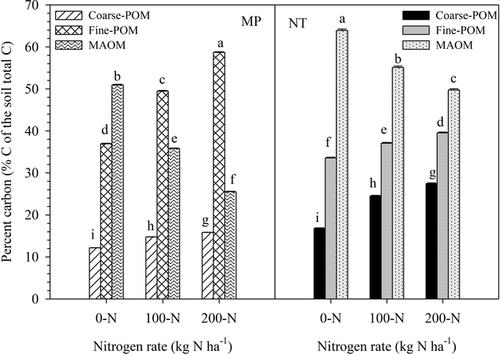
Soil organic matter (SOM) is a complex mixture of multiple fractions of soil organic C (SOC) that can be influenced by management decisions. This study evaluate the effects of tillage (moldboard plow [MP] and no-tillage [NT]) and commercial fertilizer as limestone ammonium nitrate (28–0–0) at three rates (0 [0-N], 100 [100-N], and 200 [200-N] kg N ha–1) on SOC, soil total N (STN), and SOM fractions (total particulate organic matter-C [POM-C] and mineral-associated organic matter-C [MAOM-C]). The study was established in 2008 on the National University of Lesotho Campus Farm, Roma Valley of the Maseru District in Lesotho, southern Africa. The soil classified as Berea series. Soil samples were collected from 0-to-5-, 5-to-10-, 10-to-15-, and 15-to-30-cm depths. Under NT, the SOC, STN, and POM at 0-to-15-cm were 54, 47, and 40% higher than 15-to-30-cm depth, respectively. Differently, 0-to-15-cm the MP had 17, 17, 35% higher SOC, STN, and POM than 15-to-30-cm depth. The SOC in the 0-to-15-cm increased by 27% with MP and by 36% with NT at the 200-N compared with the 100-N rate. The highest N-rate (200-N) increased total POM by 28.8% for MP and 22.6% for NT than the100-N rate. The greater increase in POM under MP with high N rate was probably related to the low initial total POM, where small changes in POM will be pronounced, whereas the high total POM in NT could mask the effect the high N rate addition. The coarse and fine POM accounted for 39 and 61%, respectively, of the changes in total POM at both NT and MP. The high percentage of SOC was observed within fine POM fraction (48.4%) in MP, which makes it susceptible to wind erosion, and within MAOM fraction (48.9%) in NT practice. The C/N ratio was highest with coarse POM (C/N ≈ 25) and lowest with MAOM (C/N ≈ 7.2) at both tillage practices. The low C/N ratio made MAOMC vulnerable to microbial decomposition. These findings suggest the need for conservation efforts where conservation tillage and N rates could be used to reduce SOC and POM losses and contribute to improve land sustainability and SOM conservation.




 京公网安备 11010802042870号
京ICP备2023020795号-1
京公网安备 11010802042870号
京ICP备2023020795号-1

 分享
分享

 求助内容:
求助内容: 应助结果提醒方式:
 扫码关注我们
