Sophie Perry, Grant Falvo, Samantha Mosier, G. Philip Robertson
{"title":"Switchgrass、原生草地和免耕玉米生物能源生产系统中土壤碳和氮组分的长期变化","authors":"Sophie Perry, Grant Falvo, Samantha Mosier, G. Philip Robertson","doi":"10.1002/saj2.20575","DOIUrl":null,"url":null,"abstract":"<p>Cellulosic bioenergy is a primary land-based climate mitigation strategy, with soil carbon (C) storage and nitrogen (N) conservation as important mitigation elements. Here, we present 13 years of soil C and N change under three cellulosic cropping systems: monoculture switchgrass (<i>Panicum virgatum</i> L.), a five native grasses polyculture, and no-till corn (<i>Zea mays</i> L.). Soil C and N fractions were measured four times over 12 years. Bulk soil C in the 0–25 cm depth at the end of the study period ranged from 28.4 (± 1.4 se) Mg C ha<sup>−1</sup> in no-till corn, to 30.8 (± 1.4) Mg C ha<sup>−1</sup> in switchgrass, and to 34.8 (± 1.4) Mg C ha<sup>−1</sup> in native grasses. Mineral-associated organic matter (MAOM) ranged from 60% to 90% and particulate organic matter (POM) from 10% to 40% of total soil C. Over 12 years, total C as well as both C fractions persisted under no-till corn and switchgrass and increased under native grasses. In contrast, POM N stocks decreased 33% to 45% across systems, whereas MAOM N decreased only in no-till corn and by less than 13%. Declining POM N stocks likely reflect pre-establishment land use, which included alfalfa and manure in earlier rotations. Root production and large soil aggregate formation explained 69% (<i>p</i> < 0.001) and 36% (<i>p</i> = 0.024) of total soil C change, respectively, and 60% (<i>p</i> = 0.020) and 41% (<i>p</i> = 0.023) of soil N change, demonstrating the importance of belowground productivity and soil aggregates for producing and protecting soil C and conserving soil N. Differences between switchgrass and native grasses also indicate a dependence on plant diversity. Soil C and N benefits of bioenergy crops depend strongly on root productivity and pre-establishment land use.</p>","PeriodicalId":101043,"journal":{"name":"Proceedings - Soil Science Society of America","volume":"87 6","pages":"1365-1375"},"PeriodicalIF":0.0000,"publicationDate":"2023-07-26","publicationTypes":"Journal Article","fieldsOfStudy":null,"isOpenAccess":false,"openAccessPdf":"https://onlinelibrary.wiley.com/doi/epdf/10.1002/saj2.20575","citationCount":"0","resultStr":"{\"title\":\"Long-term changes in soil carbon and nitrogen fractions in switchgrass, native grasses, and no-till corn bioenergy production systems\",\"authors\":\"Sophie Perry, Grant Falvo, Samantha Mosier, G. Philip Robertson\",\"doi\":\"10.1002/saj2.20575\",\"DOIUrl\":null,\"url\":null,\"abstract\":\"<p>Cellulosic bioenergy is a primary land-based climate mitigation strategy, with soil carbon (C) storage and nitrogen (N) conservation as important mitigation elements. Here, we present 13 years of soil C and N change under three cellulosic cropping systems: monoculture switchgrass (<i>Panicum virgatum</i> L.), a five native grasses polyculture, and no-till corn (<i>Zea mays</i> L.). Soil C and N fractions were measured four times over 12 years. Bulk soil C in the 0–25 cm depth at the end of the study period ranged from 28.4 (± 1.4 se) Mg C ha<sup>−1</sup> in no-till corn, to 30.8 (± 1.4) Mg C ha<sup>−1</sup> in switchgrass, and to 34.8 (± 1.4) Mg C ha<sup>−1</sup> in native grasses. Mineral-associated organic matter (MAOM) ranged from 60% to 90% and particulate organic matter (POM) from 10% to 40% of total soil C. Over 12 years, total C as well as both C fractions persisted under no-till corn and switchgrass and increased under native grasses. In contrast, POM N stocks decreased 33% to 45% across systems, whereas MAOM N decreased only in no-till corn and by less than 13%. Declining POM N stocks likely reflect pre-establishment land use, which included alfalfa and manure in earlier rotations. Root production and large soil aggregate formation explained 69% (<i>p</i> < 0.001) and 36% (<i>p</i> = 0.024) of total soil C change, respectively, and 60% (<i>p</i> = 0.020) and 41% (<i>p</i> = 0.023) of soil N change, demonstrating the importance of belowground productivity and soil aggregates for producing and protecting soil C and conserving soil N. Differences between switchgrass and native grasses also indicate a dependence on plant diversity. Soil C and N benefits of bioenergy crops depend strongly on root productivity and pre-establishment land use.</p>\",\"PeriodicalId\":101043,\"journal\":{\"name\":\"Proceedings - Soil Science Society of America\",\"volume\":\"87 6\",\"pages\":\"1365-1375\"},\"PeriodicalIF\":0.0000,\"publicationDate\":\"2023-07-26\",\"publicationTypes\":\"Journal Article\",\"fieldsOfStudy\":null,\"isOpenAccess\":false,\"openAccessPdf\":\"https://onlinelibrary.wiley.com/doi/epdf/10.1002/saj2.20575\",\"citationCount\":\"0\",\"resultStr\":null,\"platform\":\"Semanticscholar\",\"paperid\":null,\"PeriodicalName\":\"Proceedings - Soil Science Society of America\",\"FirstCategoryId\":\"1085\",\"ListUrlMain\":\"https://onlinelibrary.wiley.com/doi/10.1002/saj2.20575\",\"RegionNum\":0,\"RegionCategory\":null,\"ArticlePicture\":[],\"TitleCN\":null,\"AbstractTextCN\":null,\"PMCID\":null,\"EPubDate\":\"\",\"PubModel\":\"\",\"JCR\":\"\",\"JCRName\":\"\",\"Score\":null,\"Total\":0}","platform":"Semanticscholar","paperid":null,"PeriodicalName":"Proceedings - Soil Science Society of America","FirstCategoryId":"1085","ListUrlMain":"https://onlinelibrary.wiley.com/doi/10.1002/saj2.20575","RegionNum":0,"RegionCategory":null,"ArticlePicture":[],"TitleCN":null,"AbstractTextCN":null,"PMCID":null,"EPubDate":"","PubModel":"","JCR":"","JCRName":"","Score":null,"Total":0}
引用次数: 0
摘要
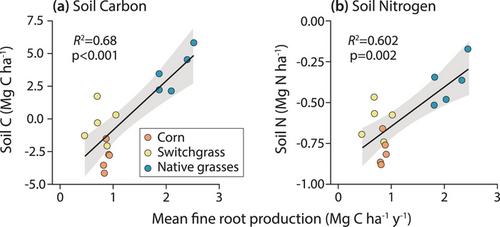
纤维素生物能源是一种主要的陆地气候缓解战略,土壤碳(C)储存和氮(N)保护是重要的缓解要素。在这里,我们展示了13年来三种纤维素种植制度下的土壤C和N的变化:单一栽培柳枝稷(Panicum virgatum L.),五种本土草混养和免耕玉米(Zea mays L.)。土壤C和N组分在12年内测量了4次。免耕玉米0 ~ 25 cm土壤C含量为28.4(±1.4 se) Mg C ha - 1,柳枝稷土壤C含量为30.8(±1.4 se) Mg C ha - 1,天然禾本科土壤C含量为34.8(±1.4 se) Mg C ha - 1。土壤中有机质(MAOM)占总碳的60% ~ 90%,颗粒有机质(POM)占总碳的10% ~ 40%。在12年的时间里,免耕玉米和柳枝稷土壤中总碳和两个组分保持不变,而原生禾本科土壤中总碳含量有所增加。相比之下,POM N库存量在各系统中下降了33%至45%,而MAOM N仅在免耕玉米中下降,下降幅度不到13%。POM N储量的下降可能反映了建立前的土地利用,其中包括早期轮作中的苜蓿和粪肥。根系生产和土壤团聚体形成解释了69% (p <;分别占土壤总碳变化的60% (p = 0.020)和41% (p = 0.023),表明地下生产力和土壤团聚体对产生和保护土壤碳和保持土壤氮的重要性。柳枝稷与原生禾草之间的差异也表明对植物多样性的依赖。生物能源作物的土壤碳氮效益在很大程度上取决于根系生产力和种植前的土地利用。
Long-term changes in soil carbon and nitrogen fractions in switchgrass, native grasses, and no-till corn bioenergy production systems
Cellulosic bioenergy is a primary land-based climate mitigation strategy, with soil carbon (C) storage and nitrogen (N) conservation as important mitigation elements. Here, we present 13 years of soil C and N change under three cellulosic cropping systems: monoculture switchgrass (Panicum virgatum L.), a five native grasses polyculture, and no-till corn (Zea mays L.). Soil C and N fractions were measured four times over 12 years. Bulk soil C in the 0–25 cm depth at the end of the study period ranged from 28.4 (± 1.4 se) Mg C ha−1 in no-till corn, to 30.8 (± 1.4) Mg C ha−1 in switchgrass, and to 34.8 (± 1.4) Mg C ha−1 in native grasses. Mineral-associated organic matter (MAOM) ranged from 60% to 90% and particulate organic matter (POM) from 10% to 40% of total soil C. Over 12 years, total C as well as both C fractions persisted under no-till corn and switchgrass and increased under native grasses. In contrast, POM N stocks decreased 33% to 45% across systems, whereas MAOM N decreased only in no-till corn and by less than 13%. Declining POM N stocks likely reflect pre-establishment land use, which included alfalfa and manure in earlier rotations. Root production and large soil aggregate formation explained 69% (p < 0.001) and 36% (p = 0.024) of total soil C change, respectively, and 60% (p = 0.020) and 41% (p = 0.023) of soil N change, demonstrating the importance of belowground productivity and soil aggregates for producing and protecting soil C and conserving soil N. Differences between switchgrass and native grasses also indicate a dependence on plant diversity. Soil C and N benefits of bioenergy crops depend strongly on root productivity and pre-establishment land use.




 京公网安备 11010802042870号
京ICP备2023020795号-1
京公网安备 11010802042870号
京ICP备2023020795号-1

 分享
分享

 求助内容:
求助内容: 应助结果提醒方式:
 扫码关注我们
