Julia Slotta-Huspenina, Kristina Schwamborn, Katja Steiger, Ricarda Simon, Florian Paul Kirchhoff, Jakob Wolf Büchler, Julia Fiedler, Margitta Retz, Roman Nawroth, Christoph Ritschel, Jürgen Erich Gschwend, Thomas Horn
{"title":"MHC I表达预测转移性尿路上皮癌对检查点抑制剂的反应,但在局限性疾病中缺乏预后价值","authors":"Julia Slotta-Huspenina, Kristina Schwamborn, Katja Steiger, Ricarda Simon, Florian Paul Kirchhoff, Jakob Wolf Büchler, Julia Fiedler, Margitta Retz, Roman Nawroth, Christoph Ritschel, Jürgen Erich Gschwend, Thomas Horn","doi":"10.3233/BLC-211604","DOIUrl":null,"url":null,"abstract":"<p><strong>Background: </strong>Loss of MHC I expression is a tumoral escape mechanism, part of the process of immunoediting. MHC expression patterns and their prognostic and predictive value have not been studied in urothelial carcinoma of the bladder (UC) so far.</p><p><strong>Objective: </strong>To correlate the expression of MHC I and MHC II with prognosis after curative treatment, response to chemotherapy and checkpoint inhibition.</p><p><strong>Patients and methods: </strong>We analyzed different patient cohorts for their expression of MHC I(HLA-A/B/C) and II (HLA-DR/DP/DQ) and examined potential correlations with prognosis and response to cisplatin-based chemotherapy or PD-1/PD-L1 directed immunotherapy.</p><p><strong>Results and limitations: </strong>Overall, MHC expression was analyzed in 246 patients, and complete MHC I loss was seen in 29.7% of patients. In 35% of patients aberrant tumoral expression of MHC II was observed. In a homogeneous cohort of 149 patients with cystectomy with curative intent there were no significant differences in survival between the MHC expression groups. MHC I+ and MHC II+ patients had higher infiltration densities with CD8+ T effector cells.An analysis of 77 additional patients (cohort II) with neoadjuvant chemotherapy revealed no associations of MHC status with response defined as < pT2 pN0 in the cystectomy specimen. Lastly, we analyzed 26 patients with metastatic disease treated with PD-1/PD-L1 directed immunotherapy (cohort III, best response: 11 PD, 5 SD, 10 OR) and observed responses exclusively in MHC I+ patients (10/19 patients, 52.6). All four MHC I+ /MHC II+ /PD-L1+ patients had a progression-free interval of at least 12 months.</p><p><strong>Conclusions: </strong>Tumoral MHC I expression is frequently lost in UC. We found no association with prognosis or response to cisplatin-based chemotherapy but response to checkpoint inhibitors was limited to MHC I+ patients.</p>","PeriodicalId":1,"journal":{"name":"Accounts of Chemical Research","volume":" ","pages":"269-276"},"PeriodicalIF":17.7000,"publicationDate":"2022-09-15","publicationTypes":"Journal Article","fieldsOfStudy":null,"isOpenAccess":false,"openAccessPdf":"https://www.ncbi.nlm.nih.gov/pmc/articles/PMC11181837/pdf/","citationCount":"0","resultStr":"{\"title\":\"MHC I Expression Predicts Response to Checkpoint Inhibitors in Metastatic Urothelial Carcinoma but Lacks Prognostic Value in Localized Disease.\",\"authors\":\"Julia Slotta-Huspenina, Kristina Schwamborn, Katja Steiger, Ricarda Simon, Florian Paul Kirchhoff, Jakob Wolf Büchler, Julia Fiedler, Margitta Retz, Roman Nawroth, Christoph Ritschel, Jürgen Erich Gschwend, Thomas Horn\",\"doi\":\"10.3233/BLC-211604\",\"DOIUrl\":null,\"url\":null,\"abstract\":\"<p><strong>Background: </strong>Loss of MHC I expression is a tumoral escape mechanism, part of the process of immunoediting. MHC expression patterns and their prognostic and predictive value have not been studied in urothelial carcinoma of the bladder (UC) so far.</p><p><strong>Objective: </strong>To correlate the expression of MHC I and MHC II with prognosis after curative treatment, response to chemotherapy and checkpoint inhibition.</p><p><strong>Patients and methods: </strong>We analyzed different patient cohorts for their expression of MHC I(HLA-A/B/C) and II (HLA-DR/DP/DQ) and examined potential correlations with prognosis and response to cisplatin-based chemotherapy or PD-1/PD-L1 directed immunotherapy.</p><p><strong>Results and limitations: </strong>Overall, MHC expression was analyzed in 246 patients, and complete MHC I loss was seen in 29.7% of patients. In 35% of patients aberrant tumoral expression of MHC II was observed. In a homogeneous cohort of 149 patients with cystectomy with curative intent there were no significant differences in survival between the MHC expression groups. MHC I+ and MHC II+ patients had higher infiltration densities with CD8+ T effector cells.An analysis of 77 additional patients (cohort II) with neoadjuvant chemotherapy revealed no associations of MHC status with response defined as < pT2 pN0 in the cystectomy specimen. Lastly, we analyzed 26 patients with metastatic disease treated with PD-1/PD-L1 directed immunotherapy (cohort III, best response: 11 PD, 5 SD, 10 OR) and observed responses exclusively in MHC I+ patients (10/19 patients, 52.6). All four MHC I+ /MHC II+ /PD-L1+ patients had a progression-free interval of at least 12 months.</p><p><strong>Conclusions: </strong>Tumoral MHC I expression is frequently lost in UC. We found no association with prognosis or response to cisplatin-based chemotherapy but response to checkpoint inhibitors was limited to MHC I+ patients.</p>\",\"PeriodicalId\":1,\"journal\":{\"name\":\"Accounts of Chemical Research\",\"volume\":\" \",\"pages\":\"269-276\"},\"PeriodicalIF\":17.7000,\"publicationDate\":\"2022-09-15\",\"publicationTypes\":\"Journal Article\",\"fieldsOfStudy\":null,\"isOpenAccess\":false,\"openAccessPdf\":\"https://www.ncbi.nlm.nih.gov/pmc/articles/PMC11181837/pdf/\",\"citationCount\":\"0\",\"resultStr\":null,\"platform\":\"Semanticscholar\",\"paperid\":null,\"PeriodicalName\":\"Accounts of Chemical Research\",\"FirstCategoryId\":\"3\",\"ListUrlMain\":\"https://doi.org/10.3233/BLC-211604\",\"RegionNum\":1,\"RegionCategory\":\"化学\",\"ArticlePicture\":[],\"TitleCN\":null,\"AbstractTextCN\":null,\"PMCID\":null,\"EPubDate\":\"2022/1/1 0:00:00\",\"PubModel\":\"eCollection\",\"JCR\":\"Q1\",\"JCRName\":\"CHEMISTRY, MULTIDISCIPLINARY\",\"Score\":null,\"Total\":0}","platform":"Semanticscholar","paperid":null,"PeriodicalName":"Accounts of Chemical Research","FirstCategoryId":"3","ListUrlMain":"https://doi.org/10.3233/BLC-211604","RegionNum":1,"RegionCategory":"化学","ArticlePicture":[],"TitleCN":null,"AbstractTextCN":null,"PMCID":null,"EPubDate":"2022/1/1 0:00:00","PubModel":"eCollection","JCR":"Q1","JCRName":"CHEMISTRY, MULTIDISCIPLINARY","Score":null,"Total":0}
MHC I Expression Predicts Response to Checkpoint Inhibitors in Metastatic Urothelial Carcinoma but Lacks Prognostic Value in Localized Disease.
Background: Loss of MHC I expression is a tumoral escape mechanism, part of the process of immunoediting. MHC expression patterns and their prognostic and predictive value have not been studied in urothelial carcinoma of the bladder (UC) so far.
Objective: To correlate the expression of MHC I and MHC II with prognosis after curative treatment, response to chemotherapy and checkpoint inhibition.
Patients and methods: We analyzed different patient cohorts for their expression of MHC I(HLA-A/B/C) and II (HLA-DR/DP/DQ) and examined potential correlations with prognosis and response to cisplatin-based chemotherapy or PD-1/PD-L1 directed immunotherapy.
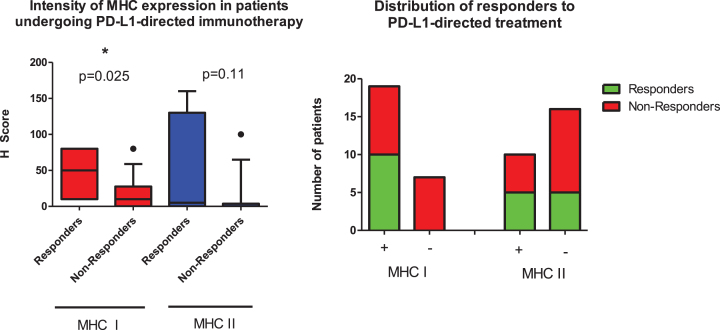
Results and limitations: Overall, MHC expression was analyzed in 246 patients, and complete MHC I loss was seen in 29.7% of patients. In 35% of patients aberrant tumoral expression of MHC II was observed. In a homogeneous cohort of 149 patients with cystectomy with curative intent there were no significant differences in survival between the MHC expression groups. MHC I+ and MHC II+ patients had higher infiltration densities with CD8+ T effector cells.An analysis of 77 additional patients (cohort II) with neoadjuvant chemotherapy revealed no associations of MHC status with response defined as < pT2 pN0 in the cystectomy specimen. Lastly, we analyzed 26 patients with metastatic disease treated with PD-1/PD-L1 directed immunotherapy (cohort III, best response: 11 PD, 5 SD, 10 OR) and observed responses exclusively in MHC I+ patients (10/19 patients, 52.6). All four MHC I+ /MHC II+ /PD-L1+ patients had a progression-free interval of at least 12 months.
Conclusions: Tumoral MHC I expression is frequently lost in UC. We found no association with prognosis or response to cisplatin-based chemotherapy but response to checkpoint inhibitors was limited to MHC I+ patients.
期刊介绍:
Accounts of Chemical Research presents short, concise and critical articles offering easy-to-read overviews of basic research and applications in all areas of chemistry and biochemistry. These short reviews focus on research from the author’s own laboratory and are designed to teach the reader about a research project. In addition, Accounts of Chemical Research publishes commentaries that give an informed opinion on a current research problem. Special Issues online are devoted to a single topic of unusual activity and significance.
Accounts of Chemical Research replaces the traditional article abstract with an article "Conspectus." These entries synopsize the research affording the reader a closer look at the content and significance of an article. Through this provision of a more detailed description of the article contents, the Conspectus enhances the article's discoverability by search engines and the exposure for the research.







 京公网安备 11010802042870号
京ICP备2023020795号-1
京公网安备 11010802042870号
京ICP备2023020795号-1

 分享
分享
 求助内容:
求助内容: 应助结果提醒方式:
 扫码关注我们
