Heather Massey, Ngianga Kandala, Candice Davis, Mark Harper, Paul Gorczynski, Hannah Denton
{"title":"开放水域新手的情绪和幸福感以及在户外游泳入门课程中的控制:一项可行性研究","authors":"Heather Massey, Ngianga Kandala, Candice Davis, Mark Harper, Paul Gorczynski, Hannah Denton","doi":"10.1002/lim2.12","DOIUrl":null,"url":null,"abstract":"<div>\n \n \n <section>\n \n <h3> Background</h3>\n \n <p>Anecdotal evidence suggests that outdoor swimming can improve mood. This feasibility study examined the mood and well-being in participants attending an outdoor swimming course.</p>\n </section>\n \n <section>\n \n <h3> Methods</h3>\n \n <p>Profile of Mood States and Short Warwick–Edinburgh Mental Well-being Scale questionnaires were completed by participants on a 10-week introductory outdoor swimming course (61 swimmers) and 22 controls who sat on the beach. Questionnaires were completed before and after three sessions: the first session (pool based), their first outdoor swim (session 4) and their final outdoor swim (session 10).</p>\n </section>\n \n <section>\n \n <h3> Results</h3>\n \n <p>Swimmers reported acute increases in positive subscales (Esteem and Vigour, <i>P </i>< .001) and reductions in negative subscales (Tension, Anger, Depression, and Confusion and Total Mood Disturbance [TMD], <i>P </i>< .001, <i>d </i>= 1.1–1.7). TMD was also reduced between sessions (<i>P </i>< .001, <i>d </i>= 0.08). Well-being also increased during the course in swimmers (<i>P </i>< .001, <i>d </i>= 3.7) and controls (<i>P </i>= .019, <i>d </i>= 0.2). Greater reductions in TMD (<i>P </i>< .001, <i>d </i>= 0.8–2.5) and increases in well-being were observed in swimmers than controls (<i>P </i>= .034, <i>r </i>= .23).</p>\n </section>\n \n <section>\n \n <h3> Conclusions</h3>\n \n <p>Novice outdoor swimmers participating in a 10-week introductory outdoor swimming course had acute and chronic reductions in negative mood, increases in well-being and acute increases in positive mood. Controls mood scores fluctuated and were similar at the start and end of the course, whereas well-being scores improved by the final session. Tension scores peaked in both swimmers and controls immediately before the first outdoor swim. Nonetheless the swimmers’ improvement in mood and well-being scores was significantly greater than that of the controls. The nature of the study does not provide mechanistic understanding; there are likely to be a number of explanations (physiological, psychological and sociological) for the changes in mood and well-being in swimmers and controls that can be investigated further.</p>\n </section>\n </div>","PeriodicalId":74076,"journal":{"name":"Lifestyle medicine (Hoboken, N.J.)","volume":"1 2","pages":""},"PeriodicalIF":0.0000,"publicationDate":"2020-11-10","publicationTypes":"Journal Article","fieldsOfStudy":null,"isOpenAccess":false,"openAccessPdf":"https://sci-hub-pdf.com/10.1002/lim2.12","citationCount":"14","resultStr":"{\"title\":\"Mood and well-being of novice open water swimmers and controls during an introductory outdoor swimming programme: A feasibility study\",\"authors\":\"Heather Massey, Ngianga Kandala, Candice Davis, Mark Harper, Paul Gorczynski, Hannah Denton\",\"doi\":\"10.1002/lim2.12\",\"DOIUrl\":null,\"url\":null,\"abstract\":\"<div>\\n \\n \\n <section>\\n \\n <h3> Background</h3>\\n \\n <p>Anecdotal evidence suggests that outdoor swimming can improve mood. This feasibility study examined the mood and well-being in participants attending an outdoor swimming course.</p>\\n </section>\\n \\n <section>\\n \\n <h3> Methods</h3>\\n \\n <p>Profile of Mood States and Short Warwick–Edinburgh Mental Well-being Scale questionnaires were completed by participants on a 10-week introductory outdoor swimming course (61 swimmers) and 22 controls who sat on the beach. Questionnaires were completed before and after three sessions: the first session (pool based), their first outdoor swim (session 4) and their final outdoor swim (session 10).</p>\\n </section>\\n \\n <section>\\n \\n <h3> Results</h3>\\n \\n <p>Swimmers reported acute increases in positive subscales (Esteem and Vigour, <i>P </i>< .001) and reductions in negative subscales (Tension, Anger, Depression, and Confusion and Total Mood Disturbance [TMD], <i>P </i>< .001, <i>d </i>= 1.1–1.7). TMD was also reduced between sessions (<i>P </i>< .001, <i>d </i>= 0.08). Well-being also increased during the course in swimmers (<i>P </i>< .001, <i>d </i>= 3.7) and controls (<i>P </i>= .019, <i>d </i>= 0.2). Greater reductions in TMD (<i>P </i>< .001, <i>d </i>= 0.8–2.5) and increases in well-being were observed in swimmers than controls (<i>P </i>= .034, <i>r </i>= .23).</p>\\n </section>\\n \\n <section>\\n \\n <h3> Conclusions</h3>\\n \\n <p>Novice outdoor swimmers participating in a 10-week introductory outdoor swimming course had acute and chronic reductions in negative mood, increases in well-being and acute increases in positive mood. Controls mood scores fluctuated and were similar at the start and end of the course, whereas well-being scores improved by the final session. Tension scores peaked in both swimmers and controls immediately before the first outdoor swim. Nonetheless the swimmers’ improvement in mood and well-being scores was significantly greater than that of the controls. The nature of the study does not provide mechanistic understanding; there are likely to be a number of explanations (physiological, psychological and sociological) for the changes in mood and well-being in swimmers and controls that can be investigated further.</p>\\n </section>\\n </div>\",\"PeriodicalId\":74076,\"journal\":{\"name\":\"Lifestyle medicine (Hoboken, N.J.)\",\"volume\":\"1 2\",\"pages\":\"\"},\"PeriodicalIF\":0.0000,\"publicationDate\":\"2020-11-10\",\"publicationTypes\":\"Journal Article\",\"fieldsOfStudy\":null,\"isOpenAccess\":false,\"openAccessPdf\":\"https://sci-hub-pdf.com/10.1002/lim2.12\",\"citationCount\":\"14\",\"resultStr\":null,\"platform\":\"Semanticscholar\",\"paperid\":null,\"PeriodicalName\":\"Lifestyle medicine (Hoboken, N.J.)\",\"FirstCategoryId\":\"1085\",\"ListUrlMain\":\"https://onlinelibrary.wiley.com/doi/10.1002/lim2.12\",\"RegionNum\":0,\"RegionCategory\":null,\"ArticlePicture\":[],\"TitleCN\":null,\"AbstractTextCN\":null,\"PMCID\":null,\"EPubDate\":\"\",\"PubModel\":\"\",\"JCR\":\"Q3\",\"JCRName\":\"Medicine\",\"Score\":null,\"Total\":0}","platform":"Semanticscholar","paperid":null,"PeriodicalName":"Lifestyle medicine (Hoboken, N.J.)","FirstCategoryId":"1085","ListUrlMain":"https://onlinelibrary.wiley.com/doi/10.1002/lim2.12","RegionNum":0,"RegionCategory":null,"ArticlePicture":[],"TitleCN":null,"AbstractTextCN":null,"PMCID":null,"EPubDate":"","PubModel":"","JCR":"Q3","JCRName":"Medicine","Score":null,"Total":0}
Mood and well-being of novice open water swimmers and controls during an introductory outdoor swimming programme: A feasibility study
Background
Anecdotal evidence suggests that outdoor swimming can improve mood. This feasibility study examined the mood and well-being in participants attending an outdoor swimming course.
Methods
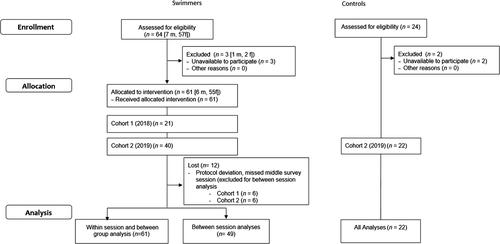
Profile of Mood States and Short Warwick–Edinburgh Mental Well-being Scale questionnaires were completed by participants on a 10-week introductory outdoor swimming course (61 swimmers) and 22 controls who sat on the beach. Questionnaires were completed before and after three sessions: the first session (pool based), their first outdoor swim (session 4) and their final outdoor swim (session 10).
Results
Swimmers reported acute increases in positive subscales (Esteem and Vigour, P < .001) and reductions in negative subscales (Tension, Anger, Depression, and Confusion and Total Mood Disturbance [TMD], P < .001, d = 1.1–1.7). TMD was also reduced between sessions (P < .001, d = 0.08). Well-being also increased during the course in swimmers (P < .001, d = 3.7) and controls (P = .019, d = 0.2). Greater reductions in TMD (P < .001, d = 0.8–2.5) and increases in well-being were observed in swimmers than controls (P = .034, r = .23).
Conclusions
Novice outdoor swimmers participating in a 10-week introductory outdoor swimming course had acute and chronic reductions in negative mood, increases in well-being and acute increases in positive mood. Controls mood scores fluctuated and were similar at the start and end of the course, whereas well-being scores improved by the final session. Tension scores peaked in both swimmers and controls immediately before the first outdoor swim. Nonetheless the swimmers’ improvement in mood and well-being scores was significantly greater than that of the controls. The nature of the study does not provide mechanistic understanding; there are likely to be a number of explanations (physiological, psychological and sociological) for the changes in mood and well-being in swimmers and controls that can be investigated further.




 京公网安备 11010802042870号
京ICP备2023020795号-1
京公网安备 11010802042870号
京ICP备2023020795号-1

 分享
分享

 求助内容:
求助内容: 应助结果提醒方式:
 扫码关注我们
