Nurose Karim, Suzanne Stone, Amber Salter, Mehari Gebreyohanns, Mark Johnson, Erica Jones
{"title":"非英语母语和机械取栓后卒中结局的差异:一项单一机构研究。","authors":"Nurose Karim, Suzanne Stone, Amber Salter, Mehari Gebreyohanns, Mark Johnson, Erica Jones","doi":"10.3389/fstro.2023.1224566","DOIUrl":null,"url":null,"abstract":"<p><strong>Background: </strong>Delays in acute treatment of ischemic stroke have been associated with worse outcomes. While having a non-English primary language has not been shown to delay receiving thrombolytic therapy, we assessed whether non-English primary language was associated with worse functional outcomes in patients receiving mechanical thrombectomy (MT).</p><p><strong>Method: </strong>This is a retrospective study of our MT database from two comprehensive stroke centers from January 2016 to May 2021. Primary endpoint was discharge modified Rankin Scale (mRS) 0-2. Differences between English primary language (EPL) and non-English primary language (nEPL) groups were evaluated using an analysis of variance (ANOVA), Kruskal-Wallis and chi square test. Multivariable logistic regression was used to evaluate EPL vs. nEPL patients using data driven models determined by stepwise selection approach.</p><p><strong>Result: </strong>We identified 276 patients receiving MT with 83% EPL and 17% nEPL patients. nEPL patients had higher mean hemoglobin A1c, were less likely to have insurance, and more likely to have symptomatic intracranial hemorrhage compared to EPL patients (Table). We observed a longer median ED arrival to groin puncture time in the nEPL group. No differences were observed in discharge or mRS 0-2 in the univariate or multivariable logistic regression.</p><p><strong>Discussion: </strong>Despite finding longer ED length of stay among nEPL patients, there was no difference between nEPL and EPL in good functional outcome rates in patients treated with MT.</p>","PeriodicalId":73108,"journal":{"name":"Frontiers in stroke","volume":"39 1","pages":"1224566"},"PeriodicalIF":1.2000,"publicationDate":"2023-07-05","publicationTypes":"Journal Article","fieldsOfStudy":null,"isOpenAccess":false,"openAccessPdf":"https://www.ncbi.nlm.nih.gov/pmc/articles/PMC12802779/pdf/","citationCount":"0","resultStr":"{\"title\":\"Non-English primary language and disparities in stroke outcomes after mechanical thrombectomy: a single institution study.\",\"authors\":\"Nurose Karim, Suzanne Stone, Amber Salter, Mehari Gebreyohanns, Mark Johnson, Erica Jones\",\"doi\":\"10.3389/fstro.2023.1224566\",\"DOIUrl\":null,\"url\":null,\"abstract\":\"<p><strong>Background: </strong>Delays in acute treatment of ischemic stroke have been associated with worse outcomes. While having a non-English primary language has not been shown to delay receiving thrombolytic therapy, we assessed whether non-English primary language was associated with worse functional outcomes in patients receiving mechanical thrombectomy (MT).</p><p><strong>Method: </strong>This is a retrospective study of our MT database from two comprehensive stroke centers from January 2016 to May 2021. Primary endpoint was discharge modified Rankin Scale (mRS) 0-2. Differences between English primary language (EPL) and non-English primary language (nEPL) groups were evaluated using an analysis of variance (ANOVA), Kruskal-Wallis and chi square test. Multivariable logistic regression was used to evaluate EPL vs. nEPL patients using data driven models determined by stepwise selection approach.</p><p><strong>Result: </strong>We identified 276 patients receiving MT with 83% EPL and 17% nEPL patients. nEPL patients had higher mean hemoglobin A1c, were less likely to have insurance, and more likely to have symptomatic intracranial hemorrhage compared to EPL patients (Table). We observed a longer median ED arrival to groin puncture time in the nEPL group. No differences were observed in discharge or mRS 0-2 in the univariate or multivariable logistic regression.</p><p><strong>Discussion: </strong>Despite finding longer ED length of stay among nEPL patients, there was no difference between nEPL and EPL in good functional outcome rates in patients treated with MT.</p>\",\"PeriodicalId\":73108,\"journal\":{\"name\":\"Frontiers in stroke\",\"volume\":\"39 1\",\"pages\":\"1224566\"},\"PeriodicalIF\":1.2000,\"publicationDate\":\"2023-07-05\",\"publicationTypes\":\"Journal Article\",\"fieldsOfStudy\":null,\"isOpenAccess\":false,\"openAccessPdf\":\"https://www.ncbi.nlm.nih.gov/pmc/articles/PMC12802779/pdf/\",\"citationCount\":\"0\",\"resultStr\":null,\"platform\":\"Semanticscholar\",\"paperid\":null,\"PeriodicalName\":\"Frontiers in stroke\",\"FirstCategoryId\":\"1085\",\"ListUrlMain\":\"https://doi.org/10.3389/fstro.2023.1224566\",\"RegionNum\":0,\"RegionCategory\":null,\"ArticlePicture\":[],\"TitleCN\":null,\"AbstractTextCN\":null,\"PMCID\":null,\"EPubDate\":\"2023/1/1 0:00:00\",\"PubModel\":\"eCollection\",\"JCR\":\"\",\"JCRName\":\"\",\"Score\":null,\"Total\":0}","platform":"Semanticscholar","paperid":null,"PeriodicalName":"Frontiers in stroke","FirstCategoryId":"1085","ListUrlMain":"https://doi.org/10.3389/fstro.2023.1224566","RegionNum":0,"RegionCategory":null,"ArticlePicture":[],"TitleCN":null,"AbstractTextCN":null,"PMCID":null,"EPubDate":"2023/1/1 0:00:00","PubModel":"eCollection","JCR":"","JCRName":"","Score":null,"Total":0}
Non-English primary language and disparities in stroke outcomes after mechanical thrombectomy: a single institution study.
Background: Delays in acute treatment of ischemic stroke have been associated with worse outcomes. While having a non-English primary language has not been shown to delay receiving thrombolytic therapy, we assessed whether non-English primary language was associated with worse functional outcomes in patients receiving mechanical thrombectomy (MT).
Method: This is a retrospective study of our MT database from two comprehensive stroke centers from January 2016 to May 2021. Primary endpoint was discharge modified Rankin Scale (mRS) 0-2. Differences between English primary language (EPL) and non-English primary language (nEPL) groups were evaluated using an analysis of variance (ANOVA), Kruskal-Wallis and chi square test. Multivariable logistic regression was used to evaluate EPL vs. nEPL patients using data driven models determined by stepwise selection approach.
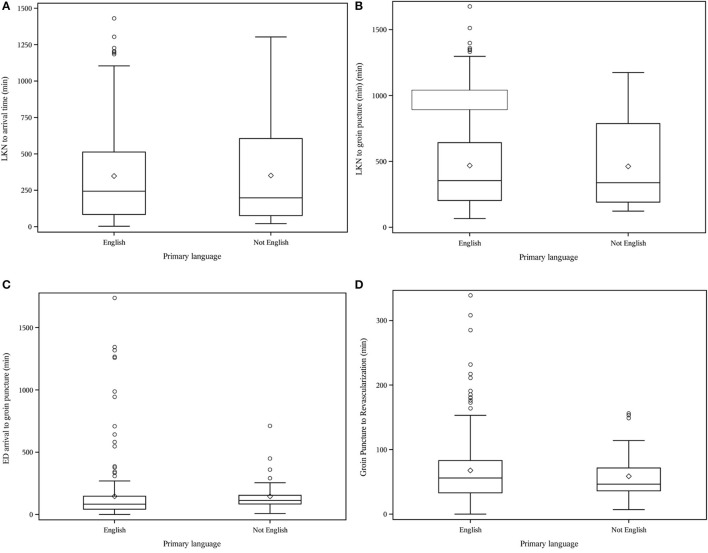
Result: We identified 276 patients receiving MT with 83% EPL and 17% nEPL patients. nEPL patients had higher mean hemoglobin A1c, were less likely to have insurance, and more likely to have symptomatic intracranial hemorrhage compared to EPL patients (Table). We observed a longer median ED arrival to groin puncture time in the nEPL group. No differences were observed in discharge or mRS 0-2 in the univariate or multivariable logistic regression.
Discussion: Despite finding longer ED length of stay among nEPL patients, there was no difference between nEPL and EPL in good functional outcome rates in patients treated with MT.




 京公网安备 11010802042870号
京ICP备2023020795号-1
京公网安备 11010802042870号
京ICP备2023020795号-1

 分享
分享

 求助内容:
求助内容: 应助结果提醒方式:
 扫码关注我们
