Sergio Machado, Leandro de Oliveira Sant'Ana, Bruno Travassos, Diogo Monteiro
{"title":"阳极经颅直流电刺激减少竞争焦虑和调节心率变异性在电子竞技选手。","authors":"Sergio Machado, Leandro de Oliveira Sant'Ana, Bruno Travassos, Diogo Monteiro","doi":"10.2174/17450179-v18-e2209270","DOIUrl":null,"url":null,"abstract":"<p><p>Previous research has recently shown that high cognitive and somatic anxiety and low self-confidence, before and during sport competitions have a significant correlation with heart rate variability (HRV) changes and can reduce overall athletic performance. Therefore, interventions, such as transcranial direct current stimulation (tDCS), can be a potential tool to reduce psychophysiological anxiety-related and enhance athletic performance. We present a case of a male professional athlete of eSports. We explored the effects of a single session of anodal tDCS (a-tDCS) at 2mA over the dosrsolateral prefrontal cortex (DLPFC) on competitive anxiety and HRV assessed in baseline (BL), pre-tDCS, post-tDCS and post-game moments and compared between moments. Here, we found a decrease in somatic and cognitive anxiety, as well as an increase in self-confidence and in SDNN index in the post-tDCS moment compared with BL, pre-tDCS and post-game moments. These findings can be a result of an acute change in the attentional state, influencing the processing of threatening information essential for cognitive anxiety and of a self-regulatory process, which can regulate physiological arousal response, such as HRV.</p>","PeriodicalId":72621,"journal":{"name":"","volume":"18 ","pages":"e174501792209270"},"PeriodicalIF":0.0,"publicationDate":"2022-01-01","publicationTypes":"Journal Article","fieldsOfStudy":null,"isOpenAccess":false,"openAccessPdf":"https://www.ncbi.nlm.nih.gov/pmc/articles/PMC10156019/pdf/","citationCount":"9","resultStr":"{\"title\":\"Anodal Transcranial Direct Current Stimulation Reduces Competitive Anxiety and Modulates Heart Rate Variability in an eSports Player.\",\"authors\":\"Sergio Machado, Leandro de Oliveira Sant'Ana, Bruno Travassos, Diogo Monteiro\",\"doi\":\"10.2174/17450179-v18-e2209270\",\"DOIUrl\":null,\"url\":null,\"abstract\":\"<p><p>Previous research has recently shown that high cognitive and somatic anxiety and low self-confidence, before and during sport competitions have a significant correlation with heart rate variability (HRV) changes and can reduce overall athletic performance. Therefore, interventions, such as transcranial direct current stimulation (tDCS), can be a potential tool to reduce psychophysiological anxiety-related and enhance athletic performance. We present a case of a male professional athlete of eSports. We explored the effects of a single session of anodal tDCS (a-tDCS) at 2mA over the dosrsolateral prefrontal cortex (DLPFC) on competitive anxiety and HRV assessed in baseline (BL), pre-tDCS, post-tDCS and post-game moments and compared between moments. Here, we found a decrease in somatic and cognitive anxiety, as well as an increase in self-confidence and in SDNN index in the post-tDCS moment compared with BL, pre-tDCS and post-game moments. These findings can be a result of an acute change in the attentional state, influencing the processing of threatening information essential for cognitive anxiety and of a self-regulatory process, which can regulate physiological arousal response, such as HRV.</p>\",\"PeriodicalId\":72621,\"journal\":{\"name\":\"\",\"volume\":\"18 \",\"pages\":\"e174501792209270\"},\"PeriodicalIF\":0.0,\"publicationDate\":\"2022-01-01\",\"publicationTypes\":\"Journal Article\",\"fieldsOfStudy\":null,\"isOpenAccess\":false,\"openAccessPdf\":\"https://www.ncbi.nlm.nih.gov/pmc/articles/PMC10156019/pdf/\",\"citationCount\":\"9\",\"resultStr\":null,\"platform\":\"Semanticscholar\",\"paperid\":null,\"PeriodicalName\":\"\",\"FirstCategoryId\":\"1085\",\"ListUrlMain\":\"https://doi.org/10.2174/17450179-v18-e2209270\",\"RegionNum\":0,\"RegionCategory\":null,\"ArticlePicture\":[],\"TitleCN\":null,\"AbstractTextCN\":null,\"PMCID\":null,\"EPubDate\":\"\",\"PubModel\":\"\",\"JCR\":\"\",\"JCRName\":\"\",\"Score\":null,\"Total\":0}","platform":"Semanticscholar","paperid":null,"PeriodicalName":"","FirstCategoryId":"1085","ListUrlMain":"https://doi.org/10.2174/17450179-v18-e2209270","RegionNum":0,"RegionCategory":null,"ArticlePicture":[],"TitleCN":null,"AbstractTextCN":null,"PMCID":null,"EPubDate":"","PubModel":"","JCR":"","JCRName":"","Score":null,"Total":0}
Anodal Transcranial Direct Current Stimulation Reduces Competitive Anxiety and Modulates Heart Rate Variability in an eSports Player.
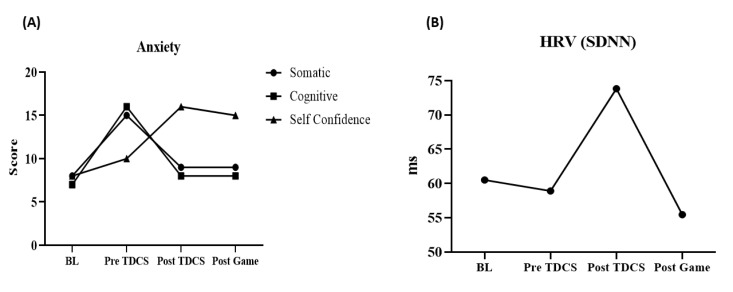
Previous research has recently shown that high cognitive and somatic anxiety and low self-confidence, before and during sport competitions have a significant correlation with heart rate variability (HRV) changes and can reduce overall athletic performance. Therefore, interventions, such as transcranial direct current stimulation (tDCS), can be a potential tool to reduce psychophysiological anxiety-related and enhance athletic performance. We present a case of a male professional athlete of eSports. We explored the effects of a single session of anodal tDCS (a-tDCS) at 2mA over the dosrsolateral prefrontal cortex (DLPFC) on competitive anxiety and HRV assessed in baseline (BL), pre-tDCS, post-tDCS and post-game moments and compared between moments. Here, we found a decrease in somatic and cognitive anxiety, as well as an increase in self-confidence and in SDNN index in the post-tDCS moment compared with BL, pre-tDCS and post-game moments. These findings can be a result of an acute change in the attentional state, influencing the processing of threatening information essential for cognitive anxiety and of a self-regulatory process, which can regulate physiological arousal response, such as HRV.



 京公网安备 11010802042870号
京ICP备2023020795号-1
京公网安备 11010802042870号
京ICP备2023020795号-1

 分享
分享
 求助内容:
求助内容: 应助结果提醒方式:
 扫码关注我们
