{"title":"Eggshell spots are an important cue for the egg retrieval behavior in two tit species","authors":"Jianping Liu, Laikun Ma, Xiwen Yang, Bin Li, Xingyu Wang, Wei Liang","doi":"10.1007/s10071-023-01814-w","DOIUrl":null,"url":null,"abstract":"<div><p>It is a common occurrence for incubating female ground- or cavity-nesting birds to accidentally roll their own eggs out of the nest cup. To correctly roll eggs that are not in the nest cup back to the nest, birds must be able to discriminate between their eggs and things around their nests that could be easily confused for their eggs (e.g., egg-shaped stones or other birds’ eggs). Moreover, there may be a strong interaction between egg retrieval and egg rejection behaviors in the context of avian brood parasitism where recognition and rejection of alien eggs is an effective means for hosts to defend against cuckoo parasitism. It has been shown that green-backed tits (<i>Parus monticolus</i>) and Japanese tits (<i>P. minor</i>) in China have strong egg recognition ability and are able to reject nonmimetic eggs in the nest. Eggshell spots play an essential role in the egg rejection behavior of these two tit hosts. This study investigated the egg retrieval behavior of green-backed tits and Japanese tits by adding one experimental egg to the nest corner to explore whether eggshell spots also play a role in the process of egg retrieval. The results revealed significant differences in the retrieval rates of white-rumped munia (<i>Lonchura striata</i>) eggs painted with spots, Japanese tits’ own true eggs, and unpainted, pure white-white-rumped munia eggs. The retrieval rate of white-white-rumped munia eggs was significantly lower than that of spotted white-rumped munia eggs and Japanese tits’ own spotted eggs. For green-backed tits, the retrieval rate of spotted white-rumped munia eggs in the nest corner was significantly higher than that of pure white-white-rumped munia eggs, while the rejection rate of spotted white-rumped munia eggs was significantly lower than that of pure white-white-rumped munia eggs. These findings indicate that eggshell spots play a key role in the egg retrieval of green-backed tits and Japanese tits.</p></div>","PeriodicalId":7879,"journal":{"name":"Animal Cognition","volume":"26 5","pages":"1697 - 1703"},"PeriodicalIF":2.1000,"publicationDate":"2023-07-27","publicationTypes":"Journal Article","fieldsOfStudy":null,"isOpenAccess":false,"openAccessPdf":"https://link.springer.com/content/pdf/10.1007/s10071-023-01814-w.pdf","citationCount":"0","resultStr":null,"platform":"Semanticscholar","paperid":null,"PeriodicalName":"Animal Cognition","FirstCategoryId":"99","ListUrlMain":"https://link.springer.com/article/10.1007/s10071-023-01814-w","RegionNum":2,"RegionCategory":"生物学","ArticlePicture":[],"TitleCN":null,"AbstractTextCN":null,"PMCID":null,"EPubDate":"","PubModel":"","JCR":"Q3","JCRName":"BEHAVIORAL SCIENCES","Score":null,"Total":0}
引用次数: 0
Abstract
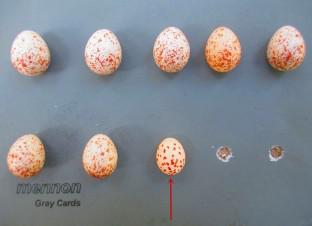
It is a common occurrence for incubating female ground- or cavity-nesting birds to accidentally roll their own eggs out of the nest cup. To correctly roll eggs that are not in the nest cup back to the nest, birds must be able to discriminate between their eggs and things around their nests that could be easily confused for their eggs (e.g., egg-shaped stones or other birds’ eggs). Moreover, there may be a strong interaction between egg retrieval and egg rejection behaviors in the context of avian brood parasitism where recognition and rejection of alien eggs is an effective means for hosts to defend against cuckoo parasitism. It has been shown that green-backed tits (Parus monticolus) and Japanese tits (P. minor) in China have strong egg recognition ability and are able to reject nonmimetic eggs in the nest. Eggshell spots play an essential role in the egg rejection behavior of these two tit hosts. This study investigated the egg retrieval behavior of green-backed tits and Japanese tits by adding one experimental egg to the nest corner to explore whether eggshell spots also play a role in the process of egg retrieval. The results revealed significant differences in the retrieval rates of white-rumped munia (Lonchura striata) eggs painted with spots, Japanese tits’ own true eggs, and unpainted, pure white-white-rumped munia eggs. The retrieval rate of white-white-rumped munia eggs was significantly lower than that of spotted white-rumped munia eggs and Japanese tits’ own spotted eggs. For green-backed tits, the retrieval rate of spotted white-rumped munia eggs in the nest corner was significantly higher than that of pure white-white-rumped munia eggs, while the rejection rate of spotted white-rumped munia eggs was significantly lower than that of pure white-white-rumped munia eggs. These findings indicate that eggshell spots play a key role in the egg retrieval of green-backed tits and Japanese tits.
期刊介绍:
Animal Cognition is an interdisciplinary journal offering current research from many disciplines (ethology, behavioral ecology, animal behavior and learning, cognitive sciences, comparative psychology and evolutionary psychology) on all aspects of animal (and human) cognition in an evolutionary framework.
Animal Cognition publishes original empirical and theoretical work, reviews, methods papers, short communications and correspondence on the mechanisms and evolution of biologically rooted cognitive-intellectual structures.
The journal explores animal time perception and use; causality detection; innate reaction patterns and innate bases of learning; numerical competence and frequency expectancies; symbol use; communication; problem solving, animal thinking and use of tools, and the modularity of the mind.



 京公网安备 11010802042870号
京ICP备2023020795号-1
京公网安备 11010802042870号
京ICP备2023020795号-1

 分享
分享
 求助内容:
求助内容: 应助结果提醒方式:
 扫码关注我们
