{"title":"Local adaptation to aridity in a widely distributed angiosperm tree species is mediated by seasonal increase of sugars and reduced growth.","authors":"Frida I Piper, Alex Fajardo","doi":"10.1093/treephys/tpad078","DOIUrl":null,"url":null,"abstract":"<p><p>Trees in dry climates often have higher concentrations of total non-structural carbohydrates (NSC = starch + soluble sugars [SS]) and grow less than conspecifics in more humid climates. This pattern might result from the growth being more constrained by aridity than the carbon (C) gain, or reflect local adaptation to aridity, since NSC fuel metabolism and ensure adequate osmoregulation through the supply of SS, while low growth reduces water and C demands. It has been further proposed that C allocation to storage could come at the expense of growth (i.e., a growth-storage trade-off). We examined whether NSC and growth reflect the local adaptation to aridity in Embothrium coccineum J. R. Forst & G. Forst. (Proteaceae), a species with an exceptionally wide niche. To control for any influence of phenotypic plasticity on NSC and growth, we collected seeds from dry (46° 16'S, 71° 55'W, 500 mm year-1) and moist (45° 24'S, 72° 40'W, >2500 mm year-1) climates and grew seedlings in a common garden experiment for 3 years. We then compared the NSC and SS concentrations and pools (i.e., total contents) and the biomass of seedlings at spring, summer and fall. Seedlings from the dry climate had significantly lower biomass and similar NSC concentrations and pools as seedlings from moist climate, suggesting that reduced growth in arid environments does not result from a prioritization of C allocation to storage but that it confers advantages under aridity (e.g., lower transpiration area). Across organs, starch and NSC decreased similarly in seedlings from both climates from spring onward. However, root and stem SS concentrations increased during the growing season, and these increases were significantly higher in seedlings from the dry climate. The greater SS accumulation in seedlings from the dry climate compared with those from the moist climate demonstrates ecotypic differentiation in the seasonal dynamics of SS, suggesting that SS underlie local adaptation to aridity.</p>","PeriodicalId":23286,"journal":{"name":"Tree physiology","volume":" ","pages":"134-144"},"PeriodicalIF":3.7000,"publicationDate":"2024-12-25","publicationTypes":"Journal Article","fieldsOfStudy":null,"isOpenAccess":false,"openAccessPdf":"https://www.ncbi.nlm.nih.gov/pmc/articles/PMC11898622/pdf/","citationCount":"0","resultStr":null,"platform":"Semanticscholar","paperid":null,"PeriodicalName":"Tree physiology","FirstCategoryId":"97","ListUrlMain":"https://doi.org/10.1093/treephys/tpad078","RegionNum":2,"RegionCategory":"农林科学","ArticlePicture":[],"TitleCN":null,"AbstractTextCN":null,"PMCID":null,"EPubDate":"","PubModel":"","JCR":"Q1","JCRName":"FORESTRY","Score":null,"Total":0}
引用次数: 0
Abstract
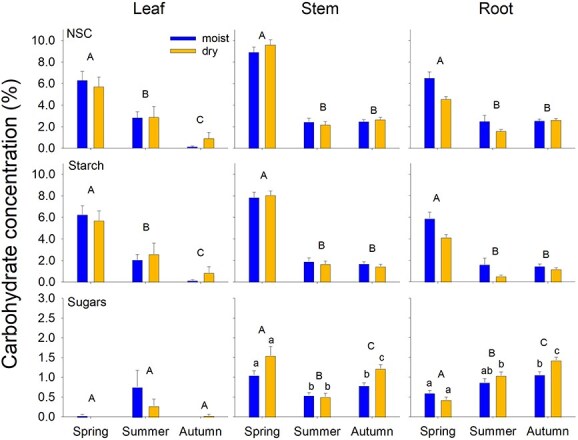
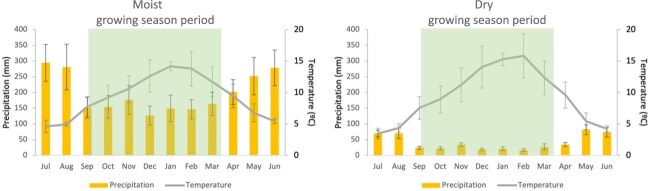
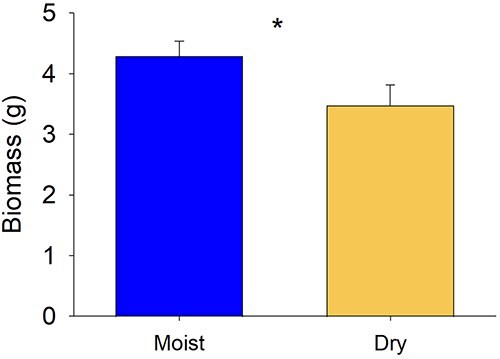
Trees in dry climates often have higher concentrations of total non-structural carbohydrates (NSC = starch + soluble sugars [SS]) and grow less than conspecifics in more humid climates. This pattern might result from the growth being more constrained by aridity than the carbon (C) gain, or reflect local adaptation to aridity, since NSC fuel metabolism and ensure adequate osmoregulation through the supply of SS, while low growth reduces water and C demands. It has been further proposed that C allocation to storage could come at the expense of growth (i.e., a growth-storage trade-off). We examined whether NSC and growth reflect the local adaptation to aridity in Embothrium coccineum J. R. Forst & G. Forst. (Proteaceae), a species with an exceptionally wide niche. To control for any influence of phenotypic plasticity on NSC and growth, we collected seeds from dry (46° 16'S, 71° 55'W, 500 mm year-1) and moist (45° 24'S, 72° 40'W, >2500 mm year-1) climates and grew seedlings in a common garden experiment for 3 years. We then compared the NSC and SS concentrations and pools (i.e., total contents) and the biomass of seedlings at spring, summer and fall. Seedlings from the dry climate had significantly lower biomass and similar NSC concentrations and pools as seedlings from moist climate, suggesting that reduced growth in arid environments does not result from a prioritization of C allocation to storage but that it confers advantages under aridity (e.g., lower transpiration area). Across organs, starch and NSC decreased similarly in seedlings from both climates from spring onward. However, root and stem SS concentrations increased during the growing season, and these increases were significantly higher in seedlings from the dry climate. The greater SS accumulation in seedlings from the dry climate compared with those from the moist climate demonstrates ecotypic differentiation in the seasonal dynamics of SS, suggesting that SS underlie local adaptation to aridity.
干燥气候下的树木通常具有较高浓度的总非结构性碳水化合物(NSC =淀粉+可溶性糖[SS]),而在潮湿气候下的树木生长较少。这种模式可能是由于干旱对生长的限制大于碳(C)增益,或者反映了局部对干旱的适应,因为NSC促进代谢并通过SS供应确保充分的渗透调节,而低生长减少了水和C的需求。有人进一步提出,对存储的C分配可能以牺牲增长为代价(即增长与存储之间的权衡)。我们研究了栓皮栎(Embothrium coccineum J. R. Forst & G. Forst)的NSC和生长是否反映了对干旱的局部适应。(变形科),具有特别宽的生态位的一种。为了控制表型可塑性对NSC和生长的任何影响,我们收集了干燥(46°16'S, 71°55'W, 500 mm -1)和潮湿(45°24'S, 72°40'W, bb0 2500 mm -1)气候下的种子,并在一个普通的花园实验中种植了3年的幼苗。然后,我们比较了春、夏、秋三个季节幼苗的NSC和SS浓度、库(即总含量)和生物量。与湿润气候下的幼苗相比,干燥气候下的幼苗的生物量明显较低,NSC浓度和库也相似,这表明干旱环境下的生长减少不是由于碳优先分配给储存的结果,而是在干旱条件下(例如,蒸腾面积较低)具有优势。从春季开始,在两种气候下的幼苗中,淀粉和NSC在各个器官中都有相似的下降。然而,根和茎的SS浓度在生长季节增加,并且在干燥气候下的幼苗中增加明显更高。干燥气候下的幼苗比湿润气候下的幼苗积累更多的SS,这表明SS在季节动态上存在生态型差异,表明SS是局部适应干旱的基础。
期刊介绍:
Tree Physiology promotes research in a framework of hierarchically organized systems, measuring insight by the ability to link adjacent layers: thus, investigated tree physiology phenomenon should seek mechanistic explanation in finer-scale phenomena as well as seek significance in larger scale phenomena (Passioura 1979). A phenomenon not linked downscale is merely descriptive; an observation not linked upscale, might be trivial. Physiologists often refer qualitatively to processes at finer or coarser scale than the scale of their observation, and studies formally directed at three, or even two adjacent scales are rare. To emphasize the importance of relating mechanisms to coarser scale function, Tree Physiology will highlight papers doing so particularly well as feature papers.



 京公网安备 11010802042870号
京ICP备2023020795号-1
京公网安备 11010802042870号
京ICP备2023020795号-1

 分享
分享
 求助内容:
求助内容: 应助结果提醒方式:
 扫码关注我们
