Xiaonan Wang , Fanfan Guo , Yi Zhang , Ziyi Wang , Jiaqi Wang , Rongrong Luo , Xiao Chu , Yongxing Zhao , Pengchao Sun
{"title":"Dual-targeting inhibition of TNFR1 for alleviating rheumatoid arthritis by a novel composite nucleic acid nanodrug","authors":"Xiaonan Wang , Fanfan Guo , Yi Zhang , Ziyi Wang , Jiaqi Wang , Rongrong Luo , Xiao Chu , Yongxing Zhao , Pengchao Sun","doi":"10.1016/j.ijpx.2023.100162","DOIUrl":null,"url":null,"abstract":"<div><p>Selective suppression of tumor necrosis factor (TNF) α-TNF receptor 1 (TNFR1) signaling is a potent solution for rheumatoid arthritis (RA). Herein, novel composite nucleic acid nanodrugs that simultaneously restrain TNF α binding and TNFR1 multimerization were designed to reinforce inhibition of TNF α-TNFR1 signaling for RA therapy. Towards this end, a novel peptide Pep4‐19 that suppresses TNFR1 clustering was extracted from TNFR1. The resulting peptide and a DNA aptamer Apt2‐55, which inhibits TNF α binding, were integrally or separately anchored on DNA tetrahedron (TD) to obtain nanodrugs with different spatial distribution of Apt2‐55 and Pep4‐19 (TD-3A-3P and TD-3(A-P)). Our results showed that Pep4‐19 enhanced the viability of inflammatory L929 cells. Both TD-3A-3P and TD-3(A-P) suppressed caspase 3, reduced cell apoptosis, and inhibited FLS-RA migration. Compared to TD-3(A-P), TD-3A-3P supplied sufficient flexibility for Apt2‐55 and Pep4‐19, and showed better anti-inflammation properties. Furthermore, TD-3A-3P significantly relieved symptoms in collagen-induced arthritis (CIA) mice, and the anti-RA efficacy through intravenous injection was comparable to transdermal administration <em>via</em> microneedles. Overall, the work provides an effective strategy for RA treatment by dual-targeting TNFR1, and demonstrates that microneedles are promising approach to drug administration in the treatment of RA.</p></div>","PeriodicalId":14280,"journal":{"name":"International Journal of Pharmaceutics: X","volume":"5 ","pages":"Article 100162"},"PeriodicalIF":6.4000,"publicationDate":"2023-01-10","publicationTypes":"Journal Article","fieldsOfStudy":null,"isOpenAccess":false,"openAccessPdf":"https://ftp.ncbi.nlm.nih.gov/pub/pmc/oa_pdf/1f/3d/main.PMC10314200.pdf","citationCount":"1","resultStr":null,"platform":"Semanticscholar","paperid":null,"PeriodicalName":"International Journal of Pharmaceutics: X","FirstCategoryId":"3","ListUrlMain":"https://www.sciencedirect.com/science/article/pii/S2590156723000063","RegionNum":2,"RegionCategory":"医学","ArticlePicture":[],"TitleCN":null,"AbstractTextCN":null,"PMCID":null,"EPubDate":"","PubModel":"","JCR":"Q1","JCRName":"PHARMACOLOGY & PHARMACY","Score":null,"Total":0}
引用次数: 1
Abstract
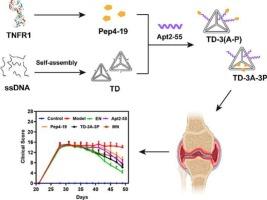
Selective suppression of tumor necrosis factor (TNF) α-TNF receptor 1 (TNFR1) signaling is a potent solution for rheumatoid arthritis (RA). Herein, novel composite nucleic acid nanodrugs that simultaneously restrain TNF α binding and TNFR1 multimerization were designed to reinforce inhibition of TNF α-TNFR1 signaling for RA therapy. Towards this end, a novel peptide Pep4‐19 that suppresses TNFR1 clustering was extracted from TNFR1. The resulting peptide and a DNA aptamer Apt2‐55, which inhibits TNF α binding, were integrally or separately anchored on DNA tetrahedron (TD) to obtain nanodrugs with different spatial distribution of Apt2‐55 and Pep4‐19 (TD-3A-3P and TD-3(A-P)). Our results showed that Pep4‐19 enhanced the viability of inflammatory L929 cells. Both TD-3A-3P and TD-3(A-P) suppressed caspase 3, reduced cell apoptosis, and inhibited FLS-RA migration. Compared to TD-3(A-P), TD-3A-3P supplied sufficient flexibility for Apt2‐55 and Pep4‐19, and showed better anti-inflammation properties. Furthermore, TD-3A-3P significantly relieved symptoms in collagen-induced arthritis (CIA) mice, and the anti-RA efficacy through intravenous injection was comparable to transdermal administration via microneedles. Overall, the work provides an effective strategy for RA treatment by dual-targeting TNFR1, and demonstrates that microneedles are promising approach to drug administration in the treatment of RA.
期刊介绍:
International Journal of Pharmaceutics: X offers authors with high-quality research who want to publish in a gold open access journal the opportunity to make their work immediately, permanently, and freely accessible.
International Journal of Pharmaceutics: X authors will pay an article publishing charge (APC), have a choice of license options, and retain copyright. Please check the APC here. The journal is indexed in SCOPUS, PUBMED, PMC and DOAJ.
The International Journal of Pharmaceutics is the second most cited journal in the "Pharmacy & Pharmacology" category out of 358 journals, being the true home for pharmaceutical scientists concerned with the physical, chemical and biological properties of devices and delivery systems for drugs, vaccines and biologicals, including their design, manufacture and evaluation. This includes evaluation of the properties of drugs, excipients such as surfactants and polymers and novel materials. The journal has special sections on pharmaceutical nanotechnology and personalized medicines, and publishes research papers, reviews, commentaries and letters to the editor as well as special issues.



 京公网安备 11010802042870号
京ICP备2023020795号-1
京公网安备 11010802042870号
京ICP备2023020795号-1

 分享
分享
 求助内容:
求助内容: 应助结果提醒方式:
 扫码关注我们
