Neil Dallaway, Sam Lucas, Joseph Marks, Christopher Ring
{"title":"Prior brain endurance training improves endurance exercise performance","authors":"Neil Dallaway, Sam Lucas, Joseph Marks, Christopher Ring","doi":"10.1080/17461391.2022.2153231","DOIUrl":null,"url":null,"abstract":"<div>\n \n <p>Mental fatigue (MF) impairs endurance exercise performance. Brain endurance training (BET) describes the systematic repetition of mentally-fatiguing cognitive tasks designed to build resilience to MF and improve endurance performance. Evidence to date shows that mental training <i>during</i> physical training can benefit post-training exercise performance, however, this concurrent BET approach may not be practical for all settings. Therefore, the current study evaluated the effects of mental training <i>before</i> physical training (<i>prior BET</i>) on exercise performance. A randomised control trial design: pre-test, training (BET, control), post-test. During the pre-test and post-test sessions, participants performed a 5-min rhythmic handgrip task requiring the generation of as much force as possible, a 20-min 2-back working memory task, and another 5-min rhythmic handgrip task. Participants were randomly assigned to a BET (<i>n</i> = 12) or control group (<i>n</i> = 12). Both groups completed the same submaximal rhythmic handgrip training for five weeks (four sessions per week). The BET group also completed 20-min cognitive training (2-back working memory task, incongruent colour-word Stroop task) before each submaximal exercise training session. Endurance performance improved more (<i>p</i> < 0.05) following BET (24%) than physical training alone (12%). Compared to the control group, the BET group showed higher prefrontal oxygenation during the post-test exercise tasks (<i>p</i> < 0.05). Both groups were characterised by the same exertion, motivation, heart rate, and heart rate variability. Mental training before physical training improves endurance performance greater than physical training alone. The benefits of p<i>rior BET</i> may be explained, at least in part, by improved prefrontal oxygenation.</p>\n </div>","PeriodicalId":93999,"journal":{"name":"European journal of sport science","volume":"23 7","pages":"1269-1278"},"PeriodicalIF":3.0000,"publicationDate":"2023-02-05","publicationTypes":"Journal Article","fieldsOfStudy":null,"isOpenAccess":false,"openAccessPdf":"https://onlinelibrary.wiley.com/doi/epdf/10.1080/17461391.2022.2153231","citationCount":"0","resultStr":null,"platform":"Semanticscholar","paperid":null,"PeriodicalName":"European journal of sport science","FirstCategoryId":"1085","ListUrlMain":"https://onlinelibrary.wiley.com/doi/10.1080/17461391.2022.2153231","RegionNum":0,"RegionCategory":null,"ArticlePicture":[],"TitleCN":null,"AbstractTextCN":null,"PMCID":null,"EPubDate":"","PubModel":"","JCR":"","JCRName":"","Score":null,"Total":0}
引用次数: 0
Abstract
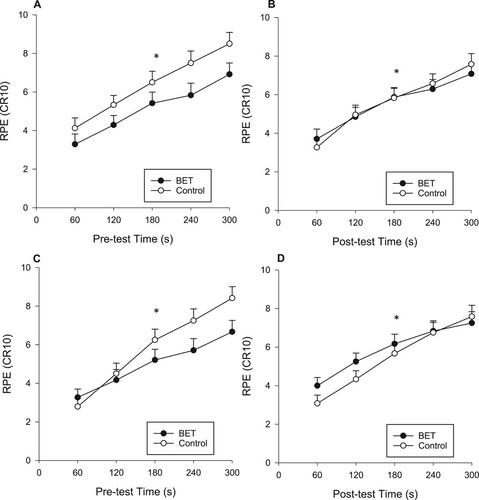
Mental fatigue (MF) impairs endurance exercise performance. Brain endurance training (BET) describes the systematic repetition of mentally-fatiguing cognitive tasks designed to build resilience to MF and improve endurance performance. Evidence to date shows that mental training during physical training can benefit post-training exercise performance, however, this concurrent BET approach may not be practical for all settings. Therefore, the current study evaluated the effects of mental training before physical training (prior BET) on exercise performance. A randomised control trial design: pre-test, training (BET, control), post-test. During the pre-test and post-test sessions, participants performed a 5-min rhythmic handgrip task requiring the generation of as much force as possible, a 20-min 2-back working memory task, and another 5-min rhythmic handgrip task. Participants were randomly assigned to a BET (n = 12) or control group (n = 12). Both groups completed the same submaximal rhythmic handgrip training for five weeks (four sessions per week). The BET group also completed 20-min cognitive training (2-back working memory task, incongruent colour-word Stroop task) before each submaximal exercise training session. Endurance performance improved more (p < 0.05) following BET (24%) than physical training alone (12%). Compared to the control group, the BET group showed higher prefrontal oxygenation during the post-test exercise tasks (p < 0.05). Both groups were characterised by the same exertion, motivation, heart rate, and heart rate variability. Mental training before physical training improves endurance performance greater than physical training alone. The benefits of prior BET may be explained, at least in part, by improved prefrontal oxygenation.



 京公网安备 11010802042870号
京ICP备2023020795号-1
京公网安备 11010802042870号
京ICP备2023020795号-1

 分享
分享

 求助内容:
求助内容: 应助结果提醒方式:
 扫码关注我们
