{"title":"Tailored ASD destabilization - Balancing shelf life stability and dissolution performance with hydroxypropyl cellulose","authors":"Christian Luebbert , Edmont Stoyanov","doi":"10.1016/j.ijpx.2023.100187","DOIUrl":null,"url":null,"abstract":"<div><p>Amorphous solid dispersion (ASD) formulations are preferred enabling formulations for poorly water soluble active pharmaceutical ingredients (API) as they reliably enhance the dissolution behavior and solubility. Balancing a high stability against unwanted transformations such as crystallization and amorphous phase separation during storage on the one hand and optimizing the dissolution behavior of the formulation (high supersaturation and maintenance for long time) on the other hand are essential during formulation development. This study assessed the potential of ternary ASDs (one API and two polymers) <em>co</em>ntaining the polymers hydroxypropyl cellulose together with poly(vinylpyrrolidone-co-vinyl acetate) (PVP VA64) or hydroxypropyl cellulose acetate succinate to stabilize the amorphously embedded APIs fenofibrate and simvastatin during storage and to enhance the dissolution performance. Thermodynamic predictions using the PC-SAFT model revealed for each combination of polymers the optimal polymer ratio, maximum API load that is thermodynamically stable as well as miscibility of the two polymers. The stability predictions were validated by three months enduring stability tests, followed by a characterization of the dissolution behavior. The thermodynamically most stable ASDs were found to be the ASDs with deteriorated dissolution performance. Within the investigated polymer combinations, physical stability and dissolution performance opposed each other.</p></div>","PeriodicalId":14280,"journal":{"name":"International Journal of Pharmaceutics: X","volume":"5 ","pages":"Article 100187"},"PeriodicalIF":6.4000,"publicationDate":"2023-06-07","publicationTypes":"Journal Article","fieldsOfStudy":null,"isOpenAccess":false,"openAccessPdf":"https://ftp.ncbi.nlm.nih.gov/pub/pmc/oa_pdf/d8/f9/main.PMC10314205.pdf","citationCount":"0","resultStr":null,"platform":"Semanticscholar","paperid":null,"PeriodicalName":"International Journal of Pharmaceutics: X","FirstCategoryId":"3","ListUrlMain":"https://www.sciencedirect.com/science/article/pii/S2590156723000312","RegionNum":2,"RegionCategory":"医学","ArticlePicture":[],"TitleCN":null,"AbstractTextCN":null,"PMCID":null,"EPubDate":"","PubModel":"","JCR":"Q1","JCRName":"PHARMACOLOGY & PHARMACY","Score":null,"Total":0}
引用次数: 0
Abstract
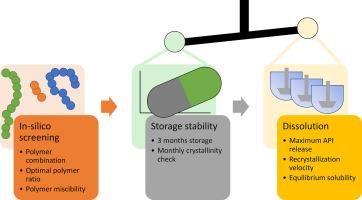
Amorphous solid dispersion (ASD) formulations are preferred enabling formulations for poorly water soluble active pharmaceutical ingredients (API) as they reliably enhance the dissolution behavior and solubility. Balancing a high stability against unwanted transformations such as crystallization and amorphous phase separation during storage on the one hand and optimizing the dissolution behavior of the formulation (high supersaturation and maintenance for long time) on the other hand are essential during formulation development. This study assessed the potential of ternary ASDs (one API and two polymers) containing the polymers hydroxypropyl cellulose together with poly(vinylpyrrolidone-co-vinyl acetate) (PVP VA64) or hydroxypropyl cellulose acetate succinate to stabilize the amorphously embedded APIs fenofibrate and simvastatin during storage and to enhance the dissolution performance. Thermodynamic predictions using the PC-SAFT model revealed for each combination of polymers the optimal polymer ratio, maximum API load that is thermodynamically stable as well as miscibility of the two polymers. The stability predictions were validated by three months enduring stability tests, followed by a characterization of the dissolution behavior. The thermodynamically most stable ASDs were found to be the ASDs with deteriorated dissolution performance. Within the investigated polymer combinations, physical stability and dissolution performance opposed each other.
期刊介绍:
International Journal of Pharmaceutics: X offers authors with high-quality research who want to publish in a gold open access journal the opportunity to make their work immediately, permanently, and freely accessible.
International Journal of Pharmaceutics: X authors will pay an article publishing charge (APC), have a choice of license options, and retain copyright. Please check the APC here. The journal is indexed in SCOPUS, PUBMED, PMC and DOAJ.
The International Journal of Pharmaceutics is the second most cited journal in the "Pharmacy & Pharmacology" category out of 358 journals, being the true home for pharmaceutical scientists concerned with the physical, chemical and biological properties of devices and delivery systems for drugs, vaccines and biologicals, including their design, manufacture and evaluation. This includes evaluation of the properties of drugs, excipients such as surfactants and polymers and novel materials. The journal has special sections on pharmaceutical nanotechnology and personalized medicines, and publishes research papers, reviews, commentaries and letters to the editor as well as special issues.