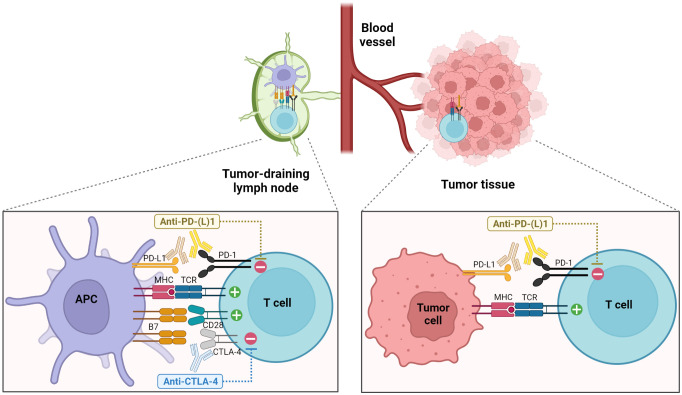
{"title":"Mechanisms underlying response and resistance to immune checkpoint blockade in cancer immunotherapy.","authors":"Junghwa Lee, Eui Ho Kim","doi":"10.3389/fonc.2023.1233376","DOIUrl":null,"url":null,"abstract":"<p><p>Cancer immunotherapies targeting immune checkpoint pathways, such as programmed cell death-1 (PD-1)/programmed cell death ligand-1 (PD-L1) and cytotoxic T-lymphocyte-associated antigen-4 (CTLA-4), have achieved unprecedented therapeutic success in treating various types of cancer. The prominent and persistent clinical responses to immune checkpoint blockade (ICB) therapy are currently constrained to a subset of patients. Owing to discrete individual tumor and immune heterogeneity, most patients fail to benefit from ICB treatment, demonstrating either primary or acquired resistance. A thorough comprehension of the mechanisms restricting the efficacy of immune checkpoint inhibitors (ICIs) is required to extend their clinical applicability to a broader spectrum of patients and cancer types. Numerous studies are presently investigating potential prognostic markers of responsiveness, the complex dynamics underlying the therapeutic and adverse effects of ICB, and tumor immune evasion throughout the course of immunotherapy. In this article, we have reviewed the extant literature elucidating the mechanisms underlying the response and resistance to ICB, with a particular emphasis on PD-1 and CTLA-4 pathway blockade in the context of anti-tumor immunity. Furthermore, we aimed to explore potential approaches to overcome cancer therapeutic resistance and develop a rational design for more personalized ICB-based combinational regimens.</p>","PeriodicalId":12482,"journal":{"name":"Frontiers in Oncology","volume":"13 ","pages":"1233376"},"PeriodicalIF":3.5000,"publicationDate":"2023-01-01","publicationTypes":"Journal Article","fieldsOfStudy":null,"isOpenAccess":false,"openAccessPdf":"https://www.ncbi.nlm.nih.gov/pmc/articles/PMC10443702/pdf/","citationCount":"3","resultStr":null,"platform":"Semanticscholar","paperid":null,"PeriodicalName":"Frontiers in Oncology","FirstCategoryId":"3","ListUrlMain":"https://doi.org/10.3389/fonc.2023.1233376","RegionNum":3,"RegionCategory":"医学","ArticlePicture":[],"TitleCN":null,"AbstractTextCN":null,"PMCID":null,"EPubDate":"","PubModel":"","JCR":"Q2","JCRName":"ONCOLOGY","Score":null,"Total":0}
引用次数: 3
Abstract
Cancer immunotherapies targeting immune checkpoint pathways, such as programmed cell death-1 (PD-1)/programmed cell death ligand-1 (PD-L1) and cytotoxic T-lymphocyte-associated antigen-4 (CTLA-4), have achieved unprecedented therapeutic success in treating various types of cancer. The prominent and persistent clinical responses to immune checkpoint blockade (ICB) therapy are currently constrained to a subset of patients. Owing to discrete individual tumor and immune heterogeneity, most patients fail to benefit from ICB treatment, demonstrating either primary or acquired resistance. A thorough comprehension of the mechanisms restricting the efficacy of immune checkpoint inhibitors (ICIs) is required to extend their clinical applicability to a broader spectrum of patients and cancer types. Numerous studies are presently investigating potential prognostic markers of responsiveness, the complex dynamics underlying the therapeutic and adverse effects of ICB, and tumor immune evasion throughout the course of immunotherapy. In this article, we have reviewed the extant literature elucidating the mechanisms underlying the response and resistance to ICB, with a particular emphasis on PD-1 and CTLA-4 pathway blockade in the context of anti-tumor immunity. Furthermore, we aimed to explore potential approaches to overcome cancer therapeutic resistance and develop a rational design for more personalized ICB-based combinational regimens.
期刊介绍:
Cancer Imaging and Diagnosis is dedicated to the publication of results from clinical and research studies applied to cancer diagnosis and treatment. The section aims to publish studies from the entire field of cancer imaging: results from routine use of clinical imaging in both radiology and nuclear medicine, results from clinical trials, experimental molecular imaging in humans and small animals, research on new contrast agents in CT, MRI, ultrasound, publication of new technical applications and processing algorithms to improve the standardization of quantitative imaging and image guided interventions for the diagnosis and treatment of cancer.



 京公网安备 11010802042870号
京ICP备2023020795号-1
京公网安备 11010802042870号
京ICP备2023020795号-1

 分享
分享
 求助内容:
求助内容: 应助结果提醒方式:
 扫码关注我们
