Kexin Xu , Zhuoyan Li , Jianchao Qiao , Senzheng Wang , Pinpeng Xie , Zhiqiang Zong , Chengyang Hu
{"title":"Persistent organic pollutants exposure and risk of autism spectrum disorders: A systematic review and meta-analysis","authors":"Kexin Xu , Zhuoyan Li , Jianchao Qiao , Senzheng Wang , Pinpeng Xie , Zhiqiang Zong , Chengyang Hu","doi":"10.1016/j.envpol.2023.122439","DOIUrl":null,"url":null,"abstract":"<div><p><span>Accumulating number of epidemiological studies has recently proposed that improvement in the risk of autism spectrum disorders (ASD) is associated with persistent organic pollutants (POPs) exposure. However, evidence from current researches is limited and inconsistent. Thus, we conducted a systematic review and meta-analysis to investigate the potential associations comprehensively. We systematically and extensively searched two electronic databases (PubMed and EMBASE) from inception to July 3, 2022 and an updated search was performed before submission. Summary odds ratios (ORs) and 95% confidence intervals (CIs) were derived from stratified random-effects meta-analyses by type of exposure and outcome. We also tested the potential heterogeneity across studies, conducted sensitivity analysis and evaluated publication bias. A total of 20 studies were finally included in our study. Meta-analytical effect estimates indicated a positive association between prenatal exposure to PCB-138, PCB-153 and PCB-170 and an increased risk of ASD, with OR of 1.89 (95% CI = 1.21–2.95, I</span><sup>2</sup> = 0%), 1.61 (95% CI = 1.05–2.47, I<sup>2</sup> = 0%) and 1.46 (95% CI = 1.03–2.06, I<sup>2</sup> = 0%) respectively. In contrast, PFDA was found inversely associated with the risk of ASD (OR = 0.70, 95% CI = 0.52–0.94, I<sup>2</sup> = 0%). The level of evidence supporting a link between ASD risk and exposure to PCB-138, PCB-153, PCB-170, and PFDA was respectively categorized as low, low, moderate, and low. In summary, this systematic review and meta-analysis suggest that exposure to PCB-138, PCB-153, and PCB-170 correlates with a heightened risk of ASD, with evidence levels rated as “low”, “low”, and “moderate”, respectively. In contrast, PFDA exposure appears to be inversely associated with ASD risk, with a “low” level of supporting evidence. However, due to the limited number of studies available for each exposure and outcome pairing, these results should be interpreted with caution. Sufficiently powered studies are needed to validate our findings.</p></div>","PeriodicalId":311,"journal":{"name":"Environmental Pollution","volume":"336 ","pages":"Article 122439"},"PeriodicalIF":7.3000,"publicationDate":"2023-11-01","publicationTypes":"Journal Article","fieldsOfStudy":null,"isOpenAccess":false,"openAccessPdf":"","citationCount":"0","resultStr":null,"platform":"Semanticscholar","paperid":null,"PeriodicalName":"Environmental Pollution","FirstCategoryId":"93","ListUrlMain":"https://www.sciencedirect.com/science/article/pii/S0269749123014410","RegionNum":2,"RegionCategory":"环境科学与生态学","ArticlePicture":[],"TitleCN":null,"AbstractTextCN":null,"PMCID":null,"EPubDate":"","PubModel":"","JCR":"Q1","JCRName":"ENVIRONMENTAL SCIENCES","Score":null,"Total":0}
引用次数: 0
Abstract
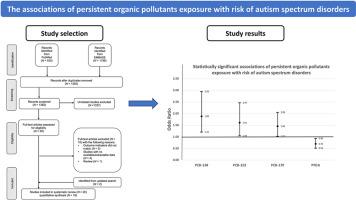
Accumulating number of epidemiological studies has recently proposed that improvement in the risk of autism spectrum disorders (ASD) is associated with persistent organic pollutants (POPs) exposure. However, evidence from current researches is limited and inconsistent. Thus, we conducted a systematic review and meta-analysis to investigate the potential associations comprehensively. We systematically and extensively searched two electronic databases (PubMed and EMBASE) from inception to July 3, 2022 and an updated search was performed before submission. Summary odds ratios (ORs) and 95% confidence intervals (CIs) were derived from stratified random-effects meta-analyses by type of exposure and outcome. We also tested the potential heterogeneity across studies, conducted sensitivity analysis and evaluated publication bias. A total of 20 studies were finally included in our study. Meta-analytical effect estimates indicated a positive association between prenatal exposure to PCB-138, PCB-153 and PCB-170 and an increased risk of ASD, with OR of 1.89 (95% CI = 1.21–2.95, I2 = 0%), 1.61 (95% CI = 1.05–2.47, I2 = 0%) and 1.46 (95% CI = 1.03–2.06, I2 = 0%) respectively. In contrast, PFDA was found inversely associated with the risk of ASD (OR = 0.70, 95% CI = 0.52–0.94, I2 = 0%). The level of evidence supporting a link between ASD risk and exposure to PCB-138, PCB-153, PCB-170, and PFDA was respectively categorized as low, low, moderate, and low. In summary, this systematic review and meta-analysis suggest that exposure to PCB-138, PCB-153, and PCB-170 correlates with a heightened risk of ASD, with evidence levels rated as “low”, “low”, and “moderate”, respectively. In contrast, PFDA exposure appears to be inversely associated with ASD risk, with a “low” level of supporting evidence. However, due to the limited number of studies available for each exposure and outcome pairing, these results should be interpreted with caution. Sufficiently powered studies are needed to validate our findings.
期刊介绍:
Environmental Pollution is an international peer-reviewed journal that publishes high-quality research papers and review articles covering all aspects of environmental pollution and its impacts on ecosystems and human health.
Subject areas include, but are not limited to:
• Sources and occurrences of pollutants that are clearly defined and measured in environmental compartments, food and food-related items, and human bodies;
• Interlinks between contaminant exposure and biological, ecological, and human health effects, including those of climate change;
• Contaminants of emerging concerns (including but not limited to antibiotic resistant microorganisms or genes, microplastics/nanoplastics, electronic wastes, light, and noise) and/or their biological, ecological, or human health effects;
• Laboratory and field studies on the remediation/mitigation of environmental pollution via new techniques and with clear links to biological, ecological, or human health effects;
• Modeling of pollution processes, patterns, or trends that is of clear environmental and/or human health interest;
• New techniques that measure and examine environmental occurrences, transport, behavior, and effects of pollutants within the environment or the laboratory, provided that they can be clearly used to address problems within regional or global environmental compartments.



 京公网安备 11010802042870号
京ICP备2023020795号-1
京公网安备 11010802042870号
京ICP备2023020795号-1

 分享
分享
 求助内容:
求助内容: 应助结果提醒方式:
 扫码关注我们
