Muyun Li, Wen Fang, Ruilin Meng, Jianxiong Hu, Guanhao He, Zhulin Hou, Maigeng Zhou, Chunliang Zhou, Sui Zhu, Yize Xiao, Min Yu, Biao Huang, Xiaojun Xu, Lifeng Lin, Donghui Jin, Mingfang Qin, Peng Yin, Yiqing Xu, Tao Liu, Wenjun Ma
{"title":"The comparison of mortality burden between exposure to dry-cold events and wet-cold events: A nationwide study in China.","authors":"Muyun Li, Wen Fang, Ruilin Meng, Jianxiong Hu, Guanhao He, Zhulin Hou, Maigeng Zhou, Chunliang Zhou, Sui Zhu, Yize Xiao, Min Yu, Biao Huang, Xiaojun Xu, Lifeng Lin, Donghui Jin, Mingfang Qin, Peng Yin, Yiqing Xu, Tao Liu, Wenjun Ma","doi":"10.1016/j.scitotenv.2023.166859","DOIUrl":null,"url":null,"abstract":"<p><strong>Background: </strong>Most previous studies have focused on the health effect of temperature or humidity, and few studies have explored the combined health effects of exposure to temperature and humidity. This study aims to estimate the relationship between humidity-cold events and mortality, and then to compare the mortality burden between exposure to dry-cold events and wet-cold events, and finally to explore whether there was an additive interaction of temperature and humidity on mortality.</p><p><strong>Methods: </strong>In the study, Daily mortality data during 2006-2017 were collected from Centers for Disease Control and Prevention in China, and daily mean temperature and daily mean relative humidity data from 698 weather stations in China were obtained from the China Meteorological Data Sharing Service system. We first employed time-series design with a distributed lag nonlinear model and a multivariate meta-analysis model to examine the association between humidity-cold events with mortality.</p><p><strong>Results: </strong>We found that humidity-cold events significantly increased mortality risk, and the effect of wet-cold events (RR:1.24, 95%CI:1.20,1.29) was higher than that of dry-cold events (RR:1.14, 95%CI:1.10,1.18). Dry-cold events and wet-cold events accounted for 2.41 % and 2.99 % excess deaths, respectively with higher burden for the elderly ≥85 years old, Central China and CVD. In addition, there is a synergistic additive interaction between low temperature and high humidity in winter.</p><p><strong>Conclusion: </strong>This study showed that humidity-cold events significantly increased mortality risk, and the effect of wet-cold events was higher than that of dry-cold events.</p>","PeriodicalId":422,"journal":{"name":"Science of the Total Environment","volume":"904 ","pages":"166859"},"PeriodicalIF":8.0000,"publicationDate":"2023-12-15","publicationTypes":"Journal Article","fieldsOfStudy":null,"isOpenAccess":false,"openAccessPdf":"","citationCount":"0","resultStr":null,"platform":"Semanticscholar","paperid":null,"PeriodicalName":"Science of the Total Environment","FirstCategoryId":"93","ListUrlMain":"https://doi.org/10.1016/j.scitotenv.2023.166859","RegionNum":1,"RegionCategory":"环境科学与生态学","ArticlePicture":[],"TitleCN":null,"AbstractTextCN":null,"PMCID":null,"EPubDate":"2023/9/9 0:00:00","PubModel":"Epub","JCR":"Q1","JCRName":"ENVIRONMENTAL SCIENCES","Score":null,"Total":0}
引用次数: 0
Abstract
Background: Most previous studies have focused on the health effect of temperature or humidity, and few studies have explored the combined health effects of exposure to temperature and humidity. This study aims to estimate the relationship between humidity-cold events and mortality, and then to compare the mortality burden between exposure to dry-cold events and wet-cold events, and finally to explore whether there was an additive interaction of temperature and humidity on mortality.
Methods: In the study, Daily mortality data during 2006-2017 were collected from Centers for Disease Control and Prevention in China, and daily mean temperature and daily mean relative humidity data from 698 weather stations in China were obtained from the China Meteorological Data Sharing Service system. We first employed time-series design with a distributed lag nonlinear model and a multivariate meta-analysis model to examine the association between humidity-cold events with mortality.
Results: We found that humidity-cold events significantly increased mortality risk, and the effect of wet-cold events (RR:1.24, 95%CI:1.20,1.29) was higher than that of dry-cold events (RR:1.14, 95%CI:1.10,1.18). Dry-cold events and wet-cold events accounted for 2.41 % and 2.99 % excess deaths, respectively with higher burden for the elderly ≥85 years old, Central China and CVD. In addition, there is a synergistic additive interaction between low temperature and high humidity in winter.
Conclusion: This study showed that humidity-cold events significantly increased mortality risk, and the effect of wet-cold events was higher than that of dry-cold events.
期刊介绍:
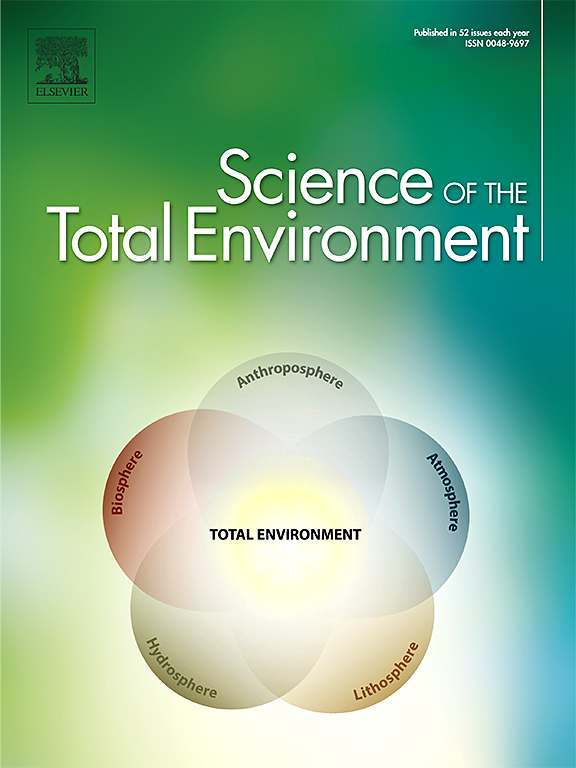
The Science of the Total Environment is an international journal dedicated to scientific research on the environment and its interaction with humanity. It covers a wide range of disciplines and seeks to publish innovative, hypothesis-driven, and impactful research that explores the entire environment, including the atmosphere, lithosphere, hydrosphere, biosphere, and anthroposphere.
The journal's updated Aims & Scope emphasizes the importance of interdisciplinary environmental research with broad impact. Priority is given to studies that advance fundamental understanding and explore the interconnectedness of multiple environmental spheres. Field studies are preferred, while laboratory experiments must demonstrate significant methodological advancements or mechanistic insights with direct relevance to the environment.



 京公网安备 11010802042870号
京ICP备2023020795号-1
京公网安备 11010802042870号
京ICP备2023020795号-1

 分享
分享
 求助内容:
求助内容: 应助结果提醒方式:
 扫码关注我们
