Xuejun Du, Hao Hu, Tianhao Wang, Li Zou, Wenfeng Zhou, Haixiang Gao, Xueqin Ren, Jie Wang, Shuwen Hu
{"title":"Long-term rice cultivation increases contributions of plant and microbial-derived carbon to soil organic carbon in saline-sodic soils.","authors":"Xuejun Du, Hao Hu, Tianhao Wang, Li Zou, Wenfeng Zhou, Haixiang Gao, Xueqin Ren, Jie Wang, Shuwen Hu","doi":"10.1016/j.scitotenv.2023.166713","DOIUrl":null,"url":null,"abstract":"<p><p>Rice cultivation has been demonstrated to have the ability to improve saline-sodic soil. Whether this human activity can influence the accumulation of soil organic carbon (SOC) in saline-sodic soil remains unclear. In this study, the impact of rice cultivation across different planting durations (1, 5, 10, 27 years and abandoned land) on the carbon (C) levels, derived from plant residues and microbial necromass, were assessed. Compared to the control, plant residues and microbial necromass greatly contributed to the carbon accumulation. For the short-term of rice cultivation (1-10 years), the C content originated from both microbial and plant residues gradually accumulated. In the prolonged cultivation phase (27Y), plant residues and microbial necromasses contributed 40.82 % and 21.03 % of the total SOC, respectively. Additionally, rice cultivation significantly reduced the pH by 13.58-22.51 %, electrical conductivity (EC) by 60.06-90.30 %, and exchangeable sodium percentage (ESP) by 60.68-78.39 %. In contrast, total nitrogen (TN), total phosphorus (TP), SOC, particulate organic C, mineral-bound organic C, and microbial biomass all saw statistical increases. The activities of extracellular enzymes in paddy soils, such as peroxidase, phenol oxidase, and leucine aminopeptidase, were significantly reduced, and the decomposition of lignin, phenol, and amino sugars by soil microorganisms was consequently suppressed. The partial least squares path modeling results demonstrated that rice cultivation affected the accumulation of plant and microbial components via the corresponding chemical properties (pH, EC, and ESP), nutrient content (TN, TP, and SOC), enzyme activity (LAP, PER, and POX), microbial biomass, and plant biomass. These findings are crucial for understanding the organic carbon sequestration potential of sodic saline soils.</p>","PeriodicalId":422,"journal":{"name":"Science of the Total Environment","volume":"904 ","pages":"166713"},"PeriodicalIF":8.0000,"publicationDate":"2023-12-15","publicationTypes":"Journal Article","fieldsOfStudy":null,"isOpenAccess":false,"openAccessPdf":"","citationCount":"0","resultStr":null,"platform":"Semanticscholar","paperid":null,"PeriodicalName":"Science of the Total Environment","FirstCategoryId":"93","ListUrlMain":"https://doi.org/10.1016/j.scitotenv.2023.166713","RegionNum":1,"RegionCategory":"环境科学与生态学","ArticlePicture":[],"TitleCN":null,"AbstractTextCN":null,"PMCID":null,"EPubDate":"2023/8/31 0:00:00","PubModel":"Epub","JCR":"Q1","JCRName":"ENVIRONMENTAL SCIENCES","Score":null,"Total":0}
引用次数: 0
Abstract
Rice cultivation has been demonstrated to have the ability to improve saline-sodic soil. Whether this human activity can influence the accumulation of soil organic carbon (SOC) in saline-sodic soil remains unclear. In this study, the impact of rice cultivation across different planting durations (1, 5, 10, 27 years and abandoned land) on the carbon (C) levels, derived from plant residues and microbial necromass, were assessed. Compared to the control, plant residues and microbial necromass greatly contributed to the carbon accumulation. For the short-term of rice cultivation (1-10 years), the C content originated from both microbial and plant residues gradually accumulated. In the prolonged cultivation phase (27Y), plant residues and microbial necromasses contributed 40.82 % and 21.03 % of the total SOC, respectively. Additionally, rice cultivation significantly reduced the pH by 13.58-22.51 %, electrical conductivity (EC) by 60.06-90.30 %, and exchangeable sodium percentage (ESP) by 60.68-78.39 %. In contrast, total nitrogen (TN), total phosphorus (TP), SOC, particulate organic C, mineral-bound organic C, and microbial biomass all saw statistical increases. The activities of extracellular enzymes in paddy soils, such as peroxidase, phenol oxidase, and leucine aminopeptidase, were significantly reduced, and the decomposition of lignin, phenol, and amino sugars by soil microorganisms was consequently suppressed. The partial least squares path modeling results demonstrated that rice cultivation affected the accumulation of plant and microbial components via the corresponding chemical properties (pH, EC, and ESP), nutrient content (TN, TP, and SOC), enzyme activity (LAP, PER, and POX), microbial biomass, and plant biomass. These findings are crucial for understanding the organic carbon sequestration potential of sodic saline soils.
期刊介绍:
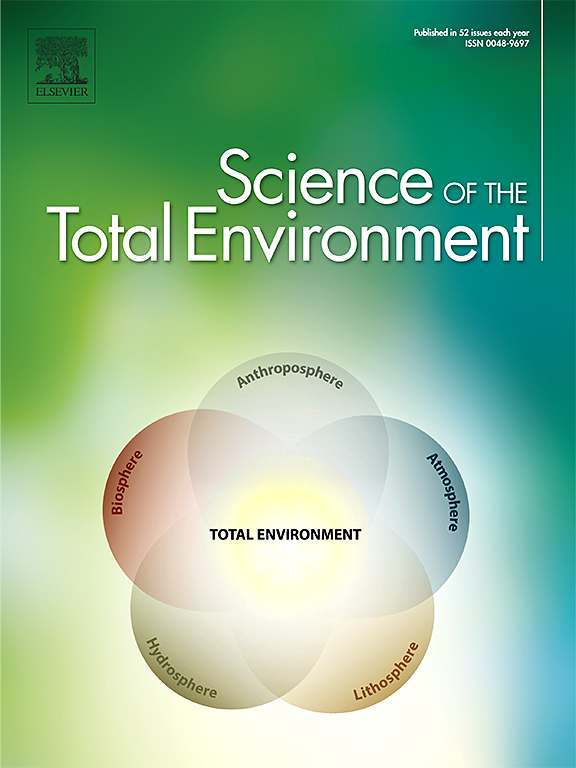
The Science of the Total Environment is an international journal dedicated to scientific research on the environment and its interaction with humanity. It covers a wide range of disciplines and seeks to publish innovative, hypothesis-driven, and impactful research that explores the entire environment, including the atmosphere, lithosphere, hydrosphere, biosphere, and anthroposphere.
The journal's updated Aims & Scope emphasizes the importance of interdisciplinary environmental research with broad impact. Priority is given to studies that advance fundamental understanding and explore the interconnectedness of multiple environmental spheres. Field studies are preferred, while laboratory experiments must demonstrate significant methodological advancements or mechanistic insights with direct relevance to the environment.



 京公网安备 11010802042870号
京ICP备2023020795号-1
京公网安备 11010802042870号
京ICP备2023020795号-1

 分享
分享
 求助内容:
求助内容: 应助结果提醒方式:
 扫码关注我们
