Comparison of Radiation Dose and Image Quality between the 2nd Generation and 3rd Generation Dual-Source Single-Energy and Dual-Source Dual-Energy CT of the Abdomen.
Chang Gun Kim, See Hyung Kim, Seung Hyun Cho, Hun Kyu Ryeom, Won Hwa Kim, Hye Jung Kim
{"title":"Comparison of Radiation Dose and Image Quality between the 2nd Generation and 3rd Generation Dual-Source Single-Energy and Dual-Source Dual-Energy CT of the Abdomen.","authors":"Chang Gun Kim, See Hyung Kim, Seung Hyun Cho, Hun Kyu Ryeom, Won Hwa Kim, Hye Jung Kim","doi":"10.3348/jksr.2021.0104","DOIUrl":null,"url":null,"abstract":"<p><strong>Purpose: </strong>We compared the radiation dose and image quality between the 2nd generation and the 3rd generation dual-source single-energy (DSSE) and dual-source dual-energy (DSDE) CT of the abdomen.</p><p><strong>Materials and methods: </strong>We included patients undergoing follow-up abdominal CT after partial or radical nephrectomy in the first 10 months of 2019 (2nd generation DS CT) and the first 10 months of 2020 (3rd generation DS CT). We divided the 320 patients into 4 groups (A, 2nd generation DSSE CT; B, 2nd generation DSDE CT; C, 3rd generation DSSE CT; and D, 3rd generation DSDE CT) (<i>n</i> = 80 each) matched by sex and body mass index. Radiation dose and image quality (objective and subjective qualities) were compared between the groups.</p><p><strong>Results: </strong>The mean size-specific dose estimation of 3rd generation DSDE CT group was significantly lower than that of the 2nd generation DSSE CT (42.5%, <i>p</i> = 0.013) and 2nd generation DSDE CT (46.9%, <i>p</i> = 0.015) groups. Interobserver agreement was excellent for the overall image quality (intraclass correlation coefficient [ICC]: 0.8867) and image artifacts (ICC: 0.9423).</p><p><strong>Conclusion: </strong>Our results showed a considerable reduction in the radiation dose while maintaining high image quality with 3rd generation DSDE CT as compared to the 2nd generation DSDE CT and 2nd generation DSSE CT.</p>","PeriodicalId":17455,"journal":{"name":"Journal of the Korean Society of Radiology","volume":"83 6","pages":"1342-1353"},"PeriodicalIF":0.0000,"publicationDate":"2022-11-01","publicationTypes":"Journal Article","fieldsOfStudy":null,"isOpenAccess":false,"openAccessPdf":"https://ftp.ncbi.nlm.nih.gov/pub/pmc/oa_pdf/a0/47/jksr-83-1342.PMC9748459.pdf","citationCount":"0","resultStr":null,"platform":"Semanticscholar","paperid":null,"PeriodicalName":"Journal of the Korean Society of Radiology","FirstCategoryId":"1085","ListUrlMain":"https://doi.org/10.3348/jksr.2021.0104","RegionNum":0,"RegionCategory":null,"ArticlePicture":[],"TitleCN":null,"AbstractTextCN":null,"PMCID":null,"EPubDate":"","PubModel":"","JCR":"Q4","JCRName":"Medicine","Score":null,"Total":0}
引用次数: 0
Abstract
Purpose: We compared the radiation dose and image quality between the 2nd generation and the 3rd generation dual-source single-energy (DSSE) and dual-source dual-energy (DSDE) CT of the abdomen.
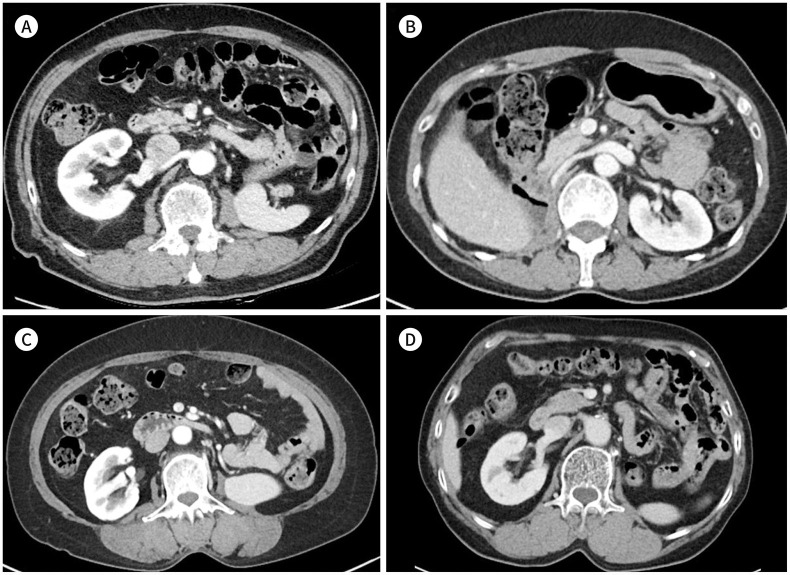
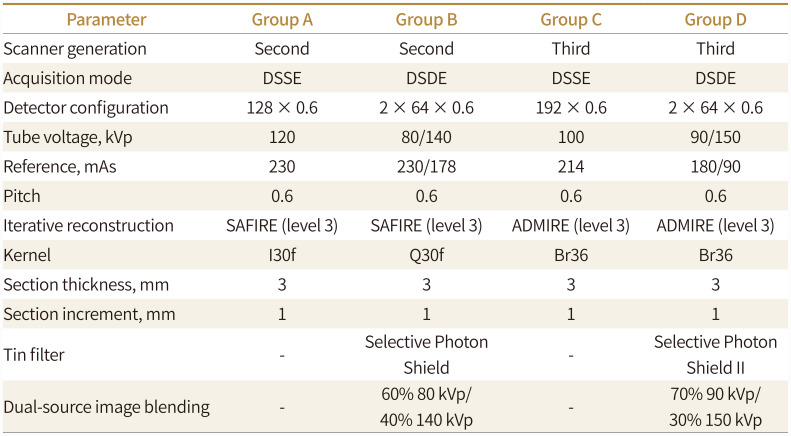
Materials and methods: We included patients undergoing follow-up abdominal CT after partial or radical nephrectomy in the first 10 months of 2019 (2nd generation DS CT) and the first 10 months of 2020 (3rd generation DS CT). We divided the 320 patients into 4 groups (A, 2nd generation DSSE CT; B, 2nd generation DSDE CT; C, 3rd generation DSSE CT; and D, 3rd generation DSDE CT) (n = 80 each) matched by sex and body mass index. Radiation dose and image quality (objective and subjective qualities) were compared between the groups.
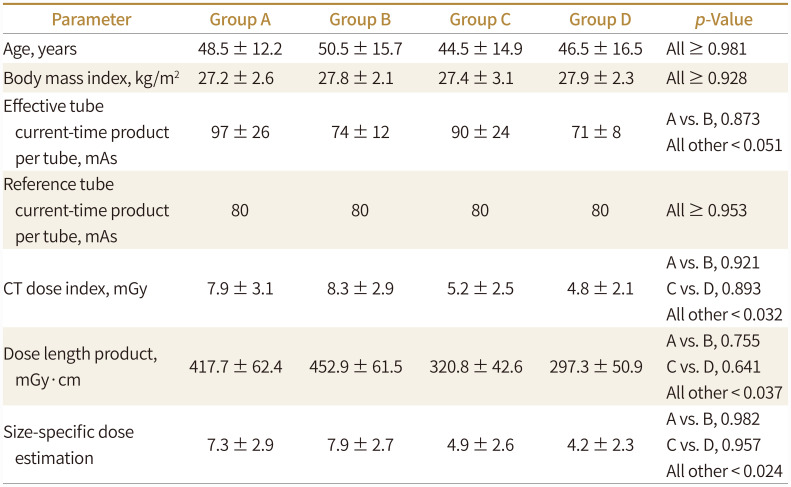
Results: The mean size-specific dose estimation of 3rd generation DSDE CT group was significantly lower than that of the 2nd generation DSSE CT (42.5%, p = 0.013) and 2nd generation DSDE CT (46.9%, p = 0.015) groups. Interobserver agreement was excellent for the overall image quality (intraclass correlation coefficient [ICC]: 0.8867) and image artifacts (ICC: 0.9423).
Conclusion: Our results showed a considerable reduction in the radiation dose while maintaining high image quality with 3rd generation DSDE CT as compared to the 2nd generation DSDE CT and 2nd generation DSSE CT.




 京公网安备 11010802042870号
京ICP备2023020795号-1
京公网安备 11010802042870号
京ICP备2023020795号-1

 分享
分享
 求助内容:
求助内容: 应助结果提醒方式:
 扫码关注我们
