Ida Westberg, Frida Meijer Carlsen, Ida Elisabeth Johansen, Bent Larsen Petersen
{"title":"Cytosine base editors optimized for genome editing in potato protoplasts.","authors":"Ida Westberg, Frida Meijer Carlsen, Ida Elisabeth Johansen, Bent Larsen Petersen","doi":"10.3389/fgeed.2023.1247702","DOIUrl":null,"url":null,"abstract":"<p><p>In this study, we generated and compared three cytidine base editors (CBEs) tailor-made for potato (<i>Solanum tuberosum</i>), which conferred up to 43% C-to-T conversion of all alleles in the protoplast pool. Earlier, gene-edited potato plants were successfully generated by polyethylene glycol-mediated CRISPR/Cas9 transformation of protoplasts followed by explant regeneration. In one study, a 3-4-fold increase in editing efficiency was obtained by replacing the standard <i>Arabidopsis thaliana At</i>U6-1 promotor with endogenous potato <i>St</i>U6 promotors driving the expression of the gRNA. Here, we used this optimized construct (<i>Sp</i>Cas9/<i>St</i>U6-1::gRNA1, target gRNA sequence GGTC<sub>4</sub>C<sub>5</sub>TTGGAGC<sub>12</sub>AAAAC<sub>17</sub>TGG) for the generation of CBEs tailor-made for potato and tested for C-to-T base editing in the granule-bound starch synthase 1 gene in the cultivar Desiree. First, the <i>Streptococcus pyogenes</i> Cas9 was converted into a (D10A) nickase (nCas9). Next, one of three cytosine deaminases from human hAPOBEC3A (A3A), rat (evo_rAPOBEC1) (rA1), or sea lamprey (evo_<i>Pm</i>CDA1) (CDA1) was C-terminally fused to nCas9 and a uracil-DNA glycosylase inhibitor, with each module interspaced with flexible linkers. The CBEs were overall highly efficient, with A3A having the best overall base editing activity, with an average 34.5%, 34.5%, and 27% C-to-T conversion at C4, C5, and C12, respectively, whereas CDA1 showed an average base editing activity of 34.5%, 34%, and 14.25% C-to-T conversion at C4, C5, and C12, respectively. rA1 exhibited an average base editing activity of 18.75% and 19% at C4 and C5 and was the only base editor to show no C-to-T conversion at C12.</p>","PeriodicalId":73086,"journal":{"name":"Frontiers in genome editing","volume":"5 ","pages":"1247702"},"PeriodicalIF":4.4000,"publicationDate":"2023-01-01","publicationTypes":"Journal Article","fieldsOfStudy":null,"isOpenAccess":false,"openAccessPdf":"https://www.ncbi.nlm.nih.gov/pmc/articles/PMC10502308/pdf/","citationCount":"0","resultStr":null,"platform":"Semanticscholar","paperid":null,"PeriodicalName":"Frontiers in genome editing","FirstCategoryId":"1085","ListUrlMain":"https://doi.org/10.3389/fgeed.2023.1247702","RegionNum":0,"RegionCategory":null,"ArticlePicture":[],"TitleCN":null,"AbstractTextCN":null,"PMCID":null,"EPubDate":"","PubModel":"","JCR":"Q1","JCRName":"BIOTECHNOLOGY & APPLIED MICROBIOLOGY","Score":null,"Total":0}
引用次数: 0
Abstract
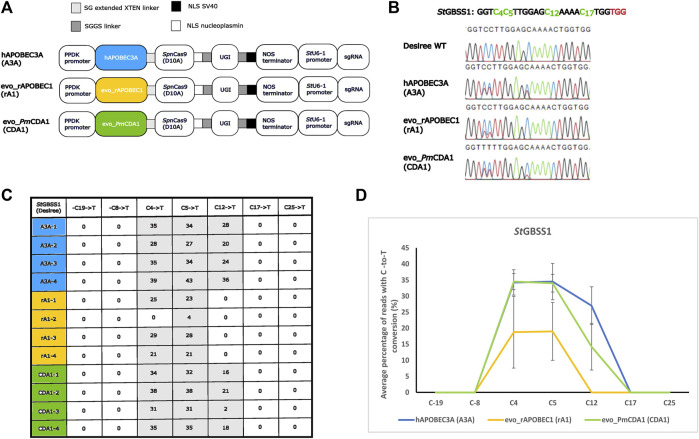
In this study, we generated and compared three cytidine base editors (CBEs) tailor-made for potato (Solanum tuberosum), which conferred up to 43% C-to-T conversion of all alleles in the protoplast pool. Earlier, gene-edited potato plants were successfully generated by polyethylene glycol-mediated CRISPR/Cas9 transformation of protoplasts followed by explant regeneration. In one study, a 3-4-fold increase in editing efficiency was obtained by replacing the standard Arabidopsis thaliana AtU6-1 promotor with endogenous potato StU6 promotors driving the expression of the gRNA. Here, we used this optimized construct (SpCas9/StU6-1::gRNA1, target gRNA sequence GGTC4C5TTGGAGC12AAAAC17TGG) for the generation of CBEs tailor-made for potato and tested for C-to-T base editing in the granule-bound starch synthase 1 gene in the cultivar Desiree. First, the Streptococcus pyogenes Cas9 was converted into a (D10A) nickase (nCas9). Next, one of three cytosine deaminases from human hAPOBEC3A (A3A), rat (evo_rAPOBEC1) (rA1), or sea lamprey (evo_PmCDA1) (CDA1) was C-terminally fused to nCas9 and a uracil-DNA glycosylase inhibitor, with each module interspaced with flexible linkers. The CBEs were overall highly efficient, with A3A having the best overall base editing activity, with an average 34.5%, 34.5%, and 27% C-to-T conversion at C4, C5, and C12, respectively, whereas CDA1 showed an average base editing activity of 34.5%, 34%, and 14.25% C-to-T conversion at C4, C5, and C12, respectively. rA1 exhibited an average base editing activity of 18.75% and 19% at C4 and C5 and was the only base editor to show no C-to-T conversion at C12.




 京公网安备 11010802042870号
京ICP备2023020795号-1
京公网安备 11010802042870号
京ICP备2023020795号-1

 分享
分享

 求助内容:
求助内容: 应助结果提醒方式:
 扫码关注我们
