Blake E. G. Collins, Cheyne Donges, Robert Robergs, Joshua Cooper, Kristie Sweeney, Michael Kingsley
{"title":"Moderate continuous- and high-intensity interval training elicit comparable cardiovascular effect among middle-aged men regardless of recovery mode","authors":"Blake E. G. Collins, Cheyne Donges, Robert Robergs, Joshua Cooper, Kristie Sweeney, Michael Kingsley","doi":"10.1080/17461391.2023.2171908","DOIUrl":null,"url":null,"abstract":"<div>\n \n <p>To assess the effect of active and passive intra-interval recovery modes in time-efficient high-intensity interval training (HIT) on cardiorespiratory fitness, autonomic function, and endothelial function in sedentary middle-aged men.</p>\n <p>Participants (<i>n </i>= 62; age: 49.5 ± 5.8 y; BMI: 29.7 ± 3.7 kg·m<sup>−2</sup>) completed the assessments of cardiorespiratory fitness, flow-mediated dilation (FMD) and heart rate variability before being randomly allocated to control (CON; <i>n </i>= 14), moderate intensity continuous training (MICT; <i>n </i>= 15), HIT with passive (P-HIT; <i>n</i>-15), or active recovery (A-HIT; <i>n </i>= 15). Participants performed thrice weekly exercise sessions for 12 weeks. MICT completed 50–60 min of continuous cycling at 60–70% heart rate (HR) maximum. HIT completed 30-s work intervals (∼85% HR) interspaced with 2.5 min of active or passive recovery.</p>\n <p>All exercise modalities increased oxygen uptake (V̇O<sub>2</sub>) (MD: ≥ 3.1 ml·kg<sup>−1</sup>·min<sup>−1</sup>, 95%CI: 1.5–4.7 ml·kg<sup>−1</sup>·min<sup>−1</sup>; <i>P </i>< 0.001), power output (MD: ≥ 26 W, 95%CI: 15–37 W; <i>P</i> < 0.001) and cycle duration (MD: ≥ 62 s, 95%CI: 36–88 s; <i>P </i>< 0.001) at 85% HRM. Significant pre-to-post differences were observed among all exercise groups for FMD (MD: ≥ 3.4%, 95%CI: 0.3–6.5%; <i>P </i>< 0.05), while MICT and P-HIT significantly increased the standard deviation of all NN intervals (SDNN) pre-to-post intervention (MD: ≥ 7 ms, 2–13 ms; <i>P</i> ≤ 0.05).</p>\n <p>Time-efficient HIT elicits significant improvements in cardiorespiratory fitness, FMD and autonomic modulation following a thrice weekly 12-week exercise intervention among sedentary middle-aged men. Active recovery between successive high-intensity intervals provided no additional benefit among this deconditioned cohort.</p>\n </div>","PeriodicalId":93999,"journal":{"name":"European journal of sport science","volume":"23 8","pages":"1612-1621"},"PeriodicalIF":3.0000,"publicationDate":"2023-02-19","publicationTypes":"Journal Article","fieldsOfStudy":null,"isOpenAccess":false,"openAccessPdf":"https://onlinelibrary.wiley.com/doi/epdf/10.1080/17461391.2023.2171908","citationCount":"0","resultStr":null,"platform":"Semanticscholar","paperid":null,"PeriodicalName":"European journal of sport science","FirstCategoryId":"1085","ListUrlMain":"https://onlinelibrary.wiley.com/doi/10.1080/17461391.2023.2171908","RegionNum":0,"RegionCategory":null,"ArticlePicture":[],"TitleCN":null,"AbstractTextCN":null,"PMCID":null,"EPubDate":"","PubModel":"","JCR":"","JCRName":"","Score":null,"Total":0}
引用次数: 0
Abstract
To assess the effect of active and passive intra-interval recovery modes in time-efficient high-intensity interval training (HIT) on cardiorespiratory fitness, autonomic function, and endothelial function in sedentary middle-aged men.
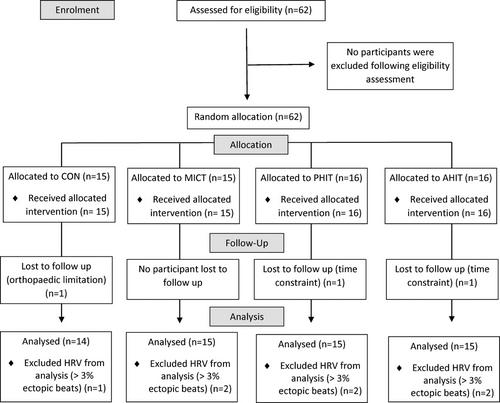
Participants (n = 62; age: 49.5 ± 5.8 y; BMI: 29.7 ± 3.7 kg·m−2) completed the assessments of cardiorespiratory fitness, flow-mediated dilation (FMD) and heart rate variability before being randomly allocated to control (CON; n = 14), moderate intensity continuous training (MICT; n = 15), HIT with passive (P-HIT; n-15), or active recovery (A-HIT; n = 15). Participants performed thrice weekly exercise sessions for 12 weeks. MICT completed 50–60 min of continuous cycling at 60–70% heart rate (HR) maximum. HIT completed 30-s work intervals (∼85% HR) interspaced with 2.5 min of active or passive recovery.
All exercise modalities increased oxygen uptake (V̇O2) (MD: ≥ 3.1 ml·kg−1·min−1, 95%CI: 1.5–4.7 ml·kg−1·min−1; P < 0.001), power output (MD: ≥ 26 W, 95%CI: 15–37 W; P < 0.001) and cycle duration (MD: ≥ 62 s, 95%CI: 36–88 s; P < 0.001) at 85% HRM. Significant pre-to-post differences were observed among all exercise groups for FMD (MD: ≥ 3.4%, 95%CI: 0.3–6.5%; P < 0.05), while MICT and P-HIT significantly increased the standard deviation of all NN intervals (SDNN) pre-to-post intervention (MD: ≥ 7 ms, 2–13 ms; P ≤ 0.05).
Time-efficient HIT elicits significant improvements in cardiorespiratory fitness, FMD and autonomic modulation following a thrice weekly 12-week exercise intervention among sedentary middle-aged men. Active recovery between successive high-intensity intervals provided no additional benefit among this deconditioned cohort.



 京公网安备 11010802042870号
京ICP备2023020795号-1
京公网安备 11010802042870号
京ICP备2023020795号-1

 分享
分享

 求助内容:
求助内容: 应助结果提醒方式:
 扫码关注我们
