Yuk Ming Tang , Pen Chung Chen , Kris M.Y. Law , C.H. Wu , Yui-yip Lau , Jieqi Guan , Dan He , G.T.S. Ho
{"title":"Comparative analysis of Student's live online learning readiness during the coronavirus (COVID-19) pandemic in the higher education sector","authors":"Yuk Ming Tang , Pen Chung Chen , Kris M.Y. Law , C.H. Wu , Yui-yip Lau , Jieqi Guan , Dan He , G.T.S. Ho","doi":"10.1016/j.compedu.2021.104211","DOIUrl":null,"url":null,"abstract":"<div><p>Amid the coronavirus outbreak, many countries are facing a dramatic situation in terms of the global economy and human social activities, including education. The shutdown of schools is affecting many students around the world, with face-to-face classes suspended. Many countries facing the disastrous situation imposed class suspension at an early stage of the coronavirus outbreak, and Asia was one of the earliest regions to implement live online learning. Despite previous research on online teaching and learning, students' readiness to participate in the real-time online learning implemented during the coronavirus outbreak is not yet well understood. This study explored several key factors in the research framework related to learning motivation, learning readiness and student's self-efficacy in participating in live online learning during the coronavirus outbreak, taking into account gender differences and differences among sub-degree (SD), undergraduate (UG) and postgraduate (PG) students. Technology readiness was used instead of conventional online/internet self-efficacy to determine students' live online learning readiness. The hypothetical model was validated using confirmatory factor analysis (CFA). The results revealed no statistically significant differences between males and females.</p><p>On the other hand, the mean scores for PG students were higher than for UG and SD students based on the post hoc test. We argue that during the coronavirus outbreak, gender differences were reduced because students are forced to learn more initiatively. We also suggest that students studying at a higher education degree level may have higher expectations of their academic achievement and were significantly different in their online learning readiness. This study has important implications for educators in implementing live online learning, particularly for the design of teaching contexts for students from different educational levels. More virtual activities should be considered to enhance the motivation for students undertaking lower-level degrees, and encouragement of student-to-student interactions can be considered.</p></div>","PeriodicalId":10568,"journal":{"name":"Computers & Education","volume":"168 ","pages":"Article 104211"},"PeriodicalIF":10.5000,"publicationDate":"2021-07-01","publicationTypes":"Journal Article","fieldsOfStudy":null,"isOpenAccess":false,"openAccessPdf":"https://sci-hub-pdf.com/10.1016/j.compedu.2021.104211","citationCount":"261","resultStr":null,"platform":"Semanticscholar","paperid":null,"PeriodicalName":"Computers & Education","FirstCategoryId":"95","ListUrlMain":"https://www.sciencedirect.com/science/article/pii/S0360131521000889","RegionNum":1,"RegionCategory":"教育学","ArticlePicture":[],"TitleCN":null,"AbstractTextCN":null,"PMCID":null,"EPubDate":"","PubModel":"","JCR":"Q1","JCRName":"COMPUTER SCIENCE, INTERDISCIPLINARY APPLICATIONS","Score":null,"Total":0}
引用次数: 261
Abstract
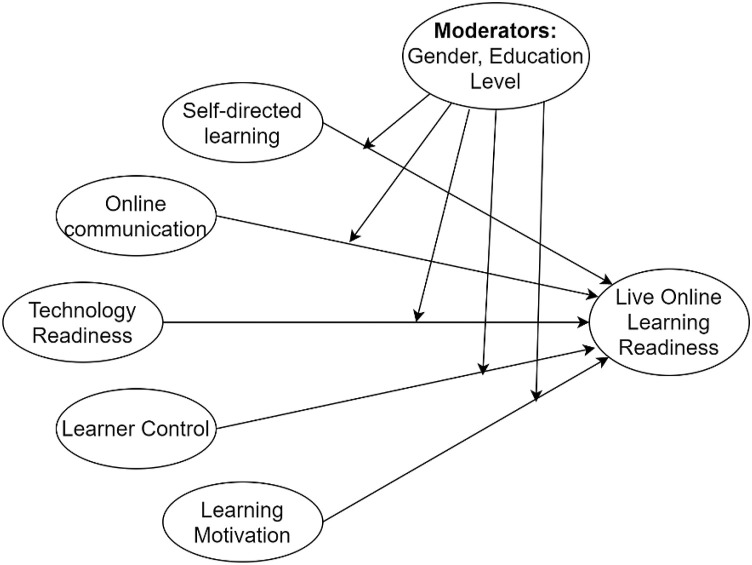
Amid the coronavirus outbreak, many countries are facing a dramatic situation in terms of the global economy and human social activities, including education. The shutdown of schools is affecting many students around the world, with face-to-face classes suspended. Many countries facing the disastrous situation imposed class suspension at an early stage of the coronavirus outbreak, and Asia was one of the earliest regions to implement live online learning. Despite previous research on online teaching and learning, students' readiness to participate in the real-time online learning implemented during the coronavirus outbreak is not yet well understood. This study explored several key factors in the research framework related to learning motivation, learning readiness and student's self-efficacy in participating in live online learning during the coronavirus outbreak, taking into account gender differences and differences among sub-degree (SD), undergraduate (UG) and postgraduate (PG) students. Technology readiness was used instead of conventional online/internet self-efficacy to determine students' live online learning readiness. The hypothetical model was validated using confirmatory factor analysis (CFA). The results revealed no statistically significant differences between males and females.
On the other hand, the mean scores for PG students were higher than for UG and SD students based on the post hoc test. We argue that during the coronavirus outbreak, gender differences were reduced because students are forced to learn more initiatively. We also suggest that students studying at a higher education degree level may have higher expectations of their academic achievement and were significantly different in their online learning readiness. This study has important implications for educators in implementing live online learning, particularly for the design of teaching contexts for students from different educational levels. More virtual activities should be considered to enhance the motivation for students undertaking lower-level degrees, and encouragement of student-to-student interactions can be considered.
期刊介绍:
Computers & Education seeks to advance understanding of how digital technology can improve education by publishing high-quality research that expands both theory and practice. The journal welcomes research papers exploring the pedagogical applications of digital technology, with a focus broad enough to appeal to the wider education community.



 京公网安备 11010802042870号
京ICP备2023020795号-1
京公网安备 11010802042870号
京ICP备2023020795号-1

 分享
分享
 求助内容:
求助内容: 应助结果提醒方式:
 扫码关注我们
