Seamus D. Jones, James Bamford, Glenn H. Fredrickson and Rachel A. Segalman*,
{"title":"Decoupling Ion Transport and Matrix Dynamics to Make High Performance Solid Polymer Electrolytes","authors":"Seamus D. Jones, James Bamford, Glenn H. Fredrickson and Rachel A. Segalman*, ","doi":"10.1021/acspolymersau.2c00024","DOIUrl":null,"url":null,"abstract":"<p >Transport of ions through solid polymeric electrolytes (SPEs) involves a complicated interplay of ion solvation, ion–ion interactions, ion-polymer interactions, and free volume. Nonetheless, prevailing viewpoints on the subject promote a significantly simplified picture, likening ion transport in a polymer to that in an unstructured fluid at low solute concentrations. Although this idealized liquid transport model has been successful in guiding the design of homogeneous electrolytes, structured electrolytes provide a promising alternate route to achieve high ionic conductivity and selectivity. In this perspective, we begin by describing the physical origins of the idealized liquid transport mechanism and then proceed to examine known cases of decoupling between the matrix dynamics and ionic transport in SPEs. Specifically we discuss conditions for “decoupled” mobility that include a highly polar electrolyte environment, a percolated path of free volume elements (either through structured or unstructured channels), high ion concentrations, and labile ion-electrolyte interactions. Finally, we proceed to reflect on the potential of these mechanisms to promote multivalent ion conductivity and the need for research into the interfacial properties of solid polymer electrolytes as well as their performance at elevated potentials.</p>","PeriodicalId":72049,"journal":{"name":"ACS polymers Au","volume":"2 6","pages":"430–448"},"PeriodicalIF":6.9000,"publicationDate":"2022-09-22","publicationTypes":"Journal Article","fieldsOfStudy":null,"isOpenAccess":false,"openAccessPdf":"https://ftp.ncbi.nlm.nih.gov/pub/pmc/oa_pdf/c8/e2/lg2c00024.PMC9761859.pdf","citationCount":"5","resultStr":null,"platform":"Semanticscholar","paperid":null,"PeriodicalName":"ACS polymers Au","FirstCategoryId":"1085","ListUrlMain":"https://pubs.acs.org/doi/10.1021/acspolymersau.2c00024","RegionNum":0,"RegionCategory":null,"ArticlePicture":[],"TitleCN":null,"AbstractTextCN":null,"PMCID":null,"EPubDate":"","PubModel":"","JCR":"Q1","JCRName":"POLYMER SCIENCE","Score":null,"Total":0}
引用次数: 5
Abstract
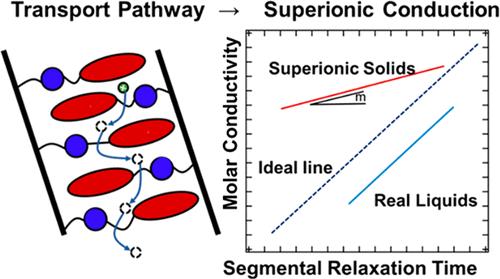
Transport of ions through solid polymeric electrolytes (SPEs) involves a complicated interplay of ion solvation, ion–ion interactions, ion-polymer interactions, and free volume. Nonetheless, prevailing viewpoints on the subject promote a significantly simplified picture, likening ion transport in a polymer to that in an unstructured fluid at low solute concentrations. Although this idealized liquid transport model has been successful in guiding the design of homogeneous electrolytes, structured electrolytes provide a promising alternate route to achieve high ionic conductivity and selectivity. In this perspective, we begin by describing the physical origins of the idealized liquid transport mechanism and then proceed to examine known cases of decoupling between the matrix dynamics and ionic transport in SPEs. Specifically we discuss conditions for “decoupled” mobility that include a highly polar electrolyte environment, a percolated path of free volume elements (either through structured or unstructured channels), high ion concentrations, and labile ion-electrolyte interactions. Finally, we proceed to reflect on the potential of these mechanisms to promote multivalent ion conductivity and the need for research into the interfacial properties of solid polymer electrolytes as well as their performance at elevated potentials.



 京公网安备 11010802042870号
京ICP备2023020795号-1
京公网安备 11010802042870号
京ICP备2023020795号-1

 分享
分享

 求助内容:
求助内容: 应助结果提醒方式:
 扫码关注我们
