{"title":"<i>Nudix hydrolase 14</i> influences plant development and grain chalkiness in rice.","authors":"Yiran Liu, Wan Zhang, Youhang Wang, Liling Xie, Qiuxin Zhang, Jingjing Zhang, Weiyan Li, Meifeng Wu, Jingsong Cui, Wenyi Wang, Zemin Zhang","doi":"10.3389/fpls.2022.1054917","DOIUrl":null,"url":null,"abstract":"<p><p>Nudix hydrolases (NUDX) can hydrolyze a wide range of organic pyrophosphates and are widely distributed in various organisms. Previous studies have shown that NUDXs are extensively involved in biotic and abiotic stress responses in different plant species; however, the role of NUDXs in plant growth and development remains largely unknown. In the present study, we identified and characterized OsNUDX14 localized in the mitochondria in rice. Results showed that <i>OsNUDX14</i> is constitutively expressed in various tissues and most strongly expressed in mature leaves. We used CRISPR/Cas9 introducing mutations that editing <i>OsNUDX14</i> and its encoding product. <i>OsNUDX14-</i>Cas9 (<i>nudx14</i>) lines presented early flowering and a larger flag leaf angle during the reproductive stage. In addition, <i>OsNUDX14</i> affected grain chalkiness in rice. Furthermore, transcript profile analysis indicated that <i>OsNUDX14</i> is associated with lignin biosynthesis in rice. Six major haplotypes were identified by six <i>OsNUDX14</i> missense mutations, including Hap_1 to Hap_6. Accessions having the Hap_5 allele were geographically located mainly in South and Southeast Asia with a low frequency in the <i>Xian</i>/<i>indica</i> subspecies. This study revealed that <i>OsNUDX14</i> is associated with plant development and grain chalkiness, providing a potential opportunity to optimize plant architecture and quality for crop breeding.</p>","PeriodicalId":12632,"journal":{"name":"Frontiers in Plant Science","volume":"13 ","pages":"1054917"},"PeriodicalIF":4.1000,"publicationDate":"2022-12-08","publicationTypes":"Journal Article","fieldsOfStudy":null,"isOpenAccess":false,"openAccessPdf":"https://www.ncbi.nlm.nih.gov/pmc/articles/PMC9773146/pdf/","citationCount":"0","resultStr":null,"platform":"Semanticscholar","paperid":null,"PeriodicalName":"Frontiers in Plant Science","FirstCategoryId":"99","ListUrlMain":"https://doi.org/10.3389/fpls.2022.1054917","RegionNum":2,"RegionCategory":"生物学","ArticlePicture":[],"TitleCN":null,"AbstractTextCN":null,"PMCID":null,"EPubDate":"2022/1/1 0:00:00","PubModel":"eCollection","JCR":"Q1","JCRName":"PLANT SCIENCES","Score":null,"Total":0}
引用次数: 0
Abstract
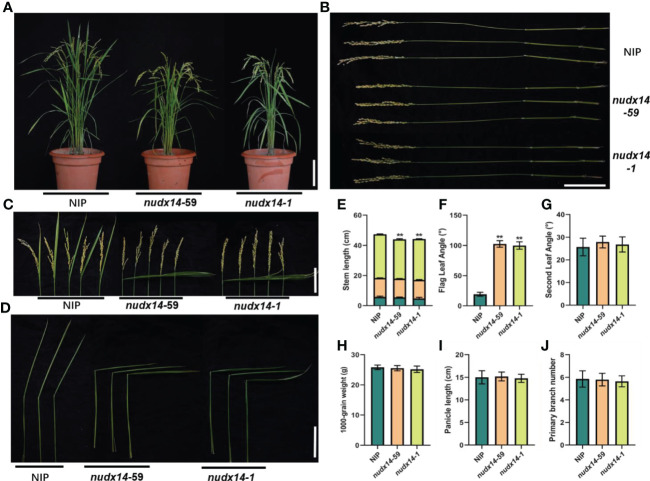
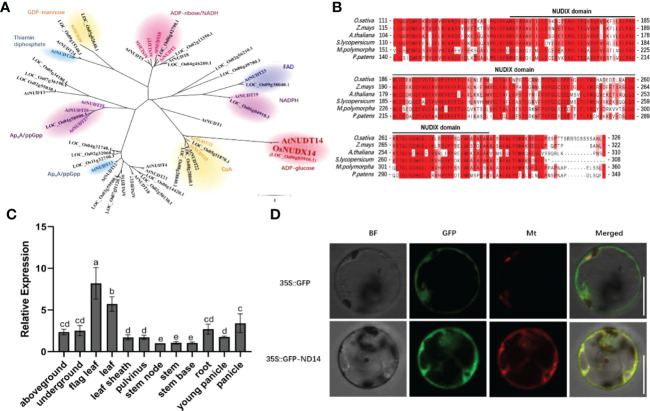
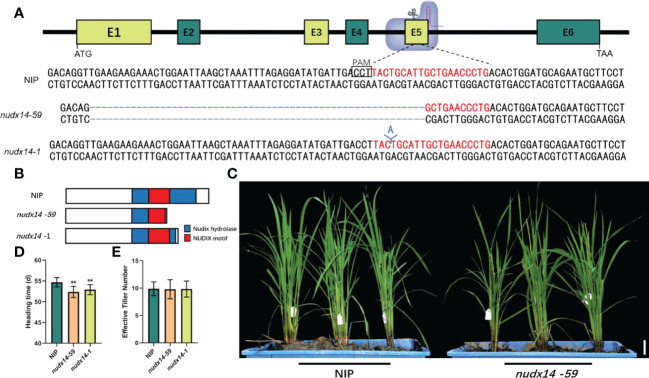
Nudix hydrolases (NUDX) can hydrolyze a wide range of organic pyrophosphates and are widely distributed in various organisms. Previous studies have shown that NUDXs are extensively involved in biotic and abiotic stress responses in different plant species; however, the role of NUDXs in plant growth and development remains largely unknown. In the present study, we identified and characterized OsNUDX14 localized in the mitochondria in rice. Results showed that OsNUDX14 is constitutively expressed in various tissues and most strongly expressed in mature leaves. We used CRISPR/Cas9 introducing mutations that editing OsNUDX14 and its encoding product. OsNUDX14-Cas9 (nudx14) lines presented early flowering and a larger flag leaf angle during the reproductive stage. In addition, OsNUDX14 affected grain chalkiness in rice. Furthermore, transcript profile analysis indicated that OsNUDX14 is associated with lignin biosynthesis in rice. Six major haplotypes were identified by six OsNUDX14 missense mutations, including Hap_1 to Hap_6. Accessions having the Hap_5 allele were geographically located mainly in South and Southeast Asia with a low frequency in the Xian/indica subspecies. This study revealed that OsNUDX14 is associated with plant development and grain chalkiness, providing a potential opportunity to optimize plant architecture and quality for crop breeding.
期刊介绍:
In an ever changing world, plant science is of the utmost importance for securing the future well-being of humankind. Plants provide oxygen, food, feed, fibers, and building materials. In addition, they are a diverse source of industrial and pharmaceutical chemicals. Plants are centrally important to the health of ecosystems, and their understanding is critical for learning how to manage and maintain a sustainable biosphere. Plant science is extremely interdisciplinary, reaching from agricultural science to paleobotany, and molecular physiology to ecology. It uses the latest developments in computer science, optics, molecular biology and genomics to address challenges in model systems, agricultural crops, and ecosystems. Plant science research inquires into the form, function, development, diversity, reproduction, evolution and uses of both higher and lower plants and their interactions with other organisms throughout the biosphere. Frontiers in Plant Science welcomes outstanding contributions in any field of plant science from basic to applied research, from organismal to molecular studies, from single plant analysis to studies of populations and whole ecosystems, and from molecular to biophysical to computational approaches.
Frontiers in Plant Science publishes articles on the most outstanding discoveries across a wide research spectrum of Plant Science. The mission of Frontiers in Plant Science is to bring all relevant Plant Science areas together on a single platform.



 京公网安备 11010802042870号
京ICP备2023020795号-1
京公网安备 11010802042870号
京ICP备2023020795号-1

 分享
分享
 求助内容:
求助内容: 应助结果提醒方式:
 扫码关注我们
