Elliot Nyagumbo , William Pote , Bridgett Shopo , Trust Nyirenda , Ignatius Chagonda , Ruvimbo J. Mapaya , Fabian Maunganidze , William N. Mavengere , Cephas Mawere , Ian Mutasa , Emmanuel Kademeteme , Alfred Maroyi , Tafadzwa Taderera , Michael Bhebhe
{"title":"Medicinal plants used for the management of respiratory diseases in Zimbabwe: Review and perspectives potential management of COVID-19","authors":"Elliot Nyagumbo , William Pote , Bridgett Shopo , Trust Nyirenda , Ignatius Chagonda , Ruvimbo J. Mapaya , Fabian Maunganidze , William N. Mavengere , Cephas Mawere , Ian Mutasa , Emmanuel Kademeteme , Alfred Maroyi , Tafadzwa Taderera , Michael Bhebhe","doi":"10.1016/j.pce.2022.103232","DOIUrl":null,"url":null,"abstract":"<div><p>Respiratory diseases have in the recent past become a health concern globally. More than 523 million cases of coronavirus disease (COVID19), a recent respiratory diseases have been reported, leaving more than 6 million deaths worldwide since the start of the pandemic. In Zimbabwe, respiratory infections have largely been managed using traditional (herbal) medicines, due to their low cost and ease of accessibility. This review highlights the plants’ toxicological and pharmacological evaluation studies explored. It seeks to document plants that have been traditionally used in Zimbabwe to treat respiratory ailments within and beyond the past four decades. Extensive literature review based on published papers and abstracts retrieved from the online bibliographic databases, books, book chapters, scientific reports and theses available at Universities in Zimbabwe, were used in this study. From the study, there were at least 58 plant families comprising 160 medicinal plants widely distributed throughout the country. The Fabaceae family had the highest number of medicinal plant species, with a total of 21 species. A total of 12 respiratory ailments were reportedly treatable using the identified plants. From a total of 160 plants, colds were reportedly treatable with 56, pneumonia 53, coughs 34, chest pain and related conditions 29, asthma 25, tuberculosis and spots in lungs 22, unspecified respiratory conditions 20, influenza 13, bronchial problems 12, dyspnoea 7, sore throat and infections 5 and sinus clearing 1 plant. The study identified potential medicinal plants that can be utilised in future to manage respiratory infections.</p></div>","PeriodicalId":54616,"journal":{"name":"Physics and Chemistry of the Earth","volume":"128 ","pages":"Article 103232"},"PeriodicalIF":4.1000,"publicationDate":"2022-12-01","publicationTypes":"Journal Article","fieldsOfStudy":null,"isOpenAccess":false,"openAccessPdf":"https://www.ncbi.nlm.nih.gov/pmc/articles/PMC9489988/pdf/","citationCount":"6","resultStr":null,"platform":"Semanticscholar","paperid":null,"PeriodicalName":"Physics and Chemistry of the Earth","FirstCategoryId":"89","ListUrlMain":"https://www.sciencedirect.com/science/article/pii/S1474706522001255","RegionNum":3,"RegionCategory":"地球科学","ArticlePicture":[],"TitleCN":null,"AbstractTextCN":null,"PMCID":null,"EPubDate":"2022/9/21 0:00:00","PubModel":"Epub","JCR":"Q2","JCRName":"GEOSCIENCES, MULTIDISCIPLINARY","Score":null,"Total":0}
引用次数: 6
Abstract
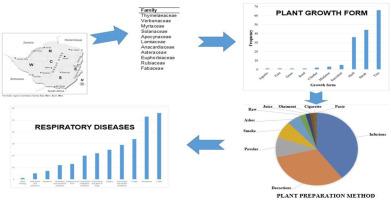
Respiratory diseases have in the recent past become a health concern globally. More than 523 million cases of coronavirus disease (COVID19), a recent respiratory diseases have been reported, leaving more than 6 million deaths worldwide since the start of the pandemic. In Zimbabwe, respiratory infections have largely been managed using traditional (herbal) medicines, due to their low cost and ease of accessibility. This review highlights the plants’ toxicological and pharmacological evaluation studies explored. It seeks to document plants that have been traditionally used in Zimbabwe to treat respiratory ailments within and beyond the past four decades. Extensive literature review based on published papers and abstracts retrieved from the online bibliographic databases, books, book chapters, scientific reports and theses available at Universities in Zimbabwe, were used in this study. From the study, there were at least 58 plant families comprising 160 medicinal plants widely distributed throughout the country. The Fabaceae family had the highest number of medicinal plant species, with a total of 21 species. A total of 12 respiratory ailments were reportedly treatable using the identified plants. From a total of 160 plants, colds were reportedly treatable with 56, pneumonia 53, coughs 34, chest pain and related conditions 29, asthma 25, tuberculosis and spots in lungs 22, unspecified respiratory conditions 20, influenza 13, bronchial problems 12, dyspnoea 7, sore throat and infections 5 and sinus clearing 1 plant. The study identified potential medicinal plants that can be utilised in future to manage respiratory infections.
期刊介绍:
Physics and Chemistry of the Earth is an international interdisciplinary journal for the rapid publication of collections of refereed communications in separate thematic issues, either stemming from scientific meetings, or, especially compiled for the occasion. There is no restriction on the length of articles published in the journal. Physics and Chemistry of the Earth incorporates the separate Parts A, B and C which existed until the end of 2001.
Please note: the Editors are unable to consider submissions that are not invited or linked to a thematic issue. Please do not submit unsolicited papers.
The journal covers the following subject areas:
-Solid Earth and Geodesy:
(geology, geochemistry, tectonophysics, seismology, volcanology, palaeomagnetism and rock magnetism, electromagnetism and potential fields, marine and environmental geosciences as well as geodesy).
-Hydrology, Oceans and Atmosphere:
(hydrology and water resources research, engineering and management, oceanography and oceanic chemistry, shelf, sea, lake and river sciences, meteorology and atmospheric sciences incl. chemistry as well as climatology and glaciology).
-Solar-Terrestrial and Planetary Science:
(solar, heliospheric and solar-planetary sciences, geology, geophysics and atmospheric sciences of planets, satellites and small bodies as well as cosmochemistry and exobiology).




 京公网安备 11010802042870号
京ICP备2023020795号-1
京公网安备 11010802042870号
京ICP备2023020795号-1

 分享
分享
 求助内容:
求助内容: 应助结果提醒方式:
 扫码关注我们
