{"title":"The Heart and Artificial Intelligence-How Can We Improve Medicine Without Causing Harm.","authors":"Christoph Reich, Benjamin Meder","doi":"10.1007/s11897-023-00606-0","DOIUrl":null,"url":null,"abstract":"<p><strong>Purpose of review: </strong>The introduction of Artificial Intelligence into the healthcare system offers enormous opportunities for biomedical research, the improvement of patient care, and cost reduction in high-end medicine. Digital concepts and workflows are already playing an increasingly important role in cardiology. The fusion of computer science and medicine offers great transformative potential and enables enormous acceleration processes in cardiovascular medicine.</p><p><strong>Recent findings: </strong>As medical data becomes smart, it is also becoming more valuable and vulnerable to malicious actors. In addition, the gap between what is technically possible and what is allowed by privacy legislation is growing. Principles of the General Data Protection Regulation that have been in force since May 2018, such as transparency, purpose limitation, and data minimization, seem to hinder the development and use of Artificial Intelligence. Concepts to secure data integrity and incorporate legal and ethical principles can help to avoid the potential risks of digitization and may result in an European leadership in regard to privacy protection and AI. The following review provides an overview of relevant aspects of Artificial Intelligence and Machine Learning, highlights selected applications in cardiology, and discusses central ethical and legal considerations.</p>","PeriodicalId":10830,"journal":{"name":"Current Heart Failure Reports","volume":"20 4","pages":"271-279"},"PeriodicalIF":3.4000,"publicationDate":"2023-08-01","publicationTypes":"Journal Article","fieldsOfStudy":null,"isOpenAccess":false,"openAccessPdf":"https://www.ncbi.nlm.nih.gov/pmc/articles/PMC10250175/pdf/","citationCount":"1","resultStr":null,"platform":"Semanticscholar","paperid":null,"PeriodicalName":"Current Heart Failure Reports","FirstCategoryId":"1085","ListUrlMain":"https://doi.org/10.1007/s11897-023-00606-0","RegionNum":0,"RegionCategory":null,"ArticlePicture":[],"TitleCN":null,"AbstractTextCN":null,"PMCID":null,"EPubDate":"","PubModel":"","JCR":"Q1","JCRName":"CARDIAC & CARDIOVASCULAR SYSTEMS","Score":null,"Total":0}
引用次数: 1
Abstract
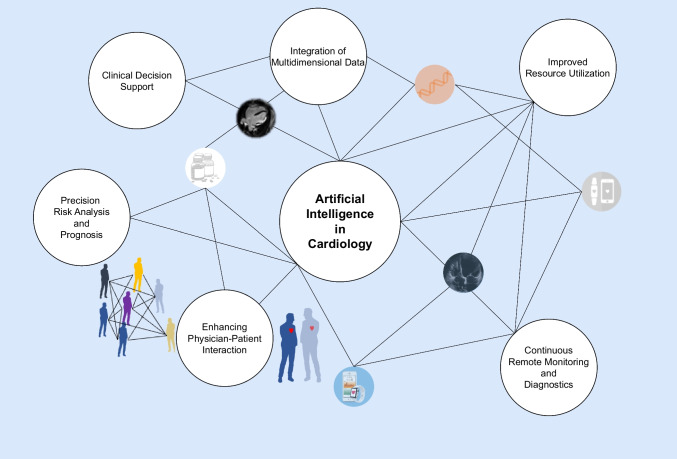
Purpose of review: The introduction of Artificial Intelligence into the healthcare system offers enormous opportunities for biomedical research, the improvement of patient care, and cost reduction in high-end medicine. Digital concepts and workflows are already playing an increasingly important role in cardiology. The fusion of computer science and medicine offers great transformative potential and enables enormous acceleration processes in cardiovascular medicine.
Recent findings: As medical data becomes smart, it is also becoming more valuable and vulnerable to malicious actors. In addition, the gap between what is technically possible and what is allowed by privacy legislation is growing. Principles of the General Data Protection Regulation that have been in force since May 2018, such as transparency, purpose limitation, and data minimization, seem to hinder the development and use of Artificial Intelligence. Concepts to secure data integrity and incorporate legal and ethical principles can help to avoid the potential risks of digitization and may result in an European leadership in regard to privacy protection and AI. The following review provides an overview of relevant aspects of Artificial Intelligence and Machine Learning, highlights selected applications in cardiology, and discusses central ethical and legal considerations.
期刊介绍:
This journal intends to provide clear, insightful, balanced contributions by international experts that review the most important, recently published clinical findings related to the diagnosis, treatment, management, and prevention of heart failure. We accomplish this aim by appointing international authorities to serve as Section Editors in key subject areas, such as investigative, pharmacologic, and nonpharmacologic therapies, pathophysiology, and prevention. Section Editors, in turn, select topics for which leading experts contribute comprehensive review articles that emphasize new developments and recently published papers of major importance, highlighted by annotated reference lists. An international Editorial Board reviews the annual table of contents, suggests articles of special interest to their country/region, and ensures that topics are current and include emerging research. Commentaries from well-known figures in the field are also provided.



 京公网安备 11010802042870号
京ICP备2023020795号-1
京公网安备 11010802042870号
京ICP备2023020795号-1

 分享
分享
 求助内容:
求助内容: 应助结果提醒方式:
 扫码关注我们
