{"title":"Evaluation of microhardness in two types of denture bases after using sodium hypochlorite and NatureDent disinfecting agents.","authors":"Elnaz Moslehifard, Tahereh Ghaffari, Khosro Zarei, Mahsa Karimoghli","doi":"10.34172/joddd.2022.033","DOIUrl":null,"url":null,"abstract":"<p><p><b>Background.</b> Chemical agents, in combination with mechanical methods, play an important role in reducing microbial plaque on denture surfaces. However, these methods might change the mechanical behavior of acrylic resins, including microhardness and surface roughness. This in vitro study investigated the effect of two disinfectants, i.e., water and sodium hypochlorite, on the microhardness of conventional heat-cured and TiO<sub>2</sub> nanoparticle-reinforced acrylic resins. <b>Methods.</b> Sixty acrylic resin specimens were divided into two groups, and the samples in each group were randomly assigned to three subgroups (n=10). Heat-cured specimens and 1 wt% TiO<sub>2</sub> acrylic resin were prepared and immersed in three solutions: water, a solution prepared with NatureDent pills, and 1% sodium hypochlorite for 30, 60, and 90 days. Microhardness tests were performed on each sample at each immersion stage. The data were analyzed using descriptive statistical methods, three-way and one-way ANOVA, repeated-measures <i>t</i> test, and Tukey HSD tests using SPSS 17. <i>P</i> values<0.05 were considered significant. <b>Results.</b> All three independent parameters, including resin, solution, and time, significantly affected microhardness (<i>P</i><0.05). The microhardness of both specimen types, i.e., conventional heat-cured and TiO<sub>2</sub> nanoparticle-reinforced acrylic resins, immersed for 30, 60, and 90 days, was the highest and lowest in water and hypochlorite solutions, respectively. Regarding 90 days, the microhardness values of conventional heat-cured and TiO<sub>2</sub> nanoparticle-reinforced acrylic resins were 17.050±0.094 and 19.953±0.053 in water, 15.675±0.069 and 18.965±0.037 in hypochlorite, and 16.713±0.122 and 19.39±20.113 in NatureDent solutions, respectively. <b>Conclusion.</b> Disinfecting two types of acrylic resin specimens decreased their microhardness as a function of immersion time for up to 90 days in the three solutions. However, the magnitude of hardness lost was less for TiO<sub>2</sub> nanoparticles-reinforced acrylic resin.</p>","PeriodicalId":15599,"journal":{"name":"Journal of Dental Research, Dental Clinics, Dental Prospects","volume":"16 3","pages":"196-203"},"PeriodicalIF":0.0000,"publicationDate":"2022-01-01","publicationTypes":"Journal Article","fieldsOfStudy":null,"isOpenAccess":false,"openAccessPdf":"https://www.ncbi.nlm.nih.gov/pmc/articles/PMC9871170/pdf/","citationCount":"0","resultStr":null,"platform":"Semanticscholar","paperid":null,"PeriodicalName":"Journal of Dental Research, Dental Clinics, Dental Prospects","FirstCategoryId":"1085","ListUrlMain":"https://doi.org/10.34172/joddd.2022.033","RegionNum":0,"RegionCategory":null,"ArticlePicture":[],"TitleCN":null,"AbstractTextCN":null,"PMCID":null,"EPubDate":"","PubModel":"","JCR":"Q4","JCRName":"Dentistry","Score":null,"Total":0}
引用次数: 0
Abstract
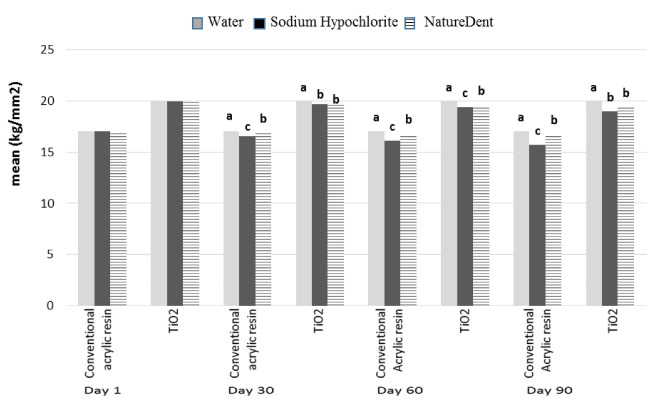
Background. Chemical agents, in combination with mechanical methods, play an important role in reducing microbial plaque on denture surfaces. However, these methods might change the mechanical behavior of acrylic resins, including microhardness and surface roughness. This in vitro study investigated the effect of two disinfectants, i.e., water and sodium hypochlorite, on the microhardness of conventional heat-cured and TiO2 nanoparticle-reinforced acrylic resins. Methods. Sixty acrylic resin specimens were divided into two groups, and the samples in each group were randomly assigned to three subgroups (n=10). Heat-cured specimens and 1 wt% TiO2 acrylic resin were prepared and immersed in three solutions: water, a solution prepared with NatureDent pills, and 1% sodium hypochlorite for 30, 60, and 90 days. Microhardness tests were performed on each sample at each immersion stage. The data were analyzed using descriptive statistical methods, three-way and one-way ANOVA, repeated-measures t test, and Tukey HSD tests using SPSS 17. P values<0.05 were considered significant. Results. All three independent parameters, including resin, solution, and time, significantly affected microhardness (P<0.05). The microhardness of both specimen types, i.e., conventional heat-cured and TiO2 nanoparticle-reinforced acrylic resins, immersed for 30, 60, and 90 days, was the highest and lowest in water and hypochlorite solutions, respectively. Regarding 90 days, the microhardness values of conventional heat-cured and TiO2 nanoparticle-reinforced acrylic resins were 17.050±0.094 and 19.953±0.053 in water, 15.675±0.069 and 18.965±0.037 in hypochlorite, and 16.713±0.122 and 19.39±20.113 in NatureDent solutions, respectively. Conclusion. Disinfecting two types of acrylic resin specimens decreased their microhardness as a function of immersion time for up to 90 days in the three solutions. However, the magnitude of hardness lost was less for TiO2 nanoparticles-reinforced acrylic resin.
期刊介绍:
Journal of Dental Research Dental Clinics Dental Prospects (JODDD) is a Platinum* Open Access, peer-reviewed quarterly indexed journal that publishes articles of basic, clinical, and prospective nature in all areas of dentistry and oral health.




 京公网安备 11010802042870号
京ICP备2023020795号-1
京公网安备 11010802042870号
京ICP备2023020795号-1

 分享
分享
 求助内容:
求助内容: 应助结果提醒方式:
 扫码关注我们
