Assessment of Virtual Mindfulness-Based Training for Health Care Professionals: Improved Self-Reported Respiration Rates, Perceived Stress, and Resilience.
{"title":"Assessment of Virtual Mindfulness-Based Training for Health Care Professionals: Improved Self-Reported Respiration Rates, Perceived Stress, and Resilience.","authors":"Justin J Merrigan, Catherine Quatman-Yates, Jacqueline Caputo, Kayla Daniel, Nadia Briones, Ilayda Sen, Slate Bretz, Anne-Marie Duchemin, Beth Steinberg, Joshua A Hagen, Maryanna Klatt","doi":"10.1177/27536130231187636","DOIUrl":null,"url":null,"abstract":"<p><strong>Background: </strong>Mindfulness in Motion (MIM) is a workplace resilience-building intervention that has shown reductions in perceived stress and burnout, as well as increased resilience and work engagement in health care workers.</p><p><strong>Objective: </strong>To evaluate effects of MIM delivered in a synchronous virtual format on self-reported respiratory rates (RR), as well as perceived stress and resiliency of health care workers.</p><p><strong>Methods: </strong>Breath counts were self-reported by 275 participants before and after 8 weekly MIM sessions. MIM was delivered virtually in a group format as a structured, evidence-based workplace intervention including a variety of mindfulness, relaxation, and resilience-building techniques. Participants counted their breaths for 30 seconds, which was then multiplied by 2 to report RR. Additionally, participants completed Perceived Stress Scale and Connor-Davidson Resiliency Scale.</p><p><strong>Results: </strong>According to mixed effect analyses there were main effects of MIM Session (P < .001) and Weeks (P < .001), but no Session by Week interaction (P = .489) on RR. On average, RR prior to MIM sessions were reduced from 13.24 bpm (95% CI = 12.94, 13.55 bpm) to 9.69 bpm (95% CI = 9.39, 9.99 bpm). When comparing average Pre-MIM and Post-MIM RR throughout the MIM intervention, Week-2 (mean = 12.34; 95% CI = 11.89, 12.79 bpm) was not significantly different than Week-1 (mean = 12.78; 95% CI = 12.34, 13.23 bpm), but Week-3 through Week-8 demonstrated significantly lower average Pre-MIM and Post-MIM RR compared to Week-1 (average weekly difference range: 1.36 to 2.48 bpm, P < .05). Perceived stress was reduced from Week-1 (17.52 ± 6.25) to after Week-8 (13.52 ± 6.04; P < .001), while perceived resiliency was increased from Week-1 (11.30 ± 5.14) to after Week-8 (19.29 ± 2.58); P < .001).</p><p><strong>Conclusion: </strong>Thus far, completion of MIM sessions has shown acute and long-term effects on self-reported RR, but more research is required to determine the extent of improved parasympathetic (relaxed) states. Collectively, this work has shown value for mind-body stress mitigation and resiliency-building in high stress acute health care environments.</p>","PeriodicalId":73159,"journal":{"name":"Global advances in integrative medicine and health","volume":"12 ","pages":"27536130231187636"},"PeriodicalIF":1.3000,"publicationDate":"2023-01-01","publicationTypes":"Journal Article","fieldsOfStudy":null,"isOpenAccess":false,"openAccessPdf":"https://ftp.ncbi.nlm.nih.gov/pub/pmc/oa_pdf/89/ae/10.1177_27536130231187636.PMC10331219.pdf","citationCount":"0","resultStr":null,"platform":"Semanticscholar","paperid":null,"PeriodicalName":"Global advances in integrative medicine and health","FirstCategoryId":"1085","ListUrlMain":"https://doi.org/10.1177/27536130231187636","RegionNum":0,"RegionCategory":null,"ArticlePicture":[],"TitleCN":null,"AbstractTextCN":null,"PMCID":null,"EPubDate":"","PubModel":"","JCR":"","JCRName":"","Score":null,"Total":0}
引用次数: 0
Abstract
Background: Mindfulness in Motion (MIM) is a workplace resilience-building intervention that has shown reductions in perceived stress and burnout, as well as increased resilience and work engagement in health care workers.
Objective: To evaluate effects of MIM delivered in a synchronous virtual format on self-reported respiratory rates (RR), as well as perceived stress and resiliency of health care workers.
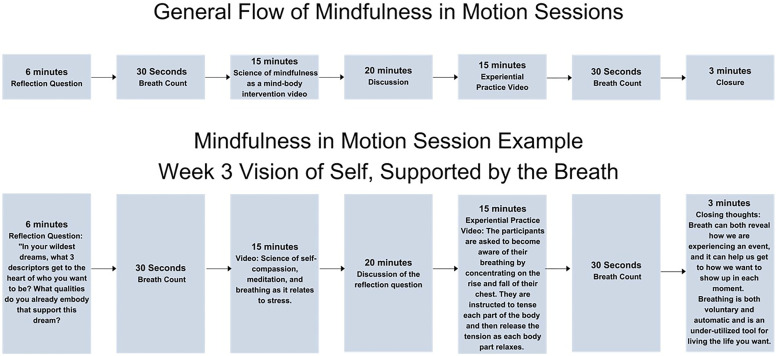
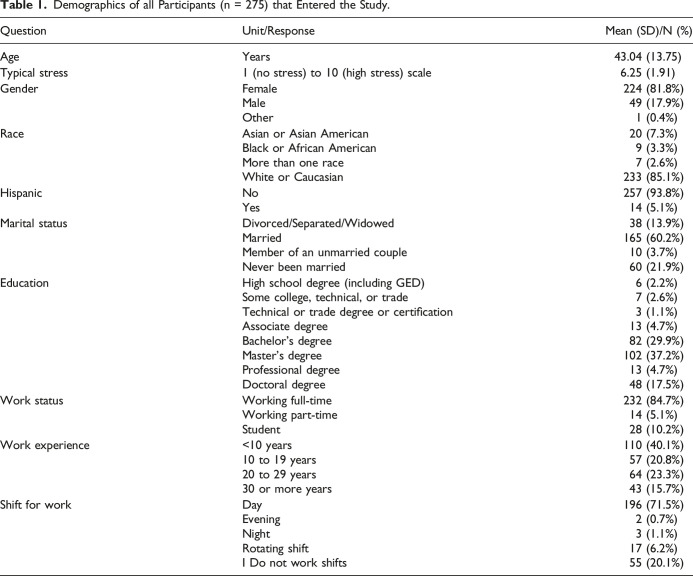
Methods: Breath counts were self-reported by 275 participants before and after 8 weekly MIM sessions. MIM was delivered virtually in a group format as a structured, evidence-based workplace intervention including a variety of mindfulness, relaxation, and resilience-building techniques. Participants counted their breaths for 30 seconds, which was then multiplied by 2 to report RR. Additionally, participants completed Perceived Stress Scale and Connor-Davidson Resiliency Scale.
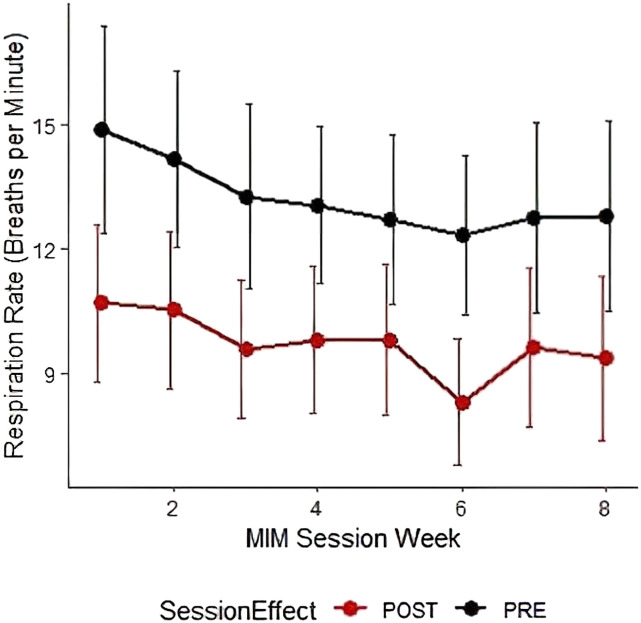
Results: According to mixed effect analyses there were main effects of MIM Session (P < .001) and Weeks (P < .001), but no Session by Week interaction (P = .489) on RR. On average, RR prior to MIM sessions were reduced from 13.24 bpm (95% CI = 12.94, 13.55 bpm) to 9.69 bpm (95% CI = 9.39, 9.99 bpm). When comparing average Pre-MIM and Post-MIM RR throughout the MIM intervention, Week-2 (mean = 12.34; 95% CI = 11.89, 12.79 bpm) was not significantly different than Week-1 (mean = 12.78; 95% CI = 12.34, 13.23 bpm), but Week-3 through Week-8 demonstrated significantly lower average Pre-MIM and Post-MIM RR compared to Week-1 (average weekly difference range: 1.36 to 2.48 bpm, P < .05). Perceived stress was reduced from Week-1 (17.52 ± 6.25) to after Week-8 (13.52 ± 6.04; P < .001), while perceived resiliency was increased from Week-1 (11.30 ± 5.14) to after Week-8 (19.29 ± 2.58); P < .001).
Conclusion: Thus far, completion of MIM sessions has shown acute and long-term effects on self-reported RR, but more research is required to determine the extent of improved parasympathetic (relaxed) states. Collectively, this work has shown value for mind-body stress mitigation and resiliency-building in high stress acute health care environments.



 京公网安备 11010802042870号
京ICP备2023020795号-1
京公网安备 11010802042870号
京ICP备2023020795号-1

 分享
分享

 求助内容:
求助内容: 应助结果提醒方式:
 扫码关注我们
