Distinction of pulmonary large cell neuroendocrine carcinoma from small cell lung carcinoma: a morphological, immunohistochemical, and molecular analysis
{"title":"Distinction of pulmonary large cell neuroendocrine carcinoma from small cell lung carcinoma: a morphological, immunohistochemical, and molecular analysis","authors":"Kenzo Hiroshima, Akira Iyoda, Takashi Shida, Kiyoshi Shibuya, Toshihiko Iizasa, Hirohisa Kishi, Tohru Tanizawa, Takehiko Fujisawa, Yukio Nakatani","doi":"10.1038/modpathol.3800659","DOIUrl":null,"url":null,"abstract":"The distinction between pulmonary large cell neuroendocrine carcinoma and small cell carcinoma is difficult in some cases. Some propose that these carcinomas should be classified as one high-grade neuroendocrine carcinoma. We examined biological features of small cell carcinoma (n=23), large cell neuroendocrine carcinoma (n=17), and classic large cell carcinoma (n=12). The average ratio of nuclear diameter of the tumor cells to that of lymphocytes for small cell carcinoma was smaller than that for large cell neuroendocrine carcinoma (P<0.0001). The frequencies of the expressions of CD56, mASH1, TTF-1, and p16 were higher and that of NeuroD was lower in small cell carcinoma than in large cell neuroendocrine carcinoma. The frequency of loss of heterozygosity at 3p was higher in high-grade neuroendocrine carcinomas than in classic large cell carcinoma (P=0.0002). Allelic losses at D5S422 (5q33) were more frequent in small cell carcinoma than in large cell neuroendocrine carcinoma (P=0.0091). Mean fractional regional loss indices of the tumors were 0.38, 0.65, and 0.72 for patients with classic large cell carcinoma, large cell neuroendocrine carcinoma, and small cell carcinoma, respectively (P=0.0003). Five-year overall survivals of patients with classic large cell carcinoma, large cell neuroendocrine carcinoma and small cell carcinoma in stage I were 67, 73, 60%, respectively. Patients with NeuroD expression had better survivals, and those with p63 expression had poorer survivals in large cell neuroendocrine carcinoma. Patients with TTF-1 expression had poorer survivals in small cell carcinoma. Our data suggest that large cell neuroendocrine carcinoma and small cell carcinoma are different morphologically, phenotypically, and genetically, although there are some overlapping features. Although further studies are needed to analyze the biological behavior of high-grade neuroendocrine carcinomas including sensitivity to chemotherapy, the pathological distinction of large cell neuroendocrine carcinoma from small cell carcinoma may be necessary to treat the patients with neuroendocrine tumors.","PeriodicalId":18706,"journal":{"name":"Modern Pathology","volume":"19 10","pages":"1358-1368"},"PeriodicalIF":5.5000,"publicationDate":"2006-07-07","publicationTypes":"Journal Article","fieldsOfStudy":null,"isOpenAccess":false,"openAccessPdf":"https://sci-hub-pdf.com/10.1038/modpathol.3800659","citationCount":"148","resultStr":null,"platform":"Semanticscholar","paperid":null,"PeriodicalName":"Modern Pathology","FirstCategoryId":"3","ListUrlMain":"https://www.nature.com/articles/3800659","RegionNum":1,"RegionCategory":"医学","ArticlePicture":[],"TitleCN":null,"AbstractTextCN":null,"PMCID":null,"EPubDate":"","PubModel":"","JCR":"Q1","JCRName":"PATHOLOGY","Score":null,"Total":0}
引用次数: 148
Abstract
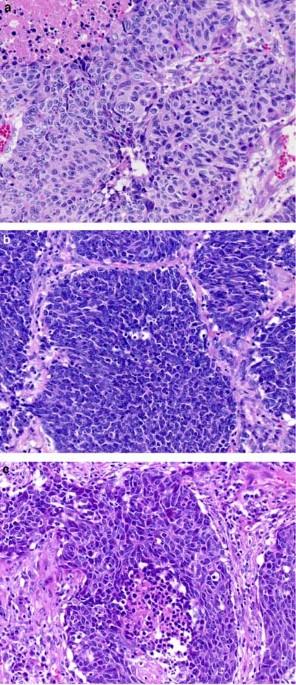
The distinction between pulmonary large cell neuroendocrine carcinoma and small cell carcinoma is difficult in some cases. Some propose that these carcinomas should be classified as one high-grade neuroendocrine carcinoma. We examined biological features of small cell carcinoma (n=23), large cell neuroendocrine carcinoma (n=17), and classic large cell carcinoma (n=12). The average ratio of nuclear diameter of the tumor cells to that of lymphocytes for small cell carcinoma was smaller than that for large cell neuroendocrine carcinoma (P<0.0001). The frequencies of the expressions of CD56, mASH1, TTF-1, and p16 were higher and that of NeuroD was lower in small cell carcinoma than in large cell neuroendocrine carcinoma. The frequency of loss of heterozygosity at 3p was higher in high-grade neuroendocrine carcinomas than in classic large cell carcinoma (P=0.0002). Allelic losses at D5S422 (5q33) were more frequent in small cell carcinoma than in large cell neuroendocrine carcinoma (P=0.0091). Mean fractional regional loss indices of the tumors were 0.38, 0.65, and 0.72 for patients with classic large cell carcinoma, large cell neuroendocrine carcinoma, and small cell carcinoma, respectively (P=0.0003). Five-year overall survivals of patients with classic large cell carcinoma, large cell neuroendocrine carcinoma and small cell carcinoma in stage I were 67, 73, 60%, respectively. Patients with NeuroD expression had better survivals, and those with p63 expression had poorer survivals in large cell neuroendocrine carcinoma. Patients with TTF-1 expression had poorer survivals in small cell carcinoma. Our data suggest that large cell neuroendocrine carcinoma and small cell carcinoma are different morphologically, phenotypically, and genetically, although there are some overlapping features. Although further studies are needed to analyze the biological behavior of high-grade neuroendocrine carcinomas including sensitivity to chemotherapy, the pathological distinction of large cell neuroendocrine carcinoma from small cell carcinoma may be necessary to treat the patients with neuroendocrine tumors.
期刊介绍:
Modern Pathology, an international journal under the ownership of The United States & Canadian Academy of Pathology (USCAP), serves as an authoritative platform for publishing top-tier clinical and translational research studies in pathology.
Original manuscripts are the primary focus of Modern Pathology, complemented by impactful editorials, reviews, and practice guidelines covering all facets of precision diagnostics in human pathology. The journal's scope includes advancements in molecular diagnostics and genomic classifications of diseases, breakthroughs in immune-oncology, computational science, applied bioinformatics, and digital pathology.




 京公网安备 11010802042870号
京ICP备2023020795号-1
京公网安备 11010802042870号
京ICP备2023020795号-1

 分享
分享
 求助内容:
求助内容: 应助结果提醒方式:
 扫码关注我们
