Daniel M DuBreuil, Xiaofan Lai, Kevin Zhu, Gracesenia Chahyadinata, Caroline Perner, Brenda M Chiang, Ashley Battenberg, Caroline L Sokol, Brian J Wainger
{"title":"Phenotypic screen identifies the natural product silymarin as a novel anti-inflammatory analgesic.","authors":"Daniel M DuBreuil, Xiaofan Lai, Kevin Zhu, Gracesenia Chahyadinata, Caroline Perner, Brenda M Chiang, Ashley Battenberg, Caroline L Sokol, Brian J Wainger","doi":"10.1177/17448069221148351","DOIUrl":null,"url":null,"abstract":"<p><p>Sensory neuron hyperexcitability is a critical driver of pathological pain and can result from axon damage, inflammation, or neuronal stress. G-protein coupled receptor signaling can induce pain amplification by modulating the activation of Trp-family ionotropic receptors and voltage-gated ion channels. Here, we sought to use calcium imaging to identify novel inhibitors of the intracellular pathways that mediate sensory neuron sensitization and lead to hyperexcitability. We identified a novel stimulus cocktail, consisting of the SSTR2 agonist L-054,264 and the S1PR3 agonist CYM5541, that elicits calcium responses in mouse primary sensory neurons <i>in vitro</i> as well as pain and thermal hypersensitivity in mice <i>in vivo</i>. We screened a library of 906 bioactive compounds and identified 24 hits that reduced calcium flux elicited by L-054,264/CYM5541. Among these hits, silymarin, a natural product derived from milk thistle, strongly reduced activation by the stimulation cocktail, as well as by a distinct inflammatory cocktail containing bradykinin and prostaglandin E2. Silymarin had no effect on sensory neuron excitability at baseline, but reduced calcium flux via Orai channels and downstream mediators of phospholipase C signaling. <i>In vivo</i>, silymarin pretreatment blocked development of adjuvant-mediated thermal hypersensitivity, indicating potential use as an anti-inflammatory analgesic.</p>","PeriodicalId":19010,"journal":{"name":"Molecular Pain","volume":"19 ","pages":"17448069221148351"},"PeriodicalIF":2.8000,"publicationDate":"2023-01-01","publicationTypes":"Journal Article","fieldsOfStudy":null,"isOpenAccess":false,"openAccessPdf":"https://ftp.ncbi.nlm.nih.gov/pub/pmc/oa_pdf/e7/65/10.1177_17448069221148351.PMC9893088.pdf","citationCount":"0","resultStr":null,"platform":"Semanticscholar","paperid":null,"PeriodicalName":"Molecular Pain","FirstCategoryId":"3","ListUrlMain":"https://doi.org/10.1177/17448069221148351","RegionNum":3,"RegionCategory":"医学","ArticlePicture":[],"TitleCN":null,"AbstractTextCN":null,"PMCID":null,"EPubDate":"","PubModel":"","JCR":"Q2","JCRName":"NEUROSCIENCES","Score":null,"Total":0}
引用次数: 0
Abstract
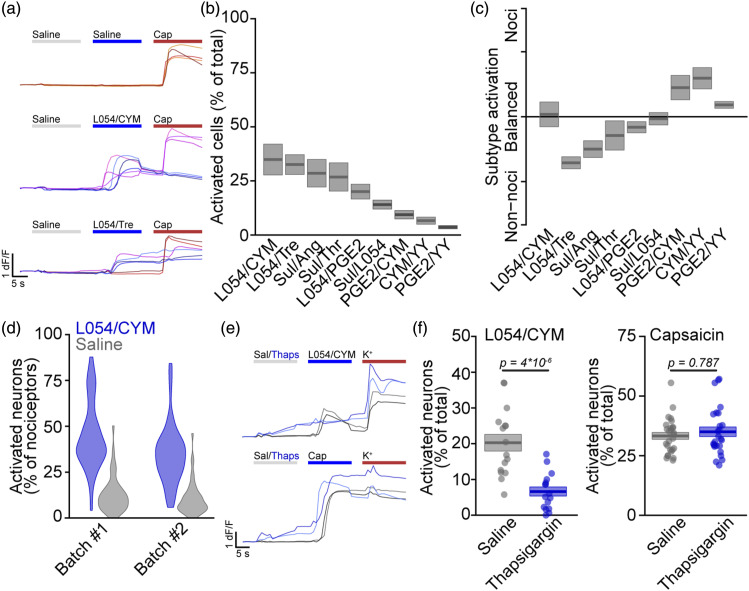
Sensory neuron hyperexcitability is a critical driver of pathological pain and can result from axon damage, inflammation, or neuronal stress. G-protein coupled receptor signaling can induce pain amplification by modulating the activation of Trp-family ionotropic receptors and voltage-gated ion channels. Here, we sought to use calcium imaging to identify novel inhibitors of the intracellular pathways that mediate sensory neuron sensitization and lead to hyperexcitability. We identified a novel stimulus cocktail, consisting of the SSTR2 agonist L-054,264 and the S1PR3 agonist CYM5541, that elicits calcium responses in mouse primary sensory neurons in vitro as well as pain and thermal hypersensitivity in mice in vivo. We screened a library of 906 bioactive compounds and identified 24 hits that reduced calcium flux elicited by L-054,264/CYM5541. Among these hits, silymarin, a natural product derived from milk thistle, strongly reduced activation by the stimulation cocktail, as well as by a distinct inflammatory cocktail containing bradykinin and prostaglandin E2. Silymarin had no effect on sensory neuron excitability at baseline, but reduced calcium flux via Orai channels and downstream mediators of phospholipase C signaling. In vivo, silymarin pretreatment blocked development of adjuvant-mediated thermal hypersensitivity, indicating potential use as an anti-inflammatory analgesic.
期刊介绍:
Molecular Pain is a peer-reviewed, open access journal that considers manuscripts in pain research at the cellular, subcellular and molecular levels. Molecular Pain provides a forum for molecular pain scientists to communicate their research findings in a targeted manner to others in this important and growing field.





 京公网安备 11010802042870号
京ICP备2023020795号-1
京公网安备 11010802042870号
京ICP备2023020795号-1

 分享
分享
 求助内容:
求助内容: 应助结果提醒方式:
 扫码关注我们
