Bethzaely Fernández-Reyes, Stefannie Morales-Jiménez, Gloriani Sánchez-Marrero, Juan C. Muñoz-Senmache, Arturo J. Hernández-Maldonado
{"title":"Hierarchical three-dimensionally ordered mesoporous carbon (3DOm) zeolite composites for the adsorption of Contaminants of emerging concern","authors":"Bethzaely Fernández-Reyes, Stefannie Morales-Jiménez, Gloriani Sánchez-Marrero, Juan C. Muñoz-Senmache, Arturo J. Hernández-Maldonado","doi":"10.1016/j.hazl.2021.100017","DOIUrl":null,"url":null,"abstract":"<div><p>Effective removal of contaminants of emerging concern (CECs) from water via adsorption requires adsorbent materials that showcase a synergistic combination of textural properties, hydrophobicity, and specific surface interactions. In this work, we present a hierarchical composite prepared on the basis of <em>in-situ</em> or confined growth of a faujasite zeolite (FAU) within the voids of a 3D mesoporous ordered carbon (3DOm). This adsorbent was tested for the removal of several CECs (i.e., caffeine, carbamazepine, naproxen and metabolites clofibric acid, 10,11-epoxy-carbamazepine, <em>o</em>-desmethyl naproxen, paraxanthine, and salicylic acid) from water at ambient conditions. Upon inclusion of copper(II) extra-framework cations, the hierarchical composite (Cu-3DOm-FAU) excelled at adsorbing ionic CECs and offered similar uptake capacity toward neutral parent compounds in both single- and multi-component fashion and while covering a μg L<sup>−1</sup> - mg L<sup>−1</sup> concentration range. Compared to other adsorbents reported so far in the literature, the Cu-3DOm-FAU composite adsorption capacities were larger, in many cases by at least one order of magnitude. Given the substantial thermal stability of the composite, regeneration could be accomplished via thermal cycling also depending on the type of CEC involved.</p></div>","PeriodicalId":93463,"journal":{"name":"Journal of hazardous materials letters","volume":"2 ","pages":"Article 100017"},"PeriodicalIF":8.1000,"publicationDate":"2021-11-01","publicationTypes":"Journal Article","fieldsOfStudy":null,"isOpenAccess":false,"openAccessPdf":"https://sci-hub-pdf.com/10.1016/j.hazl.2021.100017","citationCount":"7","resultStr":null,"platform":"Semanticscholar","paperid":null,"PeriodicalName":"Journal of hazardous materials letters","FirstCategoryId":"1085","ListUrlMain":"https://www.sciencedirect.com/science/article/pii/S2666911021000058","RegionNum":0,"RegionCategory":null,"ArticlePicture":[],"TitleCN":null,"AbstractTextCN":null,"PMCID":null,"EPubDate":"2021/2/16 0:00:00","PubModel":"Epub","JCR":"Q1","JCRName":"ENGINEERING, ENVIRONMENTAL","Score":null,"Total":0}
引用次数: 7
Abstract
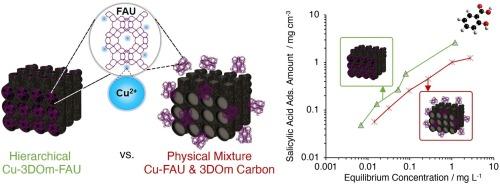
Effective removal of contaminants of emerging concern (CECs) from water via adsorption requires adsorbent materials that showcase a synergistic combination of textural properties, hydrophobicity, and specific surface interactions. In this work, we present a hierarchical composite prepared on the basis of in-situ or confined growth of a faujasite zeolite (FAU) within the voids of a 3D mesoporous ordered carbon (3DOm). This adsorbent was tested for the removal of several CECs (i.e., caffeine, carbamazepine, naproxen and metabolites clofibric acid, 10,11-epoxy-carbamazepine, o-desmethyl naproxen, paraxanthine, and salicylic acid) from water at ambient conditions. Upon inclusion of copper(II) extra-framework cations, the hierarchical composite (Cu-3DOm-FAU) excelled at adsorbing ionic CECs and offered similar uptake capacity toward neutral parent compounds in both single- and multi-component fashion and while covering a μg L−1 - mg L−1 concentration range. Compared to other adsorbents reported so far in the literature, the Cu-3DOm-FAU composite adsorption capacities were larger, in many cases by at least one order of magnitude. Given the substantial thermal stability of the composite, regeneration could be accomplished via thermal cycling also depending on the type of CEC involved.




 京公网安备 11010802042870号
京ICP备2023020795号-1
京公网安备 11010802042870号
京ICP备2023020795号-1

 分享
分享
 求助内容:
求助内容: 应助结果提醒方式:
 扫码关注我们
