Graham Keir, Willie Hu, Christopher G Filippi, Lisa Ellenbogen, Rona Woldenberg
{"title":"Using artificial intelligence in medical school admissions screening to decrease inter- and intra-observer variability.","authors":"Graham Keir, Willie Hu, Christopher G Filippi, Lisa Ellenbogen, Rona Woldenberg","doi":"10.1093/jamiaopen/ooad011","DOIUrl":null,"url":null,"abstract":"<p><strong>Objectives: </strong>Inter- and intra-observer variability is a concern for medical school admissions. Artificial intelligence (AI) may present an opportunity to apply a fair standard to all applicants systematically and yet maintain sensitivity to nuances that have been a part of traditional screening methods.</p><p><strong>Material and methods: </strong>Data from 5 years of medical school applications were retrospectively accrued and analyzed. The applicants (<i>m</i> = 22 258 applicants) were split 60%-20%-20% into a training set (<i>m</i> = 13 354), validation set (<i>m</i> = 4452), and test set (<i>m</i> = 4452). An AI model was trained and evaluated with the ground truth being whether a given applicant was invited for an interview. In addition, a \"real-world\" evaluation was conducted simultaneously within an admissions cycle to observe how it would perform if utilized.</p><p><strong>Results: </strong>The algorithm had an accuracy of 95% on the training set, 88% on the validation set, and 88% on the test set. The area under the curve of the test set was 0.93. The SHapely Additive exPlanations (SHAP) values demonstrated that the model utilizes features in a concordant manner with current admissions rubrics. By using a combined human and AI evaluation process, the accuracy of the process was demonstrated to be 96% on the \"real-world\" evaluation with a negative predictive value of 0.97.</p><p><strong>Discussion and conclusion: </strong>These results demonstrate the feasibility of an AI approach applied to medical school admissions screening decision-making. Model explainability and supplemental analyses help ensure that the model makes decisions as intended.</p>","PeriodicalId":36278,"journal":{"name":"JAMIA Open","volume":"6 1","pages":"ooad011"},"PeriodicalIF":3.4000,"publicationDate":"2023-04-01","publicationTypes":"Journal Article","fieldsOfStudy":null,"isOpenAccess":false,"openAccessPdf":"https://www.ncbi.nlm.nih.gov/pmc/articles/PMC9936956/pdf/","citationCount":"2","resultStr":null,"platform":"Semanticscholar","paperid":null,"PeriodicalName":"JAMIA Open","FirstCategoryId":"1085","ListUrlMain":"https://doi.org/10.1093/jamiaopen/ooad011","RegionNum":0,"RegionCategory":null,"ArticlePicture":[],"TitleCN":null,"AbstractTextCN":null,"PMCID":null,"EPubDate":"","PubModel":"","JCR":"Q2","JCRName":"HEALTH CARE SCIENCES & SERVICES","Score":null,"Total":0}
引用次数: 2
Abstract
Objectives: Inter- and intra-observer variability is a concern for medical school admissions. Artificial intelligence (AI) may present an opportunity to apply a fair standard to all applicants systematically and yet maintain sensitivity to nuances that have been a part of traditional screening methods.
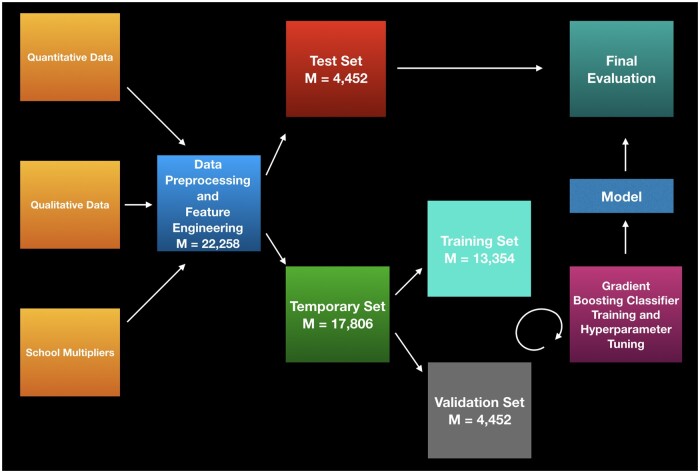
Material and methods: Data from 5 years of medical school applications were retrospectively accrued and analyzed. The applicants (m = 22 258 applicants) were split 60%-20%-20% into a training set (m = 13 354), validation set (m = 4452), and test set (m = 4452). An AI model was trained and evaluated with the ground truth being whether a given applicant was invited for an interview. In addition, a "real-world" evaluation was conducted simultaneously within an admissions cycle to observe how it would perform if utilized.
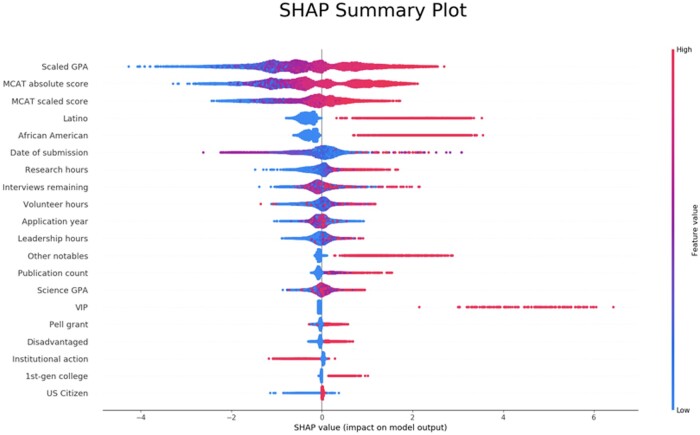
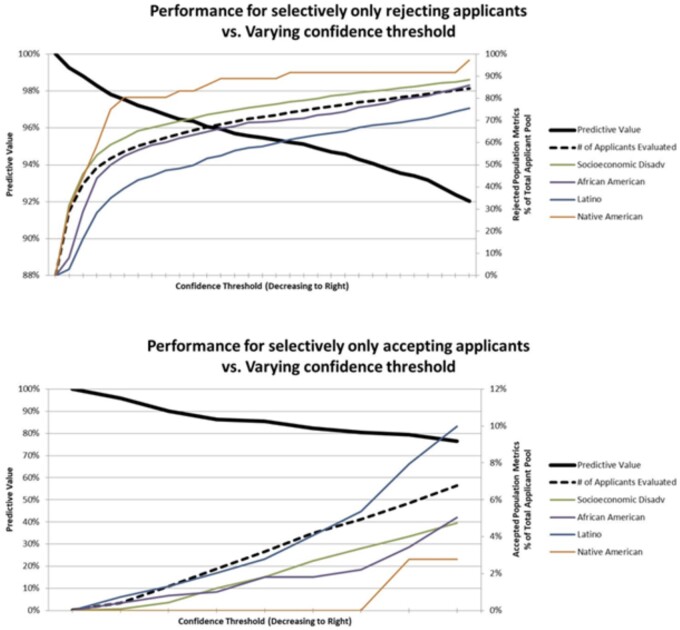
Results: The algorithm had an accuracy of 95% on the training set, 88% on the validation set, and 88% on the test set. The area under the curve of the test set was 0.93. The SHapely Additive exPlanations (SHAP) values demonstrated that the model utilizes features in a concordant manner with current admissions rubrics. By using a combined human and AI evaluation process, the accuracy of the process was demonstrated to be 96% on the "real-world" evaluation with a negative predictive value of 0.97.
Discussion and conclusion: These results demonstrate the feasibility of an AI approach applied to medical school admissions screening decision-making. Model explainability and supplemental analyses help ensure that the model makes decisions as intended.




 京公网安备 11010802042870号
京ICP备2023020795号-1
京公网安备 11010802042870号
京ICP备2023020795号-1

 分享
分享
 求助内容:
求助内容: 应助结果提醒方式:
 扫码关注我们
