{"title":"Does Motor Memory Reactivation through Practice and Post-Learning Sleep Modulate Consolidation?","authors":"Whitney Stee, Philippe Peigneux","doi":"10.3390/clockssleep5010008","DOIUrl":null,"url":null,"abstract":"<p><p>Retrieving previously stored information makes memory traces labile again and can trigger restabilization in a strengthened or weakened form depending on the reactivation condition. Available evidence for long-term performance changes upon reactivation of motor memories and the effect of post-learning sleep on their consolidation remains scarce, and so does the data on the ways in which subsequent reactivation of motor memories interacts with sleep-related consolidation. Eighty young volunteers learned (Day 1) a 12-element Serial Reaction Time Task (SRTT) before a post-training Regular Sleep (RS) or Sleep Deprivation (SD) night, either followed (Day 2) by morning motor reactivation through a short SRTT testing or no motor activity. Consolidation was assessed after three recovery nights (Day 5). A 2 × 2 ANOVA carried on proportional offline gains did not evidence significant Reactivation (Morning Reactivation/No Morning Reactivation; <i>p</i> = 0.098), post-training Sleep (RS/SD; <i>p</i> = 0.301) or Sleep*Reactivation interaction (<i>p</i> = 0.257) effect. Our results are in line with prior studies suggesting a lack of supplementary performance gains upon reactivation, and other studies that failed to disclose post-learning sleep-related effects on performance improvement. However, lack of overt behavioural effects does not detract from the possibility of sleep- or reconsolidation-related covert neurophysiological changes underlying similar behavioural performance levels.</p>","PeriodicalId":33568,"journal":{"name":"Clocks & Sleep","volume":"5 1","pages":"72-84"},"PeriodicalIF":2.1000,"publicationDate":"2023-02-17","publicationTypes":"Journal Article","fieldsOfStudy":null,"isOpenAccess":false,"openAccessPdf":"https://www.ncbi.nlm.nih.gov/pmc/articles/PMC9944088/pdf/","citationCount":"0","resultStr":null,"platform":"Semanticscholar","paperid":null,"PeriodicalName":"Clocks & Sleep","FirstCategoryId":"1085","ListUrlMain":"https://doi.org/10.3390/clockssleep5010008","RegionNum":0,"RegionCategory":null,"ArticlePicture":[],"TitleCN":null,"AbstractTextCN":null,"PMCID":null,"EPubDate":"","PubModel":"","JCR":"Q3","JCRName":"CLINICAL NEUROLOGY","Score":null,"Total":0}
引用次数: 0
Abstract
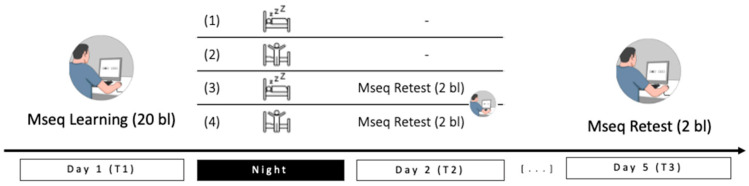
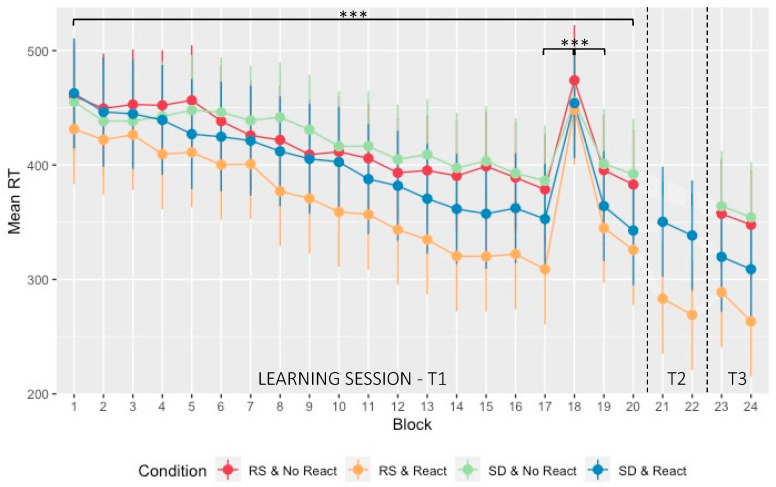
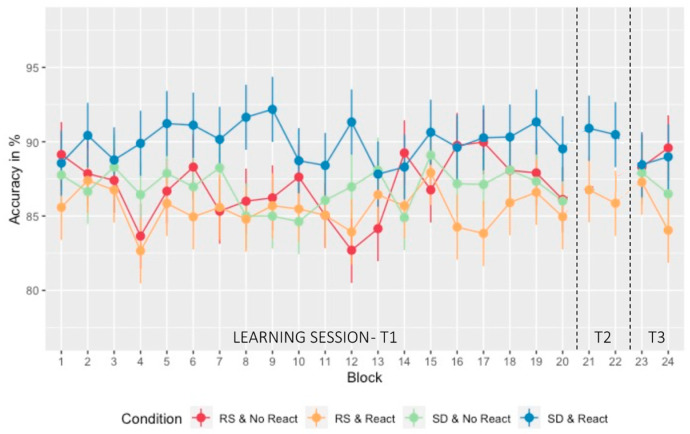
Retrieving previously stored information makes memory traces labile again and can trigger restabilization in a strengthened or weakened form depending on the reactivation condition. Available evidence for long-term performance changes upon reactivation of motor memories and the effect of post-learning sleep on their consolidation remains scarce, and so does the data on the ways in which subsequent reactivation of motor memories interacts with sleep-related consolidation. Eighty young volunteers learned (Day 1) a 12-element Serial Reaction Time Task (SRTT) before a post-training Regular Sleep (RS) or Sleep Deprivation (SD) night, either followed (Day 2) by morning motor reactivation through a short SRTT testing or no motor activity. Consolidation was assessed after three recovery nights (Day 5). A 2 × 2 ANOVA carried on proportional offline gains did not evidence significant Reactivation (Morning Reactivation/No Morning Reactivation; p = 0.098), post-training Sleep (RS/SD; p = 0.301) or Sleep*Reactivation interaction (p = 0.257) effect. Our results are in line with prior studies suggesting a lack of supplementary performance gains upon reactivation, and other studies that failed to disclose post-learning sleep-related effects on performance improvement. However, lack of overt behavioural effects does not detract from the possibility of sleep- or reconsolidation-related covert neurophysiological changes underlying similar behavioural performance levels.




 京公网安备 11010802042870号
京ICP备2023020795号-1
京公网安备 11010802042870号
京ICP备2023020795号-1

 分享
分享
 求助内容:
求助内容: 应助结果提醒方式:
 扫码关注我们
