Evaluation of a co-culture of rapidly isolated chondrocytes and stem cells seeded on tri-layered collagen-based scaffolds in a caprine osteochondral defect model
Tanya J. Levingstone , Eamon J. Sheehy , Conor J. Moran , Gráinne M. Cunniffe , Pedro J. Diaz Payno , Robert T. Brady , Henrique V. Almeida , Simon F. Carroll , John M. O’Byrne , Daniel J. Kelly , Pieter AJ. Brama , Fergal J. O’ Brien
{"title":"Evaluation of a co-culture of rapidly isolated chondrocytes and stem cells seeded on tri-layered collagen-based scaffolds in a caprine osteochondral defect model","authors":"Tanya J. Levingstone , Eamon J. Sheehy , Conor J. Moran , Gráinne M. Cunniffe , Pedro J. Diaz Payno , Robert T. Brady , Henrique V. Almeida , Simon F. Carroll , John M. O’Byrne , Daniel J. Kelly , Pieter AJ. Brama , Fergal J. O’ Brien","doi":"10.1016/j.bbiosy.2022.100066","DOIUrl":null,"url":null,"abstract":"<div><p>Cartilage has poor regenerative capacity and thus damage to the joint surfaces presents a major clinical challenge. Recent research has focussed on the development of tissue-engineered and cell-based approaches for the treatment of cartilage and osteochondral injuries, with current clinically available cell-based approaches including autologous chondrocyte implantation and matrix-assisted autologous chondrocyte implantation. However, these approaches have significant disadvantages due to the requirement for a two-stage surgical procedure and an in vitro chondrocyte expansion phase which increases logistical challenges, hospital times and costs. In this study, we hypothesized that seeding biomimetic tri-layered scaffolds, with proven regenerative potential, with chondrocyte/infrapatellar fat pad stromal cell co-cultures would improve their regenerative capacity compared to scaffolds implanted cell-free. Rapid cell isolation techniques, without the requirement for long term in vitro culture, were utilised to achieve co-cultures of chondrocytes and stromal cells and thus overcome the limitations of existing cell-based techniques. Cell-free and cell-seeded scaffolds were implanted in osteochondral defects, created within the femoral condyle and trochlear ridge, in a translational large animal goat model. While analysis showed trends towards delayed subchondral bone healing in the cell-seeded scaffold group, by the 12 month timepoint the cell-free and cell-seeded groups yield cartilage and bone tissue with comparable quality and quantity. The results of the study reinforce the potential of the biomimetic tri-layered scaffold to repair joint defects but failed to demonstrate a clear benefit from the addition of the CC/FPMSC co-culture to this scaffold. Taking into consideration the additional cost and complexity associated with the cell-seeded scaffold approach, this study demonstrates that the treatment of osteochondral defects using cell-free tri-layered scaffolds may represent a more prudent clinical approach.</p></div>","PeriodicalId":72379,"journal":{"name":"Biomaterials and biosystems","volume":"8 ","pages":"Article 100066"},"PeriodicalIF":0.0000,"publicationDate":"2022-12-01","publicationTypes":"Journal Article","fieldsOfStudy":null,"isOpenAccess":false,"openAccessPdf":"https://ftp.ncbi.nlm.nih.gov/pub/pmc/oa_pdf/2d/5b/main.PMC9934472.pdf","citationCount":"1","resultStr":null,"platform":"Semanticscholar","paperid":null,"PeriodicalName":"Biomaterials and biosystems","FirstCategoryId":"1085","ListUrlMain":"https://www.sciencedirect.com/science/article/pii/S2666534422000289","RegionNum":0,"RegionCategory":null,"ArticlePicture":[],"TitleCN":null,"AbstractTextCN":null,"PMCID":null,"EPubDate":"2022/10/8 0:00:00","PubModel":"Epub","JCR":"Q3","JCRName":"Biochemistry, Genetics and Molecular Biology","Score":null,"Total":0}
引用次数: 1
Abstract
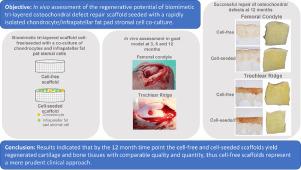
Cartilage has poor regenerative capacity and thus damage to the joint surfaces presents a major clinical challenge. Recent research has focussed on the development of tissue-engineered and cell-based approaches for the treatment of cartilage and osteochondral injuries, with current clinically available cell-based approaches including autologous chondrocyte implantation and matrix-assisted autologous chondrocyte implantation. However, these approaches have significant disadvantages due to the requirement for a two-stage surgical procedure and an in vitro chondrocyte expansion phase which increases logistical challenges, hospital times and costs. In this study, we hypothesized that seeding biomimetic tri-layered scaffolds, with proven regenerative potential, with chondrocyte/infrapatellar fat pad stromal cell co-cultures would improve their regenerative capacity compared to scaffolds implanted cell-free. Rapid cell isolation techniques, without the requirement for long term in vitro culture, were utilised to achieve co-cultures of chondrocytes and stromal cells and thus overcome the limitations of existing cell-based techniques. Cell-free and cell-seeded scaffolds were implanted in osteochondral defects, created within the femoral condyle and trochlear ridge, in a translational large animal goat model. While analysis showed trends towards delayed subchondral bone healing in the cell-seeded scaffold group, by the 12 month timepoint the cell-free and cell-seeded groups yield cartilage and bone tissue with comparable quality and quantity. The results of the study reinforce the potential of the biomimetic tri-layered scaffold to repair joint defects but failed to demonstrate a clear benefit from the addition of the CC/FPMSC co-culture to this scaffold. Taking into consideration the additional cost and complexity associated with the cell-seeded scaffold approach, this study demonstrates that the treatment of osteochondral defects using cell-free tri-layered scaffolds may represent a more prudent clinical approach.




 京公网安备 11010802042870号
京ICP备2023020795号-1
京公网安备 11010802042870号
京ICP备2023020795号-1

 分享
分享
 求助内容:
求助内容: 应助结果提醒方式:
 扫码关注我们
