Jiafu Cao, Shwe Phyu Hlaing, Juho Lee, Jihyun Kim, Eun Hee Lee, Seok Hee Kang, Suck Won Hong, In-Soo Yoon, Hwayoung Yun, Yunjin Jung and Jin-Wook Yoo*,
{"title":"Bacteria-Adhesive Nitric Oxide-Releasing Graphene Oxide Nanoparticles for MRPA-Infected Wound Healing Therapy","authors":"Jiafu Cao, Shwe Phyu Hlaing, Juho Lee, Jihyun Kim, Eun Hee Lee, Seok Hee Kang, Suck Won Hong, In-Soo Yoon, Hwayoung Yun, Yunjin Jung and Jin-Wook Yoo*, ","doi":"10.1021/acsami.2c13317","DOIUrl":null,"url":null,"abstract":"<p >A bacteria-infected wound can lead to being life-threatening and raises a great economic burden on the patient. Here, we developed polyethylenimine 1.8k (PEI<sub>1.8k</sub>) surface modified NO-releasing polyethylenimine 25k (PEI<sub>25k</sub>)-functionalized graphene oxide (GO) nanoparticles (GO-PEI<sub>25k</sub>/NO-PEI<sub>1.8k</sub> NPs) for enhanced antibacterial activity and infected wound healing via binding to the bacterial surface. In vitro antibacterial activity and in vivo wound healing efficacy in an infected wound model were evaluated compared with NO-releasing NPs (GO-PEI<sub>25k/</sub>NO NPs). Surface modification with PEI<sub>1.8k</sub> can enhance the ability of nanoparticles to adhere to bacteria. GO-PEI<sub>25k</sub>/NO-PEI<sub>1.8k</sub> NPs released NO in a sustained manner for 48 h and exhibited the highest bactericidal activity (99.99% killing) against methicillin-resistant <i>Staphylococcus aureus</i> (MRSA) and multidrug-resistant <i>Pseudomonas aeruginosa</i> (MRPA) without cytotoxicity to L929 mouse fibroblast cells at 0.1 mg/mL. In the MRPA-infected wound model, GO-PEI<sub>25k</sub>/NO-PEI<sub>1.8k</sub> NPs showed 87% wound size reduction while GO-PEI<sub>25k</sub>/NO NPs showed 23% wound size reduction at 9 days postinjury. Masson trichrome and hematoxylin and eosin staining revealed that GO-PEI<sub>25k</sub>/NO-PEI<sub>1.8k</sub> NPs enhanced re-epithelialization and collagen deposition, which are comparable to healthy mouse skin tissue. GO-PEI<sub>25k</sub>/NO-PEI<sub>1.8k</sub> NPs hold promise as effective antibacterial and wound healing agents.</p>","PeriodicalId":5,"journal":{"name":"ACS Applied Materials & Interfaces","volume":"14 45","pages":"50507–50519"},"PeriodicalIF":8.2000,"publicationDate":"2022-11-04","publicationTypes":"Journal Article","fieldsOfStudy":null,"isOpenAccess":false,"openAccessPdf":"","citationCount":"5","resultStr":null,"platform":"Semanticscholar","paperid":null,"PeriodicalName":"ACS Applied Materials & Interfaces","FirstCategoryId":"88","ListUrlMain":"https://pubs.acs.org/doi/10.1021/acsami.2c13317","RegionNum":2,"RegionCategory":"材料科学","ArticlePicture":[],"TitleCN":null,"AbstractTextCN":null,"PMCID":null,"EPubDate":"","PubModel":"","JCR":"Q1","JCRName":"MATERIALS SCIENCE, MULTIDISCIPLINARY","Score":null,"Total":0}
引用次数: 5
Abstract
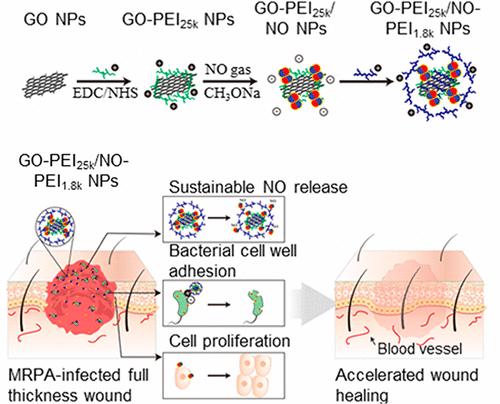
A bacteria-infected wound can lead to being life-threatening and raises a great economic burden on the patient. Here, we developed polyethylenimine 1.8k (PEI1.8k) surface modified NO-releasing polyethylenimine 25k (PEI25k)-functionalized graphene oxide (GO) nanoparticles (GO-PEI25k/NO-PEI1.8k NPs) for enhanced antibacterial activity and infected wound healing via binding to the bacterial surface. In vitro antibacterial activity and in vivo wound healing efficacy in an infected wound model were evaluated compared with NO-releasing NPs (GO-PEI25k/NO NPs). Surface modification with PEI1.8k can enhance the ability of nanoparticles to adhere to bacteria. GO-PEI25k/NO-PEI1.8k NPs released NO in a sustained manner for 48 h and exhibited the highest bactericidal activity (99.99% killing) against methicillin-resistant Staphylococcus aureus (MRSA) and multidrug-resistant Pseudomonas aeruginosa (MRPA) without cytotoxicity to L929 mouse fibroblast cells at 0.1 mg/mL. In the MRPA-infected wound model, GO-PEI25k/NO-PEI1.8k NPs showed 87% wound size reduction while GO-PEI25k/NO NPs showed 23% wound size reduction at 9 days postinjury. Masson trichrome and hematoxylin and eosin staining revealed that GO-PEI25k/NO-PEI1.8k NPs enhanced re-epithelialization and collagen deposition, which are comparable to healthy mouse skin tissue. GO-PEI25k/NO-PEI1.8k NPs hold promise as effective antibacterial and wound healing agents.
期刊介绍:
ACS Applied Materials & Interfaces is a leading interdisciplinary journal that brings together chemists, engineers, physicists, and biologists to explore the development and utilization of newly-discovered materials and interfacial processes for specific applications. Our journal has experienced remarkable growth since its establishment in 2009, both in terms of the number of articles published and the impact of the research showcased. We are proud to foster a truly global community, with the majority of published articles originating from outside the United States, reflecting the rapid growth of applied research worldwide.



 京公网安备 11010802042870号
京ICP备2023020795号-1
京公网安备 11010802042870号
京ICP备2023020795号-1

 分享
分享
 求助内容:
求助内容: 应助结果提醒方式:
 扫码关注我们
