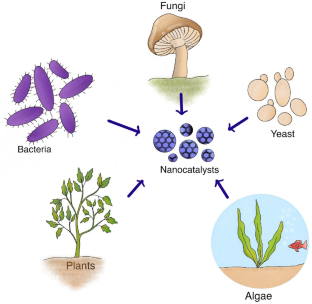
{"title":"Greener Assembly of Nano Catalysts and Sustainable Applications of Magnetically Retrievable and Plasmonic Nano Catalysts","authors":"Ananya Sridhar, Cyril Koshy Sunil, Rhitayu Sarkar, Suma Sarojini","doi":"10.1007/s11244-023-01885-6","DOIUrl":null,"url":null,"abstract":"<div><p>Since ages, catalysts have played a pivotal role in accelerating the production and lowering the cost of a plethora of industrially important commodities. The latest in the scenario are nanocatalysts, which offer a wide array of advantages ranging from improved reaction rates to higher rates of recyclability. However, factors such as stability and support systems must be fine-tuned to achieve maximum efficiency. In accordance with the principle of sustainability, green synthesis methods have propelled the development of a range of nanocatalysts that can be applied in various domains, such as the food industry and biofuel production. Simultaneously, heterogeneous catalysis is gaining more attention globally, primarily due to the ease of recoverability of the nanocatalysts and in this context, magnetically retrievable nanocatalysts are indeed a boon for the green synthesis and sustainable production. Nanocomposites combining plasmonic and catalytic components with noble metal nanoparticles (Au and Ag) and doped semiconductor nanostructures have gained interest in recent years owing to their utility in multiple sectors by virtue of their ability to convert sunlight to chemical energy. The current review describes some methods for the synthesis of such nanocatalysts and their applications in diverse domains.</p><h3>Graphical Abstract</h3>\n<div><figure><div><div><picture><source><img></source></picture></div></div></figure></div></div>","PeriodicalId":801,"journal":{"name":"Topics in Catalysis","volume":"67 1-4","pages":"265 - 279"},"PeriodicalIF":3.0000,"publicationDate":"2023-11-14","publicationTypes":"Journal Article","fieldsOfStudy":null,"isOpenAccess":false,"openAccessPdf":"","citationCount":"0","resultStr":null,"platform":"Semanticscholar","paperid":null,"PeriodicalName":"Topics in Catalysis","FirstCategoryId":"92","ListUrlMain":"https://link.springer.com/article/10.1007/s11244-023-01885-6","RegionNum":3,"RegionCategory":"化学","ArticlePicture":[],"TitleCN":null,"AbstractTextCN":null,"PMCID":null,"EPubDate":"","PubModel":"","JCR":"Q2","JCRName":"CHEMISTRY, APPLIED","Score":null,"Total":0}
引用次数: 0
Abstract
Since ages, catalysts have played a pivotal role in accelerating the production and lowering the cost of a plethora of industrially important commodities. The latest in the scenario are nanocatalysts, which offer a wide array of advantages ranging from improved reaction rates to higher rates of recyclability. However, factors such as stability and support systems must be fine-tuned to achieve maximum efficiency. In accordance with the principle of sustainability, green synthesis methods have propelled the development of a range of nanocatalysts that can be applied in various domains, such as the food industry and biofuel production. Simultaneously, heterogeneous catalysis is gaining more attention globally, primarily due to the ease of recoverability of the nanocatalysts and in this context, magnetically retrievable nanocatalysts are indeed a boon for the green synthesis and sustainable production. Nanocomposites combining plasmonic and catalytic components with noble metal nanoparticles (Au and Ag) and doped semiconductor nanostructures have gained interest in recent years owing to their utility in multiple sectors by virtue of their ability to convert sunlight to chemical energy. The current review describes some methods for the synthesis of such nanocatalysts and their applications in diverse domains.
期刊介绍:
Topics in Catalysis publishes topical collections in all fields of catalysis which are composed only of invited articles from leading authors. The journal documents today’s emerging and critical trends in all branches of catalysis. Each themed issue is organized by renowned Guest Editors in collaboration with the Editors-in-Chief. Proposals for new topics are welcome and should be submitted directly to the Editors-in-Chief.
The publication of individual uninvited original research articles can be sent to our sister journal Catalysis Letters. This journal aims for rapid publication of high-impact original research articles in all fields of both applied and theoretical catalysis, including heterogeneous, homogeneous and biocatalysis.



 京公网安备 11010802042870号
京ICP备2023020795号-1
京公网安备 11010802042870号
京ICP备2023020795号-1

 分享
分享
 求助内容:
求助内容: 应助结果提醒方式:
 扫码关注我们
