{"title":"Amplitude and phase approximation at the linear slip interface of two different tilted transversely isotropic media","authors":"Wang Hongwei","doi":"10.1007/s11600-023-01183-5","DOIUrl":null,"url":null,"abstract":"<div><p>Besides amplitude variation, phase variation of seismic wave is also an important carrier of geological information at the fault slip interface. To analyze the seismic propagation through the fault slip interface, which is assumed to be a flat, horizontal and imperfectly welded contact (nonwelded) interface between two different tilted anisotropic (TTI) media, we derived the analytical formulae for amplitude and phase variations of reflected and transmitted seismic waves with longitudinal wave (qP), the slow and fast waves (qS and SH) generated simultaneously. The derived formulae could satisfy the fracture model, in which the symmetry axis planes of the upper and lower media coincide. Also, we provided the exact and approximate methods for velocities and polarizations as well as the reflected and transmitted angles based on the slowness ellipsoid. Moreover, weakly anisotropic parameters are taken into consideration by the approximate amplitude (AVO) and phase formulae of qP and qS. The approximations also clearly show the effect of anisotropic parameters on the amplitude and phase change. The derived results show that the compliance parameters affect the phase change rather than amplitude, while anisotropic parameters affect both. The numerical model shows that with respect to the incident P-wave, the phase change of the reflected qP wave is more significant than the other generating waves due to the linear slip boundary; the coefficients could be used to determine the fracture dip and strike; the frequency hardly affects the real part of the coefficient, while the imaginary part of the coefficient. Moreover, the derived formulae for phase change will contribute to the seismic inversion with the formulae for amplitude variation simultaneously.</p></div>","PeriodicalId":6988,"journal":{"name":"Acta Geophysica","volume":"72 4","pages":"2297 - 2314"},"PeriodicalIF":2.1000,"publicationDate":"2023-11-10","publicationTypes":"Journal Article","fieldsOfStudy":null,"isOpenAccess":false,"openAccessPdf":"","citationCount":"0","resultStr":null,"platform":"Semanticscholar","paperid":null,"PeriodicalName":"Acta Geophysica","FirstCategoryId":"89","ListUrlMain":"https://link.springer.com/article/10.1007/s11600-023-01183-5","RegionNum":4,"RegionCategory":"地球科学","ArticlePicture":[],"TitleCN":null,"AbstractTextCN":null,"PMCID":null,"EPubDate":"","PubModel":"","JCR":"","JCRName":"","Score":null,"Total":0}
引用次数: 0
Abstract
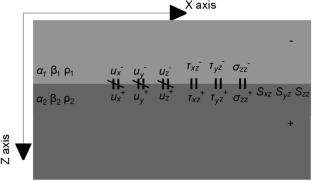
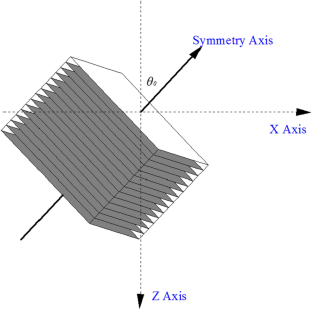
Besides amplitude variation, phase variation of seismic wave is also an important carrier of geological information at the fault slip interface. To analyze the seismic propagation through the fault slip interface, which is assumed to be a flat, horizontal and imperfectly welded contact (nonwelded) interface between two different tilted anisotropic (TTI) media, we derived the analytical formulae for amplitude and phase variations of reflected and transmitted seismic waves with longitudinal wave (qP), the slow and fast waves (qS and SH) generated simultaneously. The derived formulae could satisfy the fracture model, in which the symmetry axis planes of the upper and lower media coincide. Also, we provided the exact and approximate methods for velocities and polarizations as well as the reflected and transmitted angles based on the slowness ellipsoid. Moreover, weakly anisotropic parameters are taken into consideration by the approximate amplitude (AVO) and phase formulae of qP and qS. The approximations also clearly show the effect of anisotropic parameters on the amplitude and phase change. The derived results show that the compliance parameters affect the phase change rather than amplitude, while anisotropic parameters affect both. The numerical model shows that with respect to the incident P-wave, the phase change of the reflected qP wave is more significant than the other generating waves due to the linear slip boundary; the coefficients could be used to determine the fracture dip and strike; the frequency hardly affects the real part of the coefficient, while the imaginary part of the coefficient. Moreover, the derived formulae for phase change will contribute to the seismic inversion with the formulae for amplitude variation simultaneously.
期刊介绍:
Acta Geophysica is open to all kinds of manuscripts including research and review articles, short communications, comments to published papers, letters to the Editor as well as book reviews. Some of the issues are fully devoted to particular topics; we do encourage proposals for such topical issues. We accept submissions from scientists world-wide, offering high scientific and editorial standard and comprehensive treatment of the discussed topics.




 京公网安备 11010802042870号
京ICP备2023020795号-1
京公网安备 11010802042870号
京ICP备2023020795号-1

 分享
分享
 求助内容:
求助内容: 应助结果提醒方式:
 扫码关注我们
