Bernadine Teng, Sjaan R. Gomersall, Anna L. Hatton, Asaduzzaman Khan, Sandra G. Brauer
{"title":"Predictors of real-world adherence to prescribed home exercise in older patients with a risk of falling: A prospective observational study","authors":"Bernadine Teng, Sjaan R. Gomersall, Anna L. Hatton, Asaduzzaman Khan, Sandra G. Brauer","doi":"10.1002/agm2.12270","DOIUrl":null,"url":null,"abstract":"<div>\n \n \n <section>\n \n <h3> Objectives</h3>\n \n <p>Using a multi-ethnic Asian population, this study assessed adherence to prescribed home exercise programs, explored factors predicting adherence, and evaluated whether home exercise adherence was associated with physical activity.</p>\n </section>\n \n <section>\n \n <h3> Methods</h3>\n \n <p>A prospective cohort study was conducted in 68 older adults (aged ≥65 years) from two geriatric outpatient clinics in Singapore, who were receiving tailored home exercises while undergoing 6 weeks of outpatient physical therapy for falls prevention. Adherence was measured as the percentage of prescribed sessions completed. Predictor variables included sociodemographic factors, clinical characteristics, intervention-specific factors, and physical and psychosocial measures. Multivariable linear regressions were performed to develop a model that best predicted adherence to prescribed exercise. Physical activity levels, measured by accelerometry, were analyzed by cross-sectional univariate analysis at 6 weeks.</p>\n </section>\n \n <section>\n \n <h3> Results</h3>\n \n <p>The mean adherence rate was 65% (SD 34.3%). In the regression model, the number of medications [<i>B</i> = 0.360, 95% CI (0.098–0.630)], social support for exercising [<i>B</i> = 0.080, 95% CI (0.015–0.145)], and self-efficacy for exercising [<i>B</i> = −0.034, 95% CI (−0.068–0.000)] significantly explained 31% (<i>R</i><sup>2</sup> = 0.312) of the variance in exercise adherence. Older adults with better adherence took more steps/day at 6 weeks [<i>B</i> = 0.001, 95% CI (0.000–0.001)].</p>\n </section>\n \n <section>\n \n <h3> Conclusions</h3>\n \n <p>Low adherence to home exercise programs among older adults in Singapore, emphasizing the need for improvement. Counterintuitively, older adults with more medications, lower exercise self-efficacy, but with greater social support demonstrated higher adherence. Addressing unmet social support needs is crucial for enhancing adherence rates and reducing fall risks.</p>\n </section>\n </div>","PeriodicalId":32862,"journal":{"name":"Aging Medicine","volume":"6 4","pages":"361-369"},"PeriodicalIF":2.5000,"publicationDate":"2023-09-27","publicationTypes":"Journal Article","fieldsOfStudy":null,"isOpenAccess":false,"openAccessPdf":"https://onlinelibrary.wiley.com/doi/epdf/10.1002/agm2.12270","citationCount":"0","resultStr":null,"platform":"Semanticscholar","paperid":null,"PeriodicalName":"Aging Medicine","FirstCategoryId":"1085","ListUrlMain":"https://onlinelibrary.wiley.com/doi/10.1002/agm2.12270","RegionNum":0,"RegionCategory":null,"ArticlePicture":[],"TitleCN":null,"AbstractTextCN":null,"PMCID":null,"EPubDate":"","PubModel":"","JCR":"Q3","JCRName":"GERIATRICS & GERONTOLOGY","Score":null,"Total":0}
引用次数: 0
Abstract
Objectives
Using a multi-ethnic Asian population, this study assessed adherence to prescribed home exercise programs, explored factors predicting adherence, and evaluated whether home exercise adherence was associated with physical activity.
Methods
A prospective cohort study was conducted in 68 older adults (aged ≥65 years) from two geriatric outpatient clinics in Singapore, who were receiving tailored home exercises while undergoing 6 weeks of outpatient physical therapy for falls prevention. Adherence was measured as the percentage of prescribed sessions completed. Predictor variables included sociodemographic factors, clinical characteristics, intervention-specific factors, and physical and psychosocial measures. Multivariable linear regressions were performed to develop a model that best predicted adherence to prescribed exercise. Physical activity levels, measured by accelerometry, were analyzed by cross-sectional univariate analysis at 6 weeks.
Results
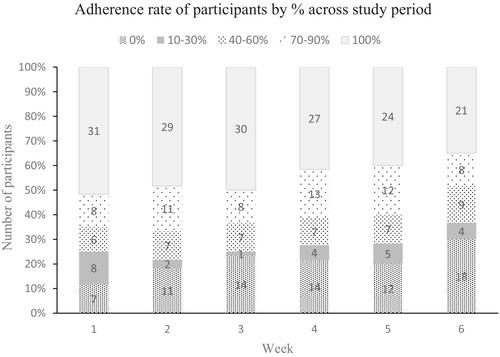
The mean adherence rate was 65% (SD 34.3%). In the regression model, the number of medications [B = 0.360, 95% CI (0.098–0.630)], social support for exercising [B = 0.080, 95% CI (0.015–0.145)], and self-efficacy for exercising [B = −0.034, 95% CI (−0.068–0.000)] significantly explained 31% (R2 = 0.312) of the variance in exercise adherence. Older adults with better adherence took more steps/day at 6 weeks [B = 0.001, 95% CI (0.000–0.001)].
Conclusions
Low adherence to home exercise programs among older adults in Singapore, emphasizing the need for improvement. Counterintuitively, older adults with more medications, lower exercise self-efficacy, but with greater social support demonstrated higher adherence. Addressing unmet social support needs is crucial for enhancing adherence rates and reducing fall risks.




 京公网安备 11010802042870号
京ICP备2023020795号-1
京公网安备 11010802042870号
京ICP备2023020795号-1

 分享
分享
 求助内容:
求助内容: 应助结果提醒方式:
 扫码关注我们
