{"title":"Visible light-driven photo remediation of hazardous cationic dye via Ce-doped WO3 nanostructures","authors":"Azra Haroon , Kaseed Anwar , Arham S. Ahmed","doi":"10.1016/j.jre.2023.11.007","DOIUrl":null,"url":null,"abstract":"<div><p>Ce-doped WO<sub>3</sub> nanoparticles were successfully synthesized by the sol–gel method and characterized through advanced characterization techniques. The high resolution transmission electron microscopy (HRTEM) and scanning electron microscopy (SEM) results show a reduction in the agglomeration of nanoparticles upon doping. The energy dispersive X-ray (EDX) analysis validates the existence of the Ce element in all the doped samples. X-ray photoelectron spectroscopy (XPS) and Raman spectra justify the presence of structural defects (oxygen vacancies) and successful formation of the monoclinic WO<sub>3</sub> phase, respectively. The Kubelka–Munk function indicates a decrease in band gap with doping, while photoluminescence (PL) spectra show intense visible and UV emissions. Significantly, all doped samples exhibit higher photocatalytic performance than pure WO<sub>3</sub> nanoparticles, with the 6 wt% Ce-doped sample displaying the highest degradation rate. Doping with Ce can help to increase the surface area of WO<sub>3</sub>, thereby improving its photoactivity. Moreover, a correlation between PL and photocatalysis is established in the light of oxygen vacancies suggesting a direct dependence of high photocatalytic activity on strong PL signals of WO<sub>3</sub> nanostructures. Trapping experiments further reveal that the degradation process is primarily driven by active species, providing insight into a plausible photocatalytic mechanism.</p></div>","PeriodicalId":16940,"journal":{"name":"Journal of Rare Earths","volume":"42 5","pages":"Pages 869-878"},"PeriodicalIF":7.2000,"publicationDate":"2024-05-01","publicationTypes":"Journal Article","fieldsOfStudy":null,"isOpenAccess":false,"openAccessPdf":"","citationCount":"0","resultStr":null,"platform":"Semanticscholar","paperid":null,"PeriodicalName":"Journal of Rare Earths","FirstCategoryId":"92","ListUrlMain":"https://www.sciencedirect.com/science/article/pii/S1002072123003198","RegionNum":1,"RegionCategory":"化学","ArticlePicture":[],"TitleCN":null,"AbstractTextCN":null,"PMCID":null,"EPubDate":"2023/11/13 0:00:00","PubModel":"Epub","JCR":"Q1","JCRName":"CHEMISTRY, APPLIED","Score":null,"Total":0}
引用次数: 0
Abstract
Ce-doped WO3 nanoparticles were successfully synthesized by the sol–gel method and characterized through advanced characterization techniques. The high resolution transmission electron microscopy (HRTEM) and scanning electron microscopy (SEM) results show a reduction in the agglomeration of nanoparticles upon doping. The energy dispersive X-ray (EDX) analysis validates the existence of the Ce element in all the doped samples. X-ray photoelectron spectroscopy (XPS) and Raman spectra justify the presence of structural defects (oxygen vacancies) and successful formation of the monoclinic WO3 phase, respectively. The Kubelka–Munk function indicates a decrease in band gap with doping, while photoluminescence (PL) spectra show intense visible and UV emissions. Significantly, all doped samples exhibit higher photocatalytic performance than pure WO3 nanoparticles, with the 6 wt% Ce-doped sample displaying the highest degradation rate. Doping with Ce can help to increase the surface area of WO3, thereby improving its photoactivity. Moreover, a correlation between PL and photocatalysis is established in the light of oxygen vacancies suggesting a direct dependence of high photocatalytic activity on strong PL signals of WO3 nanostructures. Trapping experiments further reveal that the degradation process is primarily driven by active species, providing insight into a plausible photocatalytic mechanism.
期刊介绍:
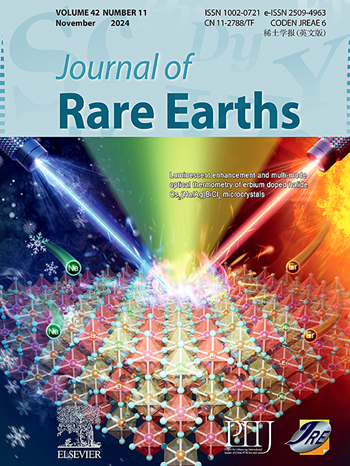
The Journal of Rare Earths reports studies on the 17 rare earth elements. It is a unique English-language learned journal that publishes works on various aspects of basic theory and applied science in the field of rare earths (RE). The journal accepts original high-quality original research papers and review articles with inventive content, and complete experimental data. It represents high academic standards and new progress in the RE field. Due to the advantage of abundant RE resources of China, the research on RE develops very actively, and papers on the latest progress in this field emerge every year. It is not only an important resource in which technicians publish and obtain their latest research results on RE, but also an important way of reflecting the updated progress in RE research field.
The Journal of Rare Earths covers all research and application of RE rare earths including spectroscopy, luminescence and phosphors, rare earth catalysis, magnetism and magnetic materials, advanced rare earth materials, RE chemistry & hydrometallurgy, RE metallography & pyrometallurgy, RE new materials, RE solid state physics & solid state chemistry, rare earth applications, RE analysis & test, RE geology & ore dressing, etc.





 京公网安备 11010802042870号
京ICP备2023020795号-1
京公网安备 11010802042870号
京ICP备2023020795号-1

 分享
分享
 求助内容:
求助内容: 应助结果提醒方式:
 扫码关注我们
