{"title":"Machine-learning-assisted design of a binary descriptor to decipher electronic and structural effects on sulfur reduction kinetics","authors":"Zhiyuan Han, Runhua Gao, Tianshuai Wang, Shengyu Tao, Yeyang Jia, Zhoujie Lao, Mengtian Zhang, Jiaqi Zhou, Chuang Li, Zhihong Piao, Xuan Zhang, Guangmin Zhou","doi":"10.1038/s41929-023-01041-z","DOIUrl":null,"url":null,"abstract":"The catalytic conversion of lithium polysulfides is a promising way to inhibit the shuttling effect in Li–S batteries. However, the mechanism of such catalytic systems remains unclear, which prevents the rational design of cathode catalysts. Here we propose the machine-learning-assisted design of a binary descriptor for Li-S battery performance composed of a band match (IBand) and a lattice mismatch (ILatt) indexes, which captures the electronic and structural contributions of cathode materials. Among our Ni-based catalysts, NiSe2 exhibits a moderate IBand and the smallest ILatt and is predicted and subsequently verified to improve the sulfur reduction kinetics and cycling stability, even with a high sulfur loading of 15.0 mg cm−2 or at low temperature (−20 °C). A pouch cell with NiSe2 delivers a gravimetric specific energy of 402 Wh kg−1 under high sulfur loading and lean-electrolyte operation. Such a fundamental understanding of the catalytic activity from electronic and structural aspects offers a rational viewpoint to design Li–S battery catalysts. The sluggish conversion of lithium polysulfides in Li–S batteries can be overcome by the use of catalysts, but their design is typically done via trial and error. Now, a binary descriptor is proposed by machine learning to capture electronic and structural effects for the design of Li–S battery cathode catalysts.","PeriodicalId":18845,"journal":{"name":"Nature Catalysis","volume":"6 11","pages":"1073-1086"},"PeriodicalIF":44.6000,"publicationDate":"2023-10-19","publicationTypes":"Journal Article","fieldsOfStudy":null,"isOpenAccess":false,"openAccessPdf":"","citationCount":"0","resultStr":null,"platform":"Semanticscholar","paperid":null,"PeriodicalName":"Nature Catalysis","FirstCategoryId":"92","ListUrlMain":"https://www.nature.com/articles/s41929-023-01041-z","RegionNum":1,"RegionCategory":"化学","ArticlePicture":[],"TitleCN":null,"AbstractTextCN":null,"PMCID":null,"EPubDate":"","PubModel":"","JCR":"Q1","JCRName":"CHEMISTRY, PHYSICAL","Score":null,"Total":0}
引用次数: 0
Abstract
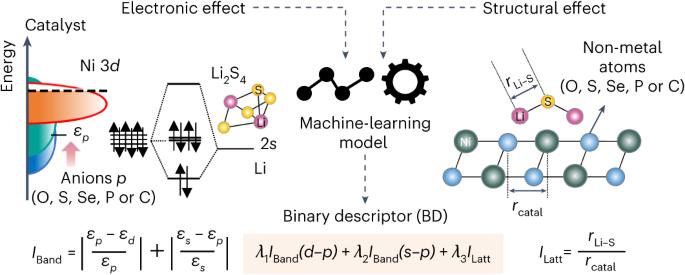
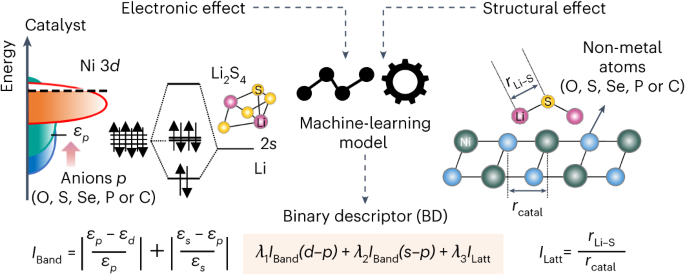
The catalytic conversion of lithium polysulfides is a promising way to inhibit the shuttling effect in Li–S batteries. However, the mechanism of such catalytic systems remains unclear, which prevents the rational design of cathode catalysts. Here we propose the machine-learning-assisted design of a binary descriptor for Li-S battery performance composed of a band match (IBand) and a lattice mismatch (ILatt) indexes, which captures the electronic and structural contributions of cathode materials. Among our Ni-based catalysts, NiSe2 exhibits a moderate IBand and the smallest ILatt and is predicted and subsequently verified to improve the sulfur reduction kinetics and cycling stability, even with a high sulfur loading of 15.0 mg cm−2 or at low temperature (−20 °C). A pouch cell with NiSe2 delivers a gravimetric specific energy of 402 Wh kg−1 under high sulfur loading and lean-electrolyte operation. Such a fundamental understanding of the catalytic activity from electronic and structural aspects offers a rational viewpoint to design Li–S battery catalysts. The sluggish conversion of lithium polysulfides in Li–S batteries can be overcome by the use of catalysts, but their design is typically done via trial and error. Now, a binary descriptor is proposed by machine learning to capture electronic and structural effects for the design of Li–S battery cathode catalysts.
期刊介绍:
Nature Catalysis serves as a platform for researchers across chemistry and related fields, focusing on homogeneous catalysis, heterogeneous catalysis, and biocatalysts, encompassing both fundamental and applied studies. With a particular emphasis on advancing sustainable industries and processes, the journal provides comprehensive coverage of catalysis research, appealing to scientists, engineers, and researchers in academia and industry.
Maintaining the high standards of the Nature brand, Nature Catalysis boasts a dedicated team of professional editors, rigorous peer-review processes, and swift publication times, ensuring editorial independence and quality. The journal publishes work spanning heterogeneous catalysis, homogeneous catalysis, and biocatalysis, covering areas such as catalytic synthesis, mechanisms, characterization, computational studies, nanoparticle catalysis, electrocatalysis, photocatalysis, environmental catalysis, asymmetric catalysis, and various forms of organocatalysis.



 京公网安备 11010802042870号
京ICP备2023020795号-1
京公网安备 11010802042870号
京ICP备2023020795号-1

 分享
分享
 求助内容:
求助内容: 应助结果提醒方式:
 扫码关注我们
